
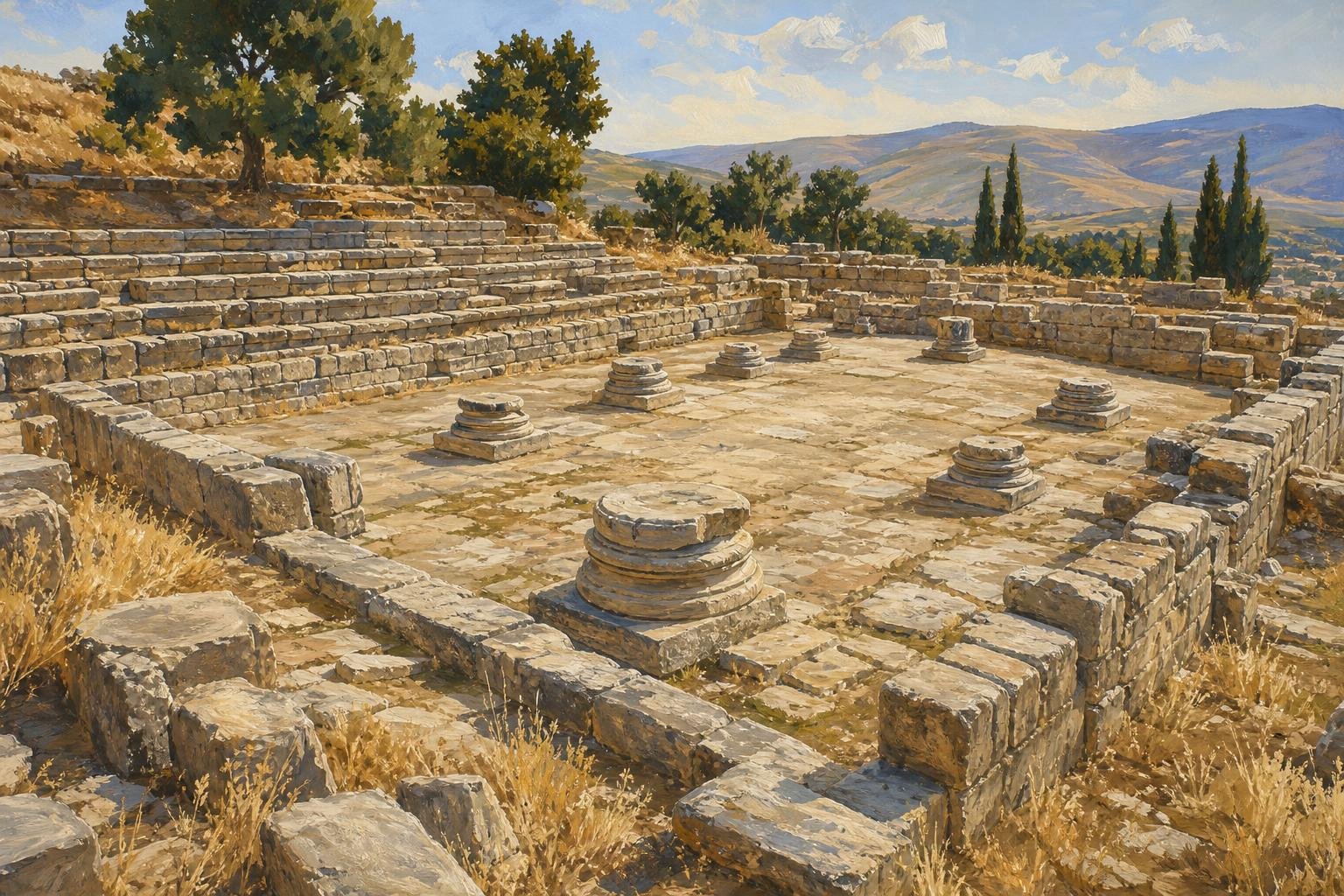
The Eleusinian Mysteries were secret initiation rites honoring Demeter and her daughter Persephone. They were held at Eleusis, a town about 14 miles west of Athens, for roughly a thousand years. Initiates came away with what ancient writers call a better hope for the life after death, and they swore never to reveal what they had seen.
Secrecy was enforced, but disclosures did occur. What survives is fragmentary: no complete, reliable account of the central rites has come down to us.
In This Article
- Where the Cult Came From and How Long It Lasted
- The Myth of Demeter and Persephone
- Who Could Be Initiated
- The Yearly Calendar and Levels of Initiation
- Priests, Torchbearers, and the Procession
- Inside the Telesterion: What the Evidence Allows
- Why Athens Guarded the Secret
- Drugs, Violence, and Claims of Survival
- Key Takeaways
- Frequently Asked Questions
- What Secrecy Leaves Us Knowing
Where the Cult Came From and How Long It Lasted
The rites ended in the late fourth century CE, amid imperial restrictions on pagan worship and the destruction of the sanctuary. Theodosius I issued anti-pagan measures in 391–392; Alaric's Goths later sacked Eleusis, around 395–396 CE. These were distinct stages in the sanctuary's demise.
The beginning is far less certain. Excavations at Eleusis have uncovered Mycenaean remains, so people were building on the site in the Bronze Age, and earlier scholars often read those remains as an early shrine to Demeter. The first substantial text, the Homeric Hymn to Demeter, is usually dated to the seventh or sixth century BCE. By then the rites were already old enough to need an origin story.
Between its uncertain beginnings and its late-fourth-century destruction lies the cult's long prime. Under Athenian administration, the Eleusis mysteries became the most famous of the ancient Greek mysteries, drawing initiates from across the Greek world and later from Rome. Its ruins stand today in the modern town of Elefsina, where the archaeological site is open to visitors.
The Myth of Demeter and Persephone
The origin story the hymn supplies goes like this. Hades seizes Persephone and carries her down to the underworld. Disguised as an old woman, Demeter comes to Eleusis and serves in the household of King Keleos. In her grief and anger she withholds the grain, and the earth goes barren until Zeus arranges Persephone's return. She has eaten a pomegranate seed below, so she must spend a third of each year with Hades.
Before Demeter leaves, she teaches her rites to the leaders of Eleusis. The hymn declares that those who have seen them are blessed, and that the uninitiated meet a different fate after death. A story about a harvest becomes a promise about dying.
Persephone's yearly return is why the rites are sometimes called a cult of Persephone. Yet the hymn belongs to the mother. Demeter is the one who wanders for nine days without eating or bathing, a burning torch in each hand, looking for her child. Then, when the daughter comes back up into the light, the bare fields of Eleusis turn green again.
Who Could Be Initiated
The hymn's promise was offered unusually widely. Women could be initiated, and so could enslaved people. Ancient sources describe two broad requirements: candidates had to understand Greek, so they could follow the spoken parts of the rite, and they had to be free of blood guilt. Athenian citizenship was not required, but eligibility did not make participation affordable to everyone. Initiation fees, sacrifices, travel, and time away from work could all be barriers.
Initiates, known as mystai, were bound to secrecy regardless of social rank. That obligation extended across a population that included enslaved women and Athenian generals. But the surviving record cannot establish identical oath wording across centuries or universal obedience. It preserves fragments and allegations rather than a complete, reliable account of the central rites.
The Yearly Calendar and Levels of Initiation
The path began in late winter. The Lesser Mysteries were held at Agrai, just outside Athens, in the month of Anthesterion, roughly February to March, and they prepared candidates for what came later. The Greater Mysteries followed in Boedromion, roughly September to October.
The Greater Mysteries opened in Athens, with initiates gathering in the city. Then came the day named for its cry: "Halade mystai," "To the sea, initiates!" Each candidate went down to the shore carrying a young pig. Initiates bathed in the salt water with their piglets, washing away pollution, and afterward each piglet was sacrificed. The piglet was one expense among several; the costs of participation could exclude poorer candidates. For many people this wet, noisy, crowded morning on the beach was their first real act as an initiate.
A first-time initiate became a mystes. A year or more later, the same person could return for the epopteia, a higher stage whose name means roughly "beholding." The word itself is the main clue to what it offered. The epoptes came back to see.
Priests, Torchbearers, and the Procession
Two hereditary families ran the rites. The Eumolpidae supplied the hierophant, the priest who revealed the sacred objects. The Kerykes supplied the dadouchos, or torchbearer, and torches were essential because the central rites happened at night, as Demeter's search had.
The procession set out from Athens along the Sacred Way, covering the same 14 miles that separate the city from Eleusis. Crowds walked it together, shouting the name of Iacchus, the god who led the march. They carried torches as the light failed. The road ran past the bay toward the hills, and the walkers reached the sanctuary after dark.
At the gates, the crowd went in. Everyone else was left outside in the dark.
Inside the Telesterion: What the Evidence Allows
Inside stood the Telesterion, the initiation hall, unlike almost any other Greek temple. A typical temple housed a god's statue, and worshippers stayed outside it. The Telesterion was built to hold people. It was a large, nearly square room, with eight rows of stepped seating along all four walls from which initiates watched the rites. Rows of interior columns held up the roof. The hall was rebuilt and enlarged several times over the centuries, always growing to fit more.
Near the center stood a smaller structure, often called the Anaktoron, which is linked with the sacred objects. Initiates had fasted, as Demeter fasted in her grief, and they drank the kykeon, the barley and water drink flavored with pennyroyal that the goddess accepts at Eleusis in the hymn.
The rites involved actions, spoken words, and things shown. The hierophant revealed the sacred objects. Surviving accounts suggest the importance of light in initiation, but neither its source nor the precise staging and sequence inside the Telesterion can be securely reconstructed.
Why Athens Guarded the Secret
Breaking the silence was a crime as well as a sin. The clearest case dates from 415 BCE, when Alcibiades, one of the most prominent men in Athens, was accused of profaning the mysteries by performing them in private houses. The charge surfaced as the Sicilian expedition he helped command was preparing to sail. It ended in his recall, his flight, and his condemnation in absence.
The punishment fit how Athens saw the rites. Each Eleusinian mystery belonged to the whole city and its shared gods, so staging one for dinner guests was an offense against everyone. The charge was serious enough to bring down a leading general in the middle of a war.
Drugs, Violence, and Claims of Survival
The silence Athens enforced has invited bold guesses. The most famous came in 1978, when R. Gordon Wasson, Albert Hofmann, and Carl Ruck published The Road to Eleusis. Hofmann was the chemist who had first synthesized LSD, and the three argued that the kykeon contained ergot, a fungus that grows on grain and produces compounds related to that drug. On their reading, the great light in the Telesterion was a vision, and thousands of people shared one hallucinogenic night each autumn for centuries.
No ancient source says the drink was psychoactive.
Claims of violence and sexual ritual require a different distinction. The myth begins with an abduction, and Clement of Alexandria's Exhortation, chapter 2, attacks the mysteries as obscene. Such hostile allegations are ancient testimony, but they do not establish that sexual acts or violence against initiates formed part of the Eleusinian rites.
The cult of Eleusis also gets credited with a long afterlife in Greek folk customs and modern revival groups. Themes of grain, grief, and return do recur in later traditions. A shared theme does not prove an unbroken line of practice running from Boedromion to the present.
Key Takeaways
- The myth of Demeter and Persephone tied the return of the grain to human hopes about death.
- Women and enslaved people could be initiated, and initiates were bound to secrecy.
- The washing in the sea and the procession along the Sacred Way are well documented because they happened in public.
- The night in the Telesterion is known only in outline: a fast, the kykeon, sacred objects, and light in darkness.
- No ancient source explicitly identifies the kykeon as psychoactive; ancient allegations of obscenity do not establish that sexual acts formed part of the rites.
- Echoes of renewal in later customs do not show that the ancient cult survived.
Frequently Asked Questions
What were the Eleusinian Mysteries?
They were secret initiation rites for Demeter and Persephone, held at the sanctuary of Eleusis under Athenian administration. Initiates swore to keep silent about what they saw. In return, according to the Homeric Hymn, they could hope for a blessed lot after death.
What happened during the Eleusinian Mysteries?
Initiates purified themselves in the sea, sacrificed piglets, and processed from Athens to Eleusis, arriving after dark before entering the Telesterion. There the hierophant revealed sacred objects amid torchlight. No complete, reliable account of what was seen or said survives.
What did Aristotle say about the Eleusinian Mysteries?
A fragment attributed to Aristotle says initiates were meant to undergo an experience and be brought into a certain state of mind, not to learn a lesson. It survives secondhand, preserved by the later writer Synesius. It fits other evidence that the rites worked through what initiates felt and saw.
What does the word "Eleusinian" mean in English?
Eleusinian means "of Eleusis," the town in Attica where the sanctuary stood, now called Elefsina. The Eleusinian Mysteries are simply the mysteries of Eleusis. The origin of the place name itself is uncertain.
How did the Lesser Mysteries differ from the Greater Mysteries?
The Lesser Mysteries prepared candidates, while the Greater Mysteries made them initiates. Beyond the different places and seasons given in the calendar section, only the Greater Mysteries included the night in the Telesterion. That night also opened the way to the later epopteia.
What Secrecy Leaves Us Knowing
The Eleusinian Mysteries come down to a single idea, acted out with a whole community taking part: the return of the grain was a promise about death. The Homeric Hymn states it outright when it calls those who have seen the rites blessed. Everything the public could watch served that promise, from the piglets washed in the sea to the torchlit walk along the Sacred Way. What happened in the Telesterion stayed private, and Athens treated it as the city's shared property, as the case against Alcibiades in 415 BCE shows. For around a thousand years, people of very different ranks sought initiation. Their participation shows the cult's enduring appeal; the fragmentary accounts leave the central experience only partly recoverable.