
Iris is the Greek goddess of the rainbow and a messenger of the Olympian gods, working mostly for Zeus and Hera. For Iris, Greek mythology rarely supplies a story of her own, so every episode below turns on the same two questions: who sent her, and what changed once she spoke.
In This Article
- What Her Name Means
- Her Parents and Sisters
- Her Work as Messenger in the Iliad
- The Golden Jug of Styx Water
- Errands for Leto, Demeter, and Hera
- Her Partner, Her Son, and Her Roman Afterlife
- How to Recognize Iris in Ancient Art
- Key Takeaways
- Frequently Asked Questions
- The Rainbow That Carries Divine Messages
What Her Name Means
Her name is simply the Greek word for rainbow, iris (ἶρις). In Ovid's Metamorphoses Book 11, she leaves the cave of Sleep along the rainbow by which she came. One end touches the sky where the gods sit, and the other touches the earth where people live. A rainbow goddess makes sense as a courier because her body is already the bridge.
Homer calls her swift-footed and golden-winged, and she moves that way. Zeus finishes speaking, and in the next line she is already at the walls of Troy.
Her Parents and Sisters
Hesiod gives her parents in the Theogony: Thaumas, a son of Pontus and Gaia, and Electra, one of the Oceanids. Thaumas takes his name from thauma, "wonder," which suits the father of the rainbow.
Her sisters are the Harpies, Aello and Ocypete. Their names mean roughly storm-wind and swift-flier, and they personify storm winds: gusts that snatch things and people away without a trace. Iris shares their speed and their wings.
That family puts her among the older sea powers, born before the Olympians took control. She serves Zeus, but she is not his daughter.
Her Work as Messenger in the Iliad
The Iliad shows Iris at her busiest, and many of her errands there are confrontations.
Hera and Athena harness a chariot to help the Greeks against Zeus's orders, and Iris meets them at the gates of Olympus. She repeats his threat word for word. He will lame their horses, hurl them from the car, and give them thunderbolt wounds that will not heal in ten years. They turn back.
Poseidon is harder. Zeus sends Iris to order him out of the fighting, and Poseidon answers in fury: he, Zeus and Hades divided the world by lot, so he holds equal honor. Iris adds persuasion to Zeus's command. She asks whether he really wants her to carry so harsh an answer back, and reminds him that the Erinyes always side with the elder brother. Poseidon praises her for speaking well and withdraws, still angry.
Hera uses her too, behind Zeus's back. After Patroclus falls, Iris tells Achilles, who has no armor, to go to the ditch and show himself to the Trojans. Athena places her aegis around his shoulders and makes fire blaze above his head. He shouts three times, with Athena joining his cry. The Trojans panic, and the Greeks drag the body clear.
With mortals she can arrive in disguise. Iris finds Helen in the palace weaving a large purple cloth that shows the battles fought over her. In the shape of Laodice, Priam's daughter, she tells Helen that Paris and Menelaus are about to fight a duel with Helen as the prize. The words stir longing for her first husband. Helen veils herself and goes to the wall to watch.
The Golden Jug of Styx Water
Iris also carries the gods' most dangerous object. Hesiod says that when a quarrel breaks out among the immortals and one is suspected of lying, Zeus sends her to fetch water of the Styx in a golden jug. The suspected god swears on it.
A false oath on that water costs dearly. The perjurer lies a full year without breath or voice, then is shut out of the gods' councils and feasts for nine more.
Errands for Leto, Demeter, and Hera
Whether her errands for goddesses are kind or spiteful depends on who sends her.
When Demeter mourns Persephone and lets the crops fail, Zeus sends Iris first to call her back to Olympus. Iris finds her in dark robes at her temple in Eleusis and gives the summons. Demeter refuses. The gods sent after her fail too.
On Delos, Leto has been in labor for nine days and nine nights because Hera has kept Eileithyia, goddess of childbirth, on Olympus. The other goddesses send Iris with a bribe: a necklace of gold strung with amber, nine cubits long, to be offered where Hera cannot hear. Iris runs. Eileithyia comes, and Apollo is born.
Callimachus turns her around. In his version Iris is Hera's lookout, watching the islands so she can report any that might shelter Leto, while Ares watches the mainland. Afterward she sits beside Hera's golden throne like one of Artemis's hunting hounds, alert for her mistress's call.
Her Partner, Her Son, and Her Roman Afterlife
Homer never marries her. Later poets pair her with Zephyrus, the west wind, though they disagree about the child. Alcaeus makes Eros their son; Nonnus names Pothos, the god of longing.
Roman poets kept her Greek name, put her in Juno's service and gave her two of her best scenes. At the end of Aeneid Book 4, Dido has stabbed herself and cannot die, because no lock of her hair has been cut for the underworld. Juno pities her and sends Iris down on saffron wings, trailing a thousand colors against the sun. Iris cuts the lock and declares it an offering to Dis. The warmth leaves Dido's body, and her life passes into the winds.
Ovid sends her to the cave of Sleep in Metamorphoses Book 11, carrying Juno's request for a dream that will tell Alcyone her husband has drowned. The colors of Iris's robe light up the cave. Then drowsiness starts to creep over her, and she leaves the moment her message is delivered.
How to Recognize Iris in Ancient Art
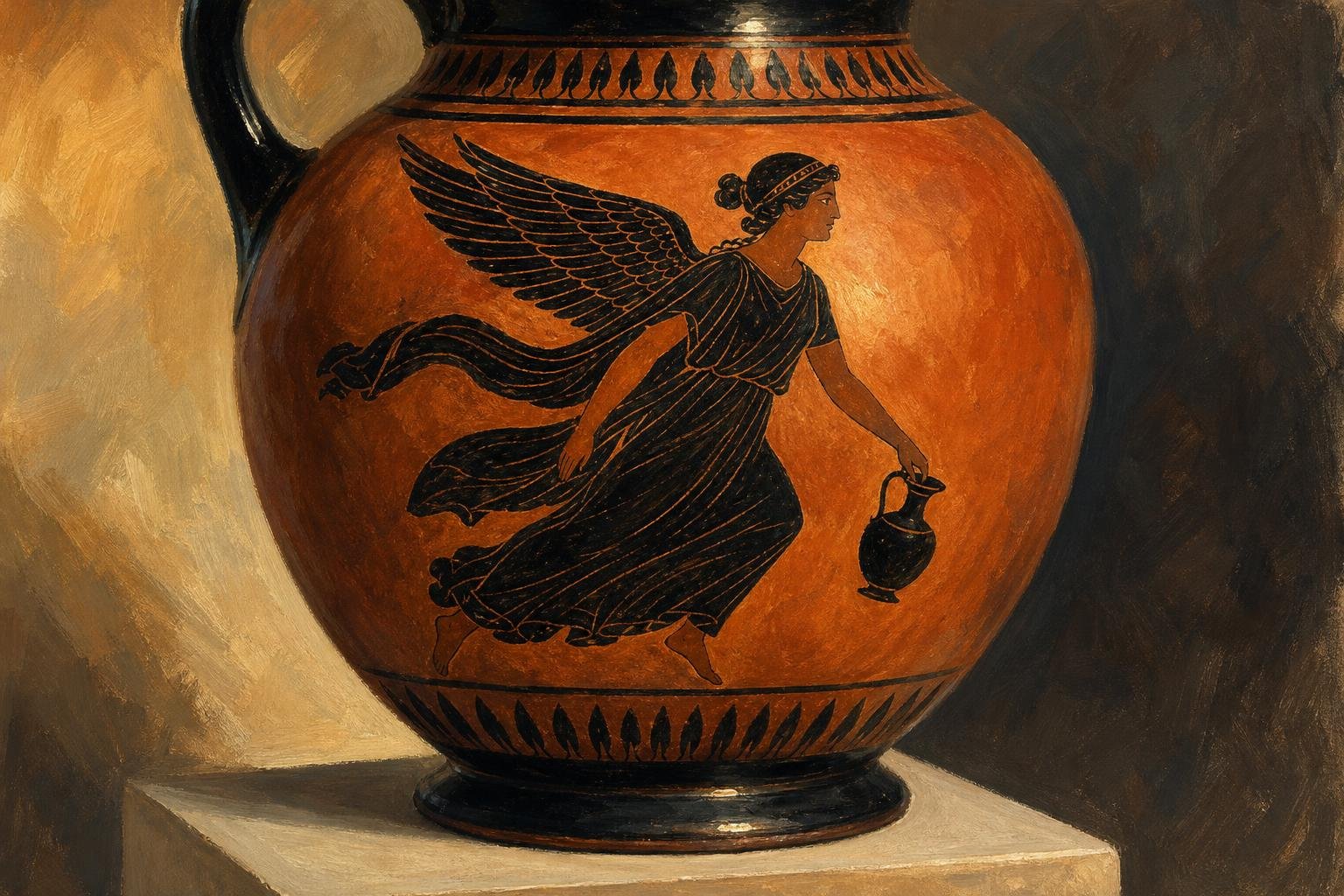
On Greek vases Iris appears as a young woman with wings, often holding a herald's staff, the kerykeion. Hermes carries the same staff. Sometimes she holds a jug and pours for the gods. Nike, the winged Victory, can also carry the staff, so it is a clue rather than proof of identity. The scene's context matters too. Some painters simply wrote her name beside her.
On the Parthenon's east frieze, a winged girl stands beside Hera among the seated gods, and she is usually read as Iris.
Key Takeaways
- Iris's name means rainbow.
- She turns back Hera and Athena with Zeus's warning, then persuades Poseidon to obey him.
- In Hesiod, Zeus sends her to fetch Styx water in a golden jug when disputes and falsehood arise among the gods.
- In art, the herald's staff helps identify her, but Nike can carry it too.
- Hesiod names Iris's parents as Thaumas and Electra, not Zeus.
- In Ovid, Iris carries Juno's request to the god of Sleep.
Frequently Asked Questions
What is Iris the goddess of?
Iris is the Greek goddess who personifies the rainbow and serves as messenger to the Olympians. She appears in Homer, Hesiod, Virgil and Ovid.
What is Iris's relationship to Hermes?
Iris and Hermes are fellow messengers, not siblings. Both carry the herald's staff. Iris does most of the carrying in the Iliad, and Hermes takes that role in the Odyssey.
Is Iris a child of Zeus?
No, Iris is not a child of Zeus. Hesiod names her father as Thaumas and her mother as Electra. Zeus sends her on missions, but she is his servant, not his daughter.
What powers did Iris have?
Her chief power is speed: she crosses from Olympus to earth, or down to the waters of the Styx, almost at once. She can also take mortal form, as when she visits Helen disguised as Laodice.
Who are Iris's sisters?
In Hesiod's Theogony, Iris's sisters are the Harpies, Aello and Ocypete. They share the same parents, Thaumas and Electra.
The Rainbow That Carries Divine Messages
Iris carries divine commands, but her judgment can shape their reception. Poseidon withdraws after she urges him to reconsider his angry reply to Zeus. At the Greek ditch, her message brings Achilles into view; Athena's fire and their combined cries then terrify the Trojans, allowing the Greeks to recover Patroclus's body.