
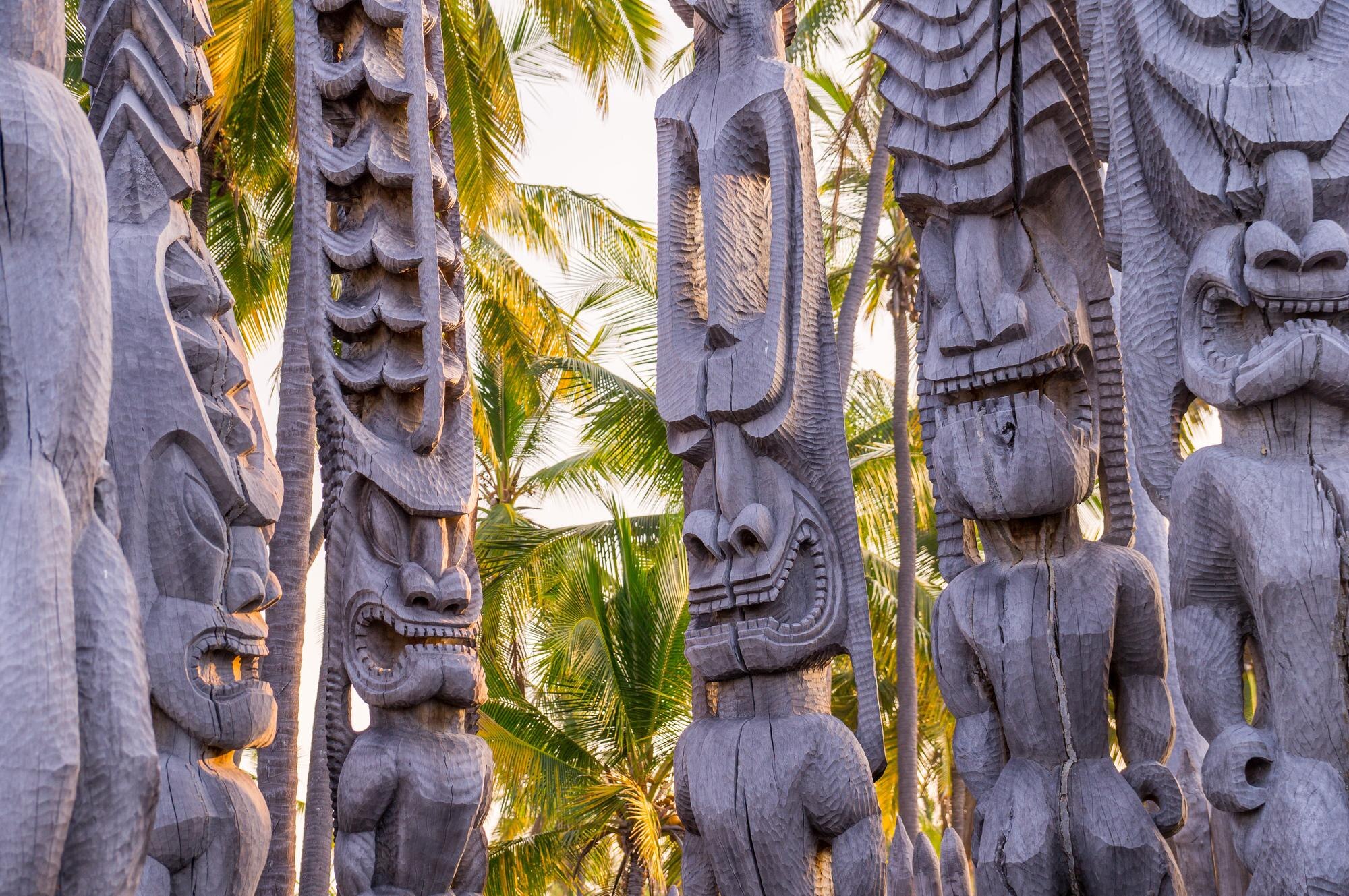
Hawaiian gods are best understood as a set of related powers: four major gods, a wider group of goddesses tied to fire, earth, moon, and dance, a demigod hero, family guardians, and spirit processions. Kāne, Kū, Lono, and Kanaloa are the principal four. Pele, Hiʻiaka, Poliʻahu, Haumea, Hina, Laka, Māui, and the Huakaʻi Pō fill out the twelve below.
The entries introduce each figure's main associations, with selected names, forms, stories, and places.
No list can cover all Hawaiian gods. Traditions held hundreds of named akua, and each family also honored ʻaumākua. These ancestral guardians could appear as a shark, an owl, or another creature, and they watched over the descendants who cared for them. For deeper reading, Ulukau: The Hawaiian Electronic Library hosts Martha Beckwith's Hawaiian Mythology and other primary collections.
In This Article
- 1. Kāne, the Creator and Giver of Fresh Water
- 2. Kū, God of War, Fishing, and Canoe Building
- 3. Lono, God of Rain, Agriculture, and the Makahiki
- 4. Kanaloa, God of the Deep Ocean
- 5. Pele, Goddess of Fire and Volcanoes
- 6. Hiʻiaka, Pele's Youngest Sister
- 7. Poliʻahu, Goddess of Snow on Mauna Kea
- 8. Haumea, the Earth Mother
- 9. Hina, Goddess of the Moon
- 10. Laka, Goddess of Hula
- 11. Māui, the Demigod
- 12. Huakaʻi Pō, the Night Marchers
- Key Takeaways
- Frequently Asked Questions
- Begin With the Principal Four
1. Kāne, the Creator and Giver of Fresh Water
Kāne is the god of creation, sunlight, forests, and fresh water. Many accounts make him the ancestor of chiefs and commoners alike. A widely told story has Kāne traveling the islands with Kanaloa. When they wanted ʻawa to drink and found no water, Kāne struck the ground with his staff, and a spring rose. Several springs across the islands carry that story.
2. Kū, God of War, Fishing, and Canoe Building
Kū is the male principle, paired in ritual with Hina. His name means "to stand" or "upright," and he appears under many epithets. Kūʻula watches over fishing, and Kūkaʻōhiʻalaka over forest work and canoe building. Kūkāʻilimoku, the war-god form, was the personal god of Kamehameha I, carried into the battles that unified the islands.
Kū's worship centered on luakini, the large heiau where chiefs held state rites. Heiau are Hawaiian temples, built as stone platforms and enclosures. Oracle towers on these sites often rose 20 feet or more, and priests set offerings on wooden platforms high above the ground.
That system ended by royal decision. In 1819, Liholiho (Kamehameha II), Kaʻahumanu, and Keōpūolani broke the kapu system, ending the religious laws that heiau worship enforced. Protestant missionaries arrived in 1820.
3. Lono, God of Rain, Agriculture, and the Makahiki
Lono brings the winter rains that make dryland crops grow. He is also associated with peace and sport. His season is the Makahiki, traditionally lasting about four months. Kamehameha Schools describes its opening marker as the rising of the Pleiades, called Makaliʻi, at sunset in late fall. During the Makahiki, war was set aside and games were held. An image of Lono on a tall crosspiece, the akua loa, was carried around each island while tribute was collected district by district. Communities continue to mark the season through local observances rather than one statewide opening date.
4. Kanaloa, God of the Deep Ocean
Kanaloa is the Hawaiian god of the ocean, linked with the deep sea, ocean winds, healing, and the octopus. Kahoʻolawe was once called Kanaloa after him.
He is often paired with Kāne, and their associations divide along the line between kinds of water. Kāne holds fresh water, sunlight, and growth on land. Kanaloa holds the salt sea and what lies beneath it. They usually appear as companions, not rivals, sharing ʻawa in the spring story from Kāne's entry.
5. Pele, Goddess of Fire and Volcanoes
Pele governs fire, lava, and the making of new land. Her chants describe a voyage from Kahiki. She moved down the island chain looking for a home deep enough to hold her fires, pursued by her sea-goddess sister Nāmakaokahaʻi.
She settled in Halemaʻumaʻu, the crater within Kīlauea's summit caldera on Hawaiʻi Island, inside Hawaiʻi Volcanoes National Park. Practitioners bring chants and offerings to the crater rim. Many residents ask visitors not to take lava rock, out of respect for Pele and the land. Park conditions near the caldera change with volcanic activity.
6. Hiʻiaka, Pele's Youngest Sister
Among the Hawaiian gods, Hiʻiaka, fully Hiʻiakaikapoliopele ("Hiʻiaka in the bosom of Pele"), is associated with hula, healing, and the lehua forests. Her epic is among the longest in Hawaiian literature. Pele, in a dream, fell in love with the chief Lohiʻau of Kauaʻi, and she sent Hiʻiaka to bring him to Hawaiʻi Island.
Hiʻiaka asked Pele to protect her beloved lehua grove while she was away. On the journey she defeated moʻo (lizard spirits) and other dangers, and she revived Lohiʻau after he had died. Pele grew impatient and destroyed the grove, and the story turns on that betrayal between sisters.
7. Poliʻahu, Goddess of Snow on Mauna Kea
Poliʻahu is the snow goddess of Mauna Kea, the tallest mountain on Hawaiʻi Island. In Keawe Vredenburg's account, summarized by UH Hilo's Center for Maunakea Stewardship library, she wins a hōlua sled race at Laupāhoehoe against Pele, who enters as Keahilele. Pele's anger brings eruptions, answered by snow, mist, and water.
The two goddesses belong to different landscapes on the same island. Pele lives at Kīlauea, where land is still being made. Poliʻahu wears a white mantle on a summit that holds snow in winter. Their contest gives the island's contrast of fire and ice a family story.
8. Haumea, the Earth Mother
Haumea is a goddess of the earth, fertility, and childbirth. Many genealogies name her as the mother of Pele and Hiʻiaka. She is said to have taken new bodies again and again, returning as a young woman across generations.
Martha Beckwith's Hawaiian Mythology connects Haumea with wild forest foods, childbirth, and renewal. In one account, she becomes a growing tree to conceal her husband from those taking him to be sacrificed. Other traditions identify her with Papa, wife of Wākea, and place her in Kalihi Valley on Oʻahu. These accounts show her appearing as both a divine ancestress and a woman living on earth.
9. Hina, Goddess of the Moon
Hina is the great female figure paired with Kū, linked with the moon, the night, and women's work, especially beating kapa cloth. Many accounts name her as Māui's mother. In one story she grew tired of her labors and climbed to the moon, where some say she can still be seen. Her name also appears in compounds such as Hinahele and Hina-ʻopuhalakoʻa, each marking a different aspect.
10. Laka, Goddess of Hula
Laka is the patron of hula and of the forest plants used to adorn dancers. Hālau set up a kuahu, a hula altar, for her, dressed with greenery such as maile and ʻōhiʻa lehua, and dancers trained under her protection. Accounts differ on Laka's gender and parentage, and some traditions name other deities as hula patrons. Hula practitioners still honor her today.
11. Māui, the Demigod
Māui is a kupua, a demigod and trickster hero. He is born of a divine mother, usually Hina, and acts in the human world.
His deeds explain how the world came to be livable. At Haleakalā he snared the sun's legs with cordage and made it travel slowly enough for Hina's kapa to dry. With his magic hook, Mānaiakalani, he tried to fish the islands up from the sea into one landmass. He also learned the secret of fire from the ʻalae, the mudhen.
12. Huakaʻi Pō, the Night Marchers
Huakaʻi Pō are processions of warrior spirits, not a single deity. Stories describe them walking old trails at night with torches, drums, and chanting, often on nights tied to the moon. In Lopaka Kapanui's account in the Office of Hawaiian Affairs' newspaper, Ka Wai Ola, those unable to escape or hide should prostrate themselves and recite their genealogy, hoping an ancestor in the procession will recognize and spare them. Some places and families treat these accounts with real gravity, and they deserve the same care from visitors.
Key Takeaways
- Kāne, Kū, Lono, and Kanaloa form the principal group of Hawaiian deities.
- Hawaiian gods and goddesses connect with creation, cultivation, fire, ocean, and snow.
- Māui is a demigod and heroic trickster, not interchangeable with the principal gods.
- Huakaʻi Pō are warrior spirits, not one individual deity.
- These twelve entries introduce selected figures, not an exhaustive or uniform pantheon.
Frequently Asked Questions
Who are the four gods of Hawaiʻi?
The four principal gods are Kāne, Kū, Lono, and Kanaloa. Their domains are creation and fresh water, war and work, rain and harvest, and the deep sea. Most lists of Hawaii gods begin with them because they were honored across all the islands.
Who is the most powerful Hawaiian god?
No single answer holds across traditions. Kāne is often called the creator and the eldest. Kū's war-god form, Kūkāʻilimoku, was Kamehameha I's personal god; that association does not establish a universal ranking of divine power.
What is a Hawaiian demigod?
A demigod, or kupua, is a being with divine parentage or powers who lives and acts in the human world. Kupua can often change form, appearing as an animal, a plant, or a person.
Who is the main goddess of Hawaiʻi?
There is no single main goddess across Hawaiian traditions. Pele is honored at Halemaʻumaʻu. Haumea, Hina, Hiʻiaka, Laka, and Poliʻahu also hold major roles, each tied to a different domain.
Who are the demigods of Hawaiʻi?
Māui is the most famous kupua. Others include Kamapuaʻa, the pig demigod who courted Pele. Many lesser-known kupua belong to particular islands and families.
Are Huakaʻi Pō gods or ancestral warrior spirits?
They are spirits of warriors, chiefs, and sometimes gods marching together. They are not counted as a single god. Accounts often describe ancestors among them who can protect their own descendants.
Begin With the Principal Four
Kāne, Kū, Lono, and Kanaloa give you a firm starting point, but they are not the whole story. Pele, Hiʻiaka, Poliʻahu, Haumea, Hina, and Laka tie divine narratives to particular places and practices: a crater at Kīlauea, the snows of Mauna Kea, the hula altar. Māui and the Huakaʻi Pō show why a demigod or a procession of spirits should not be filed as one more god. Some visitors look for a Hawaiian god of the sea and expect one figure. They find Kanaloa alongside Nāmakaokahaʻi, which shows how domains overlap. The kapu system ended in 1819, but these figures did not leave with it. Chant, hula, Makahiki observances, and family ʻaumākua keep them part of living Hawaiian culture.