
Mexican folklore includes traditional stories, beliefs, customs, clothing, festivals, and music. This article focuses on legends, myths, and spirit beliefs passed down by word of mouth, many tied to real places. A narrow alley in Guanajuato, two volcanoes east of Mexico City, a harbor fortress in Veracruz and the cornfields of the Yucatán Peninsula each carry a tale that local people still tell. The ten stories below run from tragic romances and sacred narratives to ghost stories and warnings. Each one is followed back to its place, whether that place is a building you can walk into or any dark road at night.
Those stories grew from several sources that mixed over centuries. Indigenous peoples, among them the Nahua and the Maya peoples, carried sacred accounts of gods, spirits, and the land. Spanish colonial Catholicism brought devils, sin, saints, and the Inquisition. Africans brought to New Spain in bondage, many of them through the port of Veracruz, added beliefs and figures of their own. Neighbors, servants, parents, and priests passed the tales along, and each telling borrowed from the others. One tale can hold a Nahua omen and a Catholic idea of the restless soul at the same time.
In This Article
- 1. La Llorona, the Weeping Woman
- 2. El Callejón del Beso in Guanajuato
- 3. La Mulata de Córdoba
- 4. Popocatépetl and Iztaccíhuatl
- 5. El Charro Negro
- 6. La China Poblana and Catarina de San Juan
- 7. El Sombrerón
- 8. The Aluxes of the Yucatán Peninsula
- 9. Quetzalcóatl, the Feathered Serpent
- 10. El Nahual, the Shapeshifter
- Key Takeaways
- Frequently Asked Questions
- Follow Each Story to Its Roots
1. La Llorona, the Weeping Woman
La Llorona is a woman in white who drowned her children, often after a man abandoned her. She now walks beside rivers, lakes, and canals at night crying for them, and the cry most families quote is "¡Ay, mis hijos!" Children hear that if they stay near water after dark, she may mistake them for her own and take them.
One proposed antecedent appears in the Florentine Codex, compiled in the 16th century under the friar Bernardino de Sahagún: among the omens before the conquest is a woman heard weeping at night for her children. Some retellings connect La Llorona to La Malinche, the Nahua woman who interpreted for Hernán Cortés, or to Cihuacóatl, a Nahua goddess. Library of Congress folklorist Stephen Winick traces Indigenous roots and later European contributions to the legend. The Codex parallel does not establish a single origin, or when the drowned-children story entered the tradition.
In Mexico, folklore lives in practice as much as in stories, including Día de Muertos, observed on November 1 and 2. On those days, home altars called ofrendas hold photographs, favorite foods, and orange cempasúchil marigolds, whose color and scent families believe guide the dead home for a visit. Those dead are expected and fed.
2. El Callejón del Beso in Guanajuato
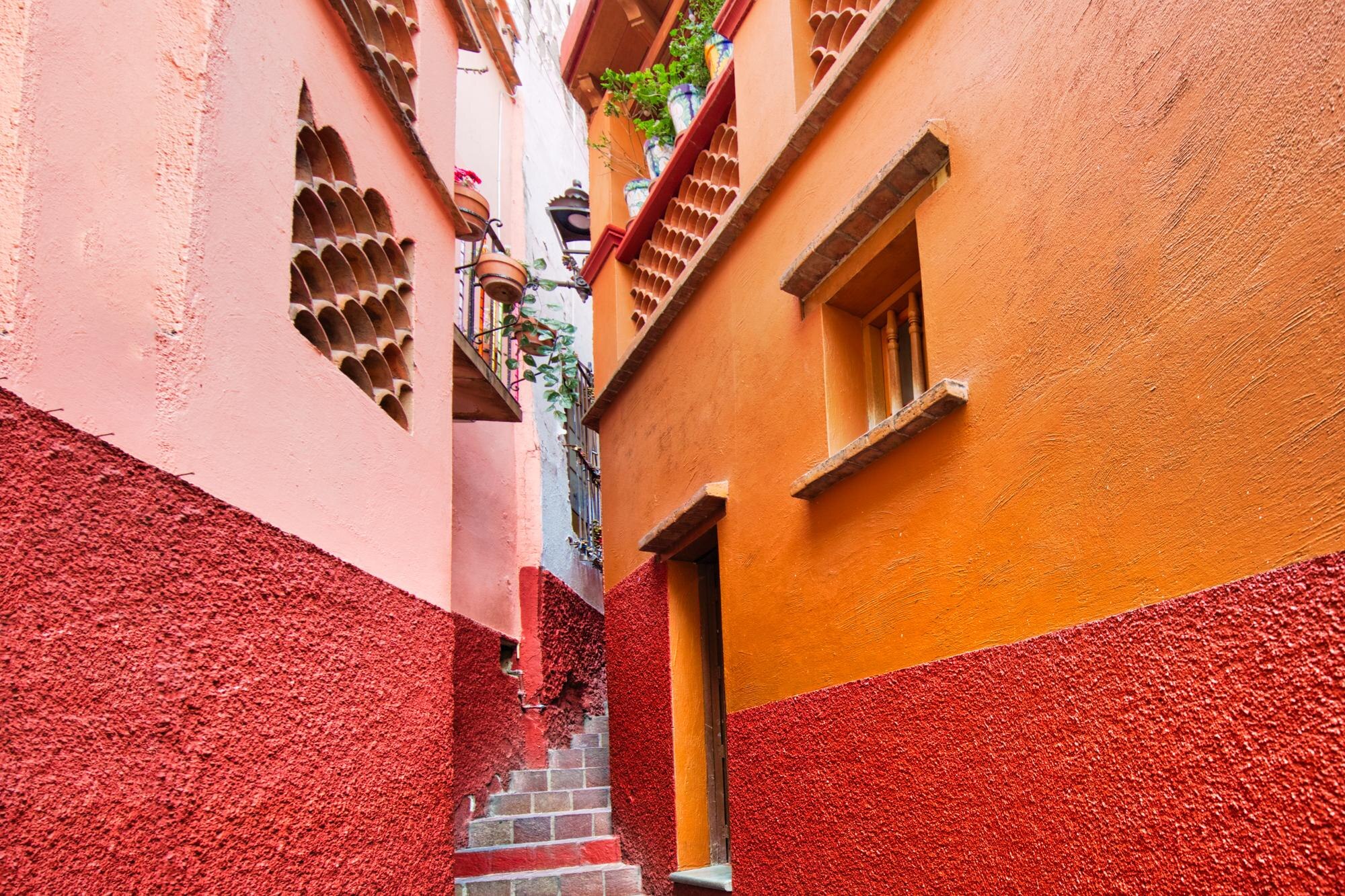
El Callejón del Beso is a stepped alley in Guanajuato where the balconies of two facing houses lean so close that people can reach across. The gap is about 27 inches. In the legend, Carmen lived on one side, and her father forbade her romance with Luis, usually described as a poor miner. Luis rented the house opposite so the two could meet at the balconies. When her father caught them, he stabbed Carmen, and Luis kissed her hand as she died.
Few places let you stand inside a Mexican story the way this alley does. It sits a short walk from the Plazuela de los Ángeles in the historic center of a city UNESCO listed as a World Heritage Site in 1988. No record names Carmen or Luis, and nobody climbing the steps seems to mind. Couples kiss on the third step, and the tradition promises 15 years of happiness. Some local guides add that a couple who skips the kiss gets seven years of bad luck.
3. La Mulata de Córdoba
In the legend, La Mulata de Córdoba was a woman of mixed African and Spanish ancestry from Córdoba, Veracruz. She was admired for her beauty and sought out for her remedies, until neighbors whispered that she had made a pact with the devil. The Inquisition arrested her and locked her in a cell at San Juan de Ulúa, the island fortress guarding the port of Veracruz.
That fortress is real. The Mexican Inquisition was formally established in 1571, and San Juan de Ulúa served as a fortress and later a prison; it is open to visitors today. The region's African history is on record too. Veracruz was a main port of entry for enslaved Africans, and the town of Yanga near Córdoba carries the name of an African leader who headed a maroon community and won recognition of a free town in the early 1600s. The woman herself lives only in Mexican folklore, as the one colonial society chose to call a witch.
What she did in that cell is the reason people still tell it. She drew a ship on the wall with charcoal and asked the jailer what it lacked. He told her it needed only to sail. She stepped aboard, and the ship carried her out through the stone.
4. Popocatépetl and Iztaccíhuatl
Popocatépetl and Iztaccíhuatl are the two volcanoes on the eastern edge of the Valley of Mexico, and their legend makes them lovers. Iztaccíhuatl was a princess, and Popocatépetl was a warrior sent off to battle. A rival brought false news of his death, and she died of grief. When he returned, he carried her body to the mountains, laid her down, and knelt beside her holding a smoking torch.
The mountains still match the story. Iztaccíhuatl's name means "white woman" in Nahuatl, and its snow-covered ridge, about 17,160 feet high, looks like a woman lying on her back. Popocatépetl, the "smoking mountain," rises to about 17,800 feet and has been active since 1994, so the torch is still burning. Climbing it is prohibited, and authorities enforce an exclusion zone around the crater. Hikers on Iztaccíhuatl usually set out from Paso de Cortés, the saddle between the peaks at around 12,000 feet.
The names are old, but the romance as most Mexicans picture it owes much to the 20th century. Jesús Helguera painted the warrior kneeling over the sleeping princess for calendars, and those calendars hung in kitchens, barbershops, and corner stores across the country.
5. El Charro Negro
El Charro Negro is a tall rider in a black charro suit trimmed with silver, mounted on a black horse. He appears on lonely roads at night and offers a ride or a bag of gold. In many versions he is the devil himself. In others he is a man who sold his soul for wealth and now rides to collect for his master.
His costume ties him to charrería, the horsemanship tradition most closely associated with Jalisco, but he is told across central and western Mexico and has no landmark. In one widely told version, a young woman walking home alone accepts his offer of a ride. Once she is up behind him, she cannot let go or climb down. The horse breaks into flames, and the rider carries her off down the road, and nobody sees her again.
6. La China Poblana and Catarina de San Juan
La China Poblana links a historical woman in Puebla with a later costume tradition, but the association is retrospective. Catarina de San Juan was born in Asia and, in the accounts of her life, called Mirra as a child. Slavers seized her and took her to Manila, and from there she crossed the Pacific on the Manila galleon route to New Spain. In colonial usage, "china" referred to people from Asia.
In Puebla she lived as a servant in a merchant's household and became known for her devotion and her visions. People of the city came to her for prayers. Her Jesuit confessor, Alonso Ramos, wrote a long account of her visions, and the Inquisition later banned it along with images of her. Her reputation as a holy woman outlasted the ban.
The embroidered blouse and sequined red-and-green skirt now seen in folkloric dance belong to a later costume tradition. UNAM historian María del Carmen Vázquez Mantecón traces the association between Catarina and the china poblana dress to the late 19th century, not Catarina's lifetime. Catarina died in 1688. She is buried in Puebla's Templo de la Compañía.
7. El Sombrerón
El Sombrerón takes different forms in local traditions. In a San Andrés Larráinzar, Chiapas, account recorded by researcher María-Cruz La Chica in 2019, Tsotsil speaker Pedro Gómez Díaz describes a normal-sized figure whose huge hat and black cape conceal his face. He associates the figure with the Dueño, or owner, of mountains, forests, and rivers, while noting that his community does not usually call it Sombrerón. This figure can lead travelers astray, especially people who are drunk, or offer money in exchange for the soul of the person they love most.
8. The Aluxes of the Yucatán Peninsula
Aluxes (singular alux) are small spirits in the beliefs of the Maya peoples of the Yucatán Peninsula. They live in fields, forests, and caves and look after the land. Treated with respect, they protect a farmer's milpa, or cornfield. Treated carelessly, they play tricks, hide tools, or bring sickness. Farmers leave food and drink for them, and in some places they build a small house for the aluxes at the edge of the field.
That relationship did not stop at the cornfield. In parts of Yucatán and Quintana Roo, people still ask the aluxes' permission before clearing land or starting construction. Before the machines go in, someone sets out food and drink among the trees for the spirits who were there first.
9. Quetzalcóatl, the Feathered Serpent
Quetzalcóatl, the Feathered Serpent, was a god honored across Mesoamerica for centuries before the Spanish arrived. In one Nahua account, he traveled to Mictlan, the land of the dead, to recover the bones of earlier people. He gave them life with his own blood and so created the humans of the present age.
The Feathered Serpent also appears in monumental religious art. At Teotihuacan, the Temple of the Feathered Serpent still bears rows of serpent heads jutting from its facade. His Maya counterpart, Kukulkán, appears at Chichén Itzá. On and around the spring and fall equinoxes, late-afternoon light and shadow outline triangles of sunlight along the balustrade of El Castillo's north stairway, creating the appearance of a descending serpent that joins the stone serpent head below. Visitors must view El Castillo from the permitted public area; Mexico's National Institute of Anthropology and History (INAH) prohibits climbing its steps.
10. El Nahual, the Shapeshifter
El Nahual, from the Nahuatl word nahualli, is a person who can turn into an animal, such as a dog, coyote, turkey, or jaguar. In frightening versions, the transformation allows someone to do harm at night, but nahuales are not always villains. Anthropologist Natalia Gabayet González documents healers as well as threatening figures among Afro-Mexican communities on the coasts of Guerrero and Oaxaca. In many Indigenous communities, a related belief holds that each person shares a fate with an animal companion. Colonial priests often interpreted these traditions as witchcraft.
Aluxes and nahuales differ in where the power lives. An alux, as entry 8 describes, is a spirit associated with the land. A nahual, in shapeshifting accounts, is a human being with an animal form. In frightening versions, the suspected shapeshifter may be someone the storyteller knows.
Some frightening nahual legends from southern Mexico describe a strange dog circling a house after dark, or a turkey on the roof that no one owns. A common telling has a villager strike the animal and drive it off. The next morning a neighbor turns up with the same wound.
Key Takeaways
- Mexican folklore mixes Nahua and Maya belief, Spanish Catholicism, and African traditions brought through Veracruz.
- Some stories have a landmark you can visit, such as the third step of El Callejón del Beso or San Juan de Ulúa, where one version places La Mulata's imprisonment; others, like El Charro Negro, belong to any dark road.
- La Llorona threatens children near water; El Charro Negro tempts travelers with rides or gold; in the Chiapas account above, El Sombrerón misleads travelers or offers money for a loved one's soul.
- Quetzalcóatl and the aluxes are sacred figures and respected neighbors to the people who tell of them, and they are honored in stone and in offerings.
- Real people and real buildings sit inside several legends, Catarina de San Juan's tomb in Puebla among them.
Frequently Asked Questions
What Are the Mythical Creatures in Mexico?
The best-known include aluxes, the small guardian spirits of the Maya, and nahuales, people who can take animal form. El Sombrerón also appears in Chiapas traditions; the account above associates him with the Dueño of mountains, forests, and rivers. Quetzalcóatl is a god more than a creature, though his feathered-serpent form appears on temples from Teotihuacan to Chichén Itzá.
Is There a Mexican Mythology?
Yes. The Mexica (Aztec) and Maya traditions each had full accounts of creation, gods, and the afterlife. Many Mexican myths survive in codices, in carved monuments, and among Indigenous communities that still tell them. Within wider Maya mythology, the Popol Vuh, written down in the colonial period, is the creation account of the K'iche' people of present-day Guatemala, not a Mexican example.
What Is the Scariest Mexican Urban Legend?
The scariest depends on the listener. La Llorona's warnings about children near water and El Charro Negro's dangerous bargains offer different kinds of fear: one threatens a family, while the other turns an offer of help or wealth into a trap.
Are There Any Mexican Fairy Tales?
Yes. Families tell cuentos with talking animals and tricksters, such as Tío Conejo, the clever rabbit, and Pedro de Urdemalas, a rogue who came from Spain and took on Mexican settings. Unlike legends, these tales are not tied to a real place or presented as true.
What Is a Famous Mexican Fairytale?
The story of Popocatépetl and Iztaccíhuatl is often told to children like a fairy tale, with a princess, a warrior, and a sad ending. Another favorite is the Nahua tale of the rabbit in the moon. In it, a rabbit offers itself as food to a starving Quetzalcóatl, and the god rewards the rabbit by placing its image on the moon.
Why Do Versions of La Llorona Differ Between Places and Families?
She spread by word of mouth, and every teller set her beside the river or canal they knew and added the warning their own children needed. Some versions link her to La Malinche or a Nahua goddess, and others make her a jilted colonial woman. No single version is the original.
Follow Each Story to Its Roots
Mexican legends tie stories to particular ground. Five of these ten connect to specific places visitors can see: El Callejón del Beso, Paso de Cortés between the volcanoes, San Juan de Ulúa, Catarina de San Juan's tomb in Puebla's Templo de la Compañía, and El Castillo at Chichén Itzá. The others live in kinds of places, such as riverbanks, lonely roads, cornfields, and village edges at night.