
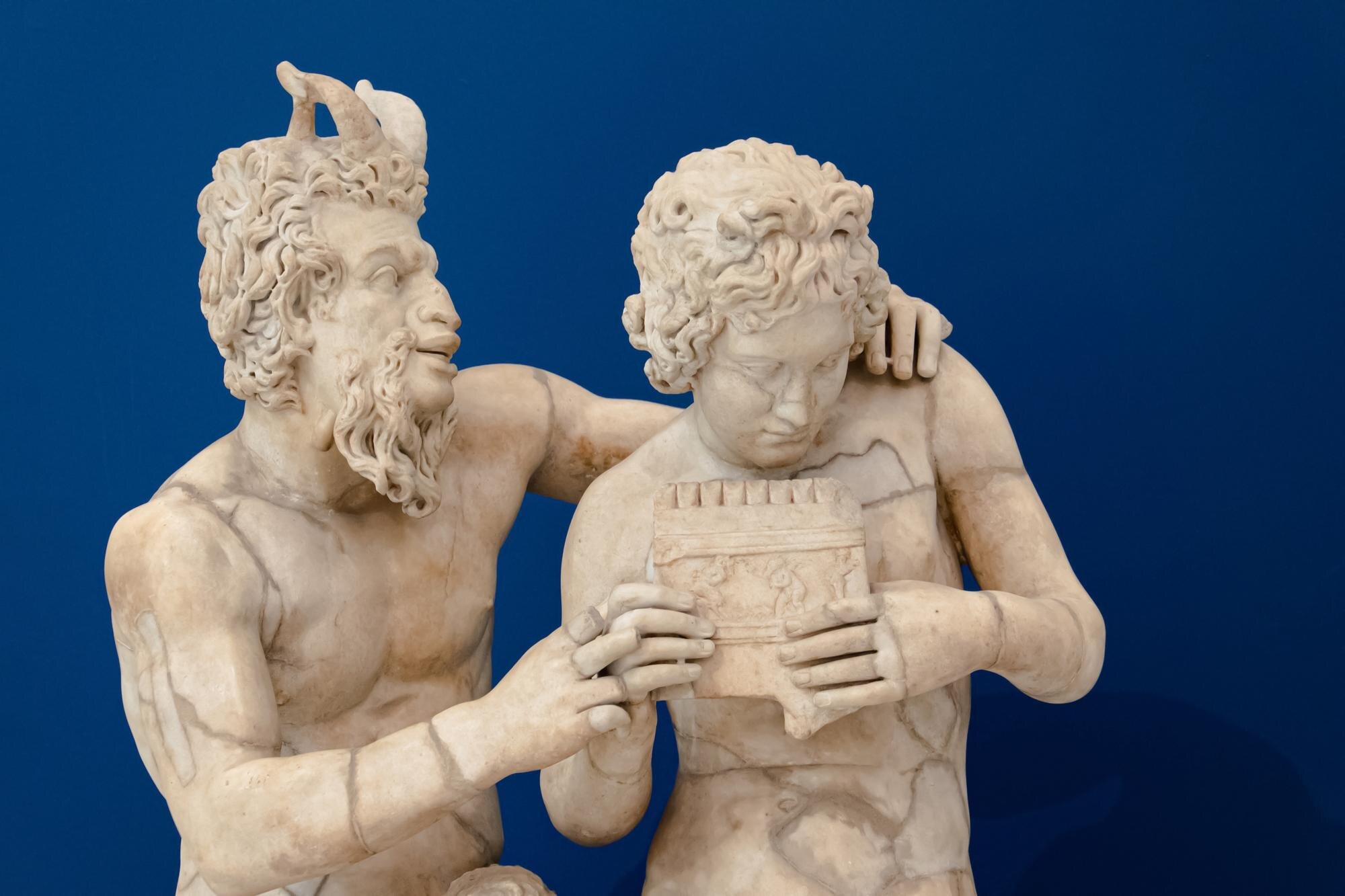
Pan is the goat-legged Greek god of shepherds and flocks, first worshiped in Arcadia. His sudden terror gave English the word panic. His stories connect protection with danger, from mountain pastures to Athens.
In This Article
- Where Pan Came From
- Flocks, Noon, and Panic
- Syrinx and the Origin of the Pipes
- The Contest With Apollo
- How Artists Showed Pan
- Pan at Marathon
- "The Great Pan Is Dead"
- Pan in Rome: Faunus and Silvanus
- Key Takeaways
- Frequently Asked Questions
- Recognizing Pan Beyond His Pipes
Where Pan Came From
The Homeric Hymn to Pan calls him the son of Hermes and a daughter of Dryops. In H. G. Evelyn-White's translation, his nurse fled at his strange face and full beard; Hermes carried him to Olympus, where the gods delighted in him.
Herodotus names Penelope as his mother. Other writers made Zeus his father: Pan had no single genealogy.
Flocks, Noon, and Panic
In Theocritus's Idyll 1, a goatherd refuses to pipe at noon because Pan is resting after the hunt. He fears the god's anger: the music associated with Pan is not welcome at every hour.
Yet herders sought his protection, often at cave shrines. The same god could send unexplained fear through flocks or armies. Protection and terror belong to the same pastoral setting: the keeper of the flocks could also frighten them.
The Athenian story below extends his protection beyond herding. Pan offers goodwill to a city facing invasion, and Athens responds with a sanctuary and public honors.
Syrinx and the Origin of the Pipes
In Ovid, Pan pursued Syrinx to the river Ladon. She begged the river nymphs for escape and became reeds.
His breath sounded through their stems. He bound unequal reeds with wax to make his pipes. Nonnus's Dionysiaca also recalls Pitys fleeing Pan's unwanted pursuit; in that account, she disappears into the earth.
The Contest With Apollo
Pan challenged Apollo's music, and the mountain god Tmolus judged Apollo's lyre superior.
King Midas disagreed. Apollo gave him donkey ears, which he hid beneath a cap. His barber whispered the secret into a hole; reeds grew there and repeated it in the wind.
How Artists Showed Pan
Early artists sometimes gave Pan a goat's head. Later depictions favored a human face with horns and goat legs, often carrying pipes.
These features connect his appearance to his stories. His goat legs place him among the animals under his care, while his instrument recalls Syrinx's escape into reeds. The pipes are therefore more than a sign of rustic music: their origin preserves the story of a nymph who fled him.
Among Dionysus's followers, those goat features help distinguish him from satyrs in early Greek art, who usually have horse ears and tails.
Pan at Marathon
Herodotus reports that, in 490 BCE, Pan addressed Pheidippides near Mount Parthenion as the runner traveled to Sparta for help against Persia. Pan asked why Athens neglected him despite his goodwill.
After victory, Athens established his cave sanctuary beneath the Acropolis, honoring him with sacrifices and a torch race.
"The Great Pan Is Dead"
Plutarch recounts how, during Tiberius's reign, a voice near Paxi ordered the pilot Thamus to announce Pan's death at Palodes.
Thamus resolved to speak only if the sea was calm. Finding still water, he delivered the message. Unseen voices answered with mourning.
Pan in Rome: Faunus and Silvanus
Romans associated Pan with Faunus, a countryside god who gave prophecies. Ovid links both to Lupercalia, held on February 15. Its runners struck people with goatskin strips; women sought the blows for fertility.
Silvanus guarded woods, fields and boundaries. His rustic appearance could resemble Pan's, but his worship remained distinct.
Key Takeaways
- Pan's protection carried the threat of sudden terror.
- His conflicting genealogies reflect different ancient accounts.
- Syrinx becomes reeds in Ovid; Pitys disappears into the earth in Nonnus.
- Midas suffers for defending his music.
- Marathon brings his worship into Athenian civic life.
- Roman associations do not erase separate cults.
Frequently Asked Questions
What is Pan the god of?
Shepherds, flocks and wild hills are his chief concerns, alongside rustic music and hunting.
Who was Pan's lover?
There is no single answer. His pursuits often fail, though Virgil credits him with winning the Moon through a gift of white fleece.
Are Pan and Dionysus the same god?
No. They are separate gods. Their shared appearances in art place Pan in Dionysus's company without making them identical.
What happened when Pan pursued Syrinx and Pitys?
In Ovid's Metamorphoses, Syrinx flees him and becomes reeds. In Nonnus's Dionysiaca, Pitys flees his unwanted pursuit and disappears into the earth.
Who is Pan in Greek mythology?
He is an Arcadian deity whose usual parentage connects him to Hermes. His animal features and musical instrument make him recognizable.
Recognizing Pan Beyond His Pipes
Pan's appearance helps identify him, but each source answers a different question. The hymn tells of his birth and welcome among the gods; Ovid explains his instrument; Herodotus recounts his relationship with Athens. Read these as distinct accounts, not consecutive chapters in a single biography.