
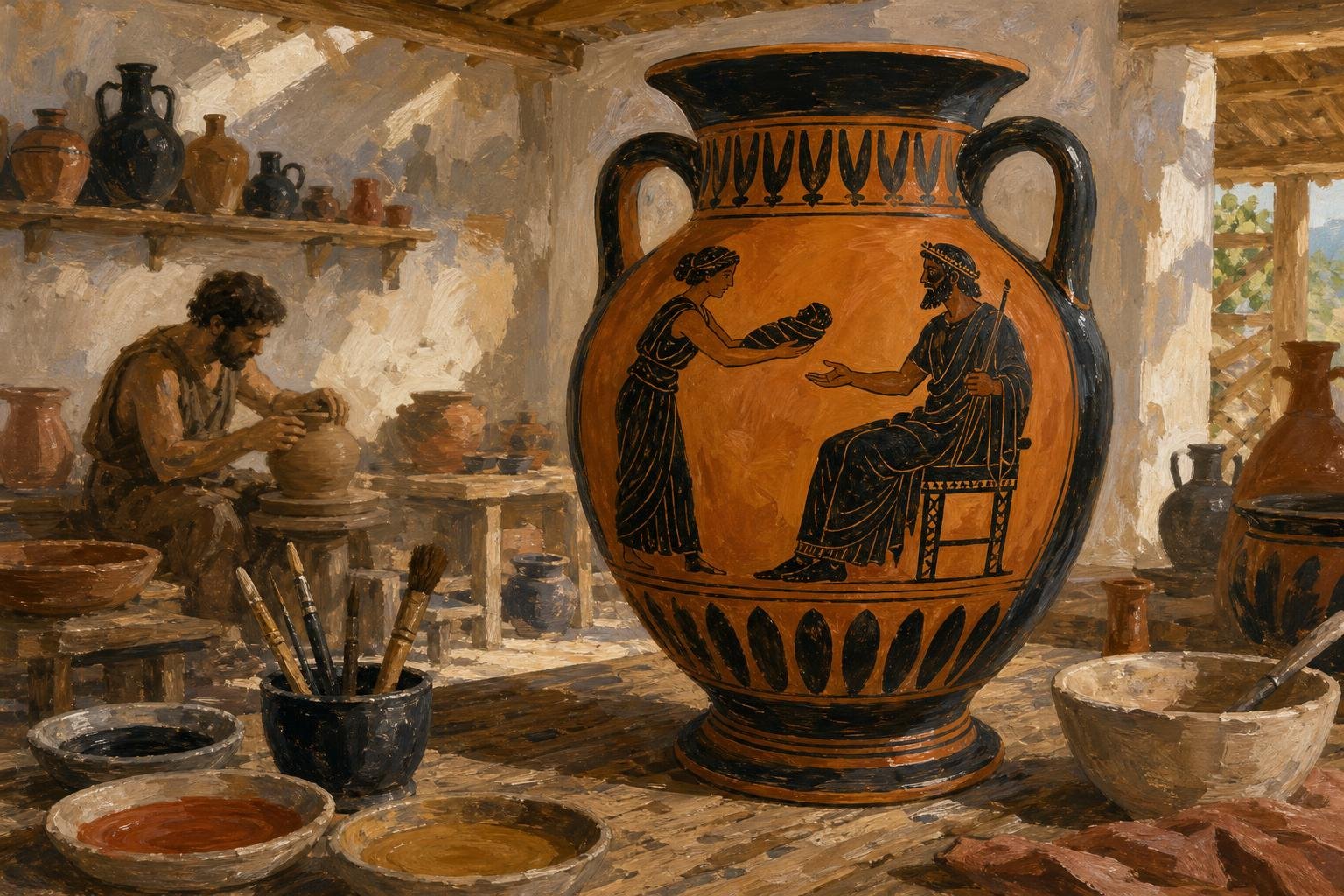
The Titans were the twelve children of Gaia, the Earth, and Uranus, the Sky. They ruled the cosmos under Cronus until Zeus and his siblings defeated them in a ten-year war, and later writers gave the name to several of their children too. Their story begins with a father who could not stand his own offspring. Uranus pushed each newborn back inside Gaia's body, and every generation after him repeated that fear of being replaced. Parentage identifies the original twelve, but neither descent from them nor family loyalty alone determines who later writers call a Titan.
In This Article
- Where the Titan Story Comes From
- The Twelve Original Titans
- How Cronus Took Power From Uranus
- Rhea's Six Children and the Swallowed Stone
- The Titanomachy and Who Took Which Side
- The Titans' Children Who Joined the List
- Titans and Giants Are Not the Same
- Key Takeaways
- Frequently Asked Questions
- Understanding the Titans Through Their Family
Where the Titan Story Comes From
Most retellings of Titan mythology start from Hesiod's Theogony, a poem usually dated to around 700 BCE. In Hesiod's account, Chaos comes first, then Gaia. Gaia bears Uranus to cover her on every side, and with him she produces three sets of children: the Titans, the one-eyed Cyclopes, and the Hundred-Handers.
Hesiod also says where the name came from, and it is an insult. Uranus called his children Titans as a reproach. The word is tied to "straining," because they strained to commit a terrible act, and to the vengeance that would come after it.
Hesiod's Theogony gives their parentage and names in lines 133–138, before recounting the attack on Uranus. Its first use of the collective name “Titans,” in lines 207–210, connects that name with the deed against their father. But when Gaia asks her children to act, the others fall silent in fear; only Cronus agrees.
The Twelve Original Titans
Hesiod names six sons and six daughters. The sons are Oceanus, Coeus, Crius, Hyperion, Iapetus, and Cronus, the youngest. The daughters are Theia, Rhea, Themis, Mnemosyne, Phoebe, and Tethys.
Four sibling couples connect the Titans to rivers, celestial lights, later gods and the succession of rulers; not every Titan has a clearly defined domain. Oceanus is water at the edge of everything, the river that circles the whole earth. His sister Tethys feeds that water outward as the mother of rivers and of the Oceanid nymphs, Styx among them.
Hyperion and Theia hold the light. Their children are the sun, the moon and the dawn, so every day's sky comes from this one couple.
In Hesiod's Theogony, Coeus and Phoebe are the parents of Leto and Asteria. Phoebe has a prophetic role in Aeschylus' Eumenides: the oracle at Delphi passes from Themis to her, and she hands it on to Apollo as a birthday gift. Apollo is her grandson through Leto. Crius has the thinnest story of all. He marries Eurybia, a daughter of Gaia and the sea god Pontus, and their sons include Perses.
The table below gathers the 12 Titans with their roles and families.
The 12 first-generation Titans: roles and children
| First-generation Titan(s) | Roles or associations | Partners and notable children |
|---|---|---|
| Oceanus and Tethys | Oceanus: earth-encircling river; Tethys: mother of rivers and Oceanids | Together: river gods and Oceanid nymphs, including Styx |
| Hyperion and Theia | Hyperion: father of celestial lights; Theia: mother of sun, moon and dawn | Together: Helios (sun), Selene (moon), Eos (dawn) |
| Coeus and Phoebe | Coeus: father of Leto and Asteria; Phoebe: associated with the Delphic oracle | Together: Leto and Asteria; grandparents of Apollo and Artemis |
| Cronus and Rhea | Cronus: ruler of the Titans; Rhea: mother of the elder Olympians | Together: Hestia, Demeter, Hera, Hades, Poseidon and Zeus |
| Crius | Father of Astraeus, Pallas and Perses | With Eurybia: Astraeus, Pallas and Perses |
| Iapetus | Father of Atlas and Prometheus | With Clymene in Hesiod: Atlas, Menoetius, Prometheus and Epimetheus |
| Themis | Divine order, justice and customary law | With Zeus: the Horae (Seasons) and, in Hesiod, the Moirai (Fates) |
| Mnemosyne | Memory; mother of the nine Muses | With Zeus: nine Muses, including Calliope, Clio and Urania |
Two daughters hold something less physical. Themis is right order, the way things ought to be done, and with Zeus she bears the Seasons and, in the Theogony, the Fates. Mnemosyne is Memory itself. With Zeus she bears the nine Muses.
How Cronus Took Power From Uranus
Gaia was in pain from the children Uranus kept forcing back inside her. She made a great sickle and asked her sons to punish their father. Only Cronus agreed. When Uranus came to lie with Gaia, Cronus ambushed him from hiding and castrated him with the sickle.
The wound produced new beings. From the blood that fell on Gaia came the Erinyes, the Giants, and the ash-tree nymphs called Meliae. From the severed parts that fell into the sea came the foam that formed Aphrodite. Cronus now held the kingship, and a son overthrowing his father became the pattern for everything that followed.
Greek tradition did not remember his reign only as tyranny. In Works and Days, Hesiod places the golden race of mortals in the time when Cronus ruled the sky. Those people lived like gods, free of toil and misery. They never grew old, and they died as if falling asleep. The Titan who maimed his father also presided over humanity's best age.
Rhea's Six Children and the Swallowed Stone
Gaia and Uranus warned Cronus that one of his own sons would overthrow him. To prevent it, he swallowed each child Rhea bore: Hestia, Demeter, Hera, Hades, and Poseidon.
When Rhea was about to give birth to Zeus, she turned to her parents for help. They sent her to Lyctus on Crete. Gaia received the newborn Zeus from Rhea and hid him in a cave on Mount Aegeum. Rhea gave Cronus a stone wrapped in swaddling clothes. He swallowed it without noticing.
Zeus grew up in hiding. Later, through Gaia's counsel, Cronus was made to bring up what he had swallowed. The stone came out first, and Zeus set it up at Pytho, the site of Delphi. Then the five siblings returned. These six children of Cronus and Rhea are the generation that displaced its parents.
Zeus did not escape the pattern either. Warned that his consort Metis would bear a son stronger than himself, he swallowed her too. In the Theogony, that is how Athena came to be born from his head. The succession story stops with Zeus because he takes the threat inside himself. The threat itself never goes away.
The Titanomachy and Who Took Which Side
The war between the Olympians and the Titans is the Titanomachy. In Hesiod it lasts ten years, with the Titans fighting from Mount Othrys and the Olympians from Mount Olympus. Neither side could win until Zeus, again on Gaia's advice, freed the Hundred-Handers: Briareus, Cottus, and Gyges. The Cyclopes gave him thunder and lightning.
With those allies the Olympians drove the Titans down into Tartarus. Hesiod measures its depth with a falling object. A bronze anvil would drop nine days from the sky to the earth, and nine more from the earth to Tartarus. The Hundred-Handers stood guard over the prisoners.
Not every Titan ended up in that pit. Styx, an Oceanid, was the first to bring her children to Zeus's side, and he rewarded her by making her the oath of the gods. Oceanus and Tethys raised Hera during the conflict between Zeus and Cronus. Themis and Mnemosyne became mothers of Zeus's children.
The sons of Iapetus split. Zeus struck Menoetius with a thunderbolt, and Atlas received his famous sentence. In Prometheus Bound, traditionally attributed to Aeschylus but of disputed authorship, Prometheus says he sided with Zeus in the war. Losing the war ended Cronus's rule, but it did not make every Greek Titan an enemy.
The Titans' Children Who Joined the List
Writers from Aeschylus onward called some of the Titans' children Titans as well. That is why lists of Titan gods often run longer than twelve. The two who earned the name most fully are sons of Iapetus and the Oceanid Clymene, and both are known for a punishment.
Atlas holds up the wide sky. He stands at the ends of the earth, near the Hesperides, bearing that weight on his head and arms. His punishment is a job that never ends.
Prometheus was a friend of Zeus in the war and then defied him. He stole fire, hid it in a hollow fennel stalk, and gave it to humans. Zeus had him bound, and an eagle came to eat his liver, which grew back each night. In Hesiod, Heracles kills the eagle and frees him. Prometheus belongs to the second generation, yet Prometheus Bound calls him a Titan, and his story is the one most retellings remember. His brother Epimetheus completed the trouble by accepting Pandora.
Hyperion's children are Titans you can still see. Helios drives the sun, Selene is the moon, and Eos brings the dawn. Leto, daughter of Coeus and Phoebe, bore Apollo and Artemis to Zeus.
Then there is Hecate, daughter of Asteria and Perses. The Theogony gives her a long passage of praise. Zeus let her keep her honors on earth, in the sea, and in the sky.
Titans and Giants Are Not the Same
The Titans and the Giants both appear in stories of resistance to Zeus, but Hesiod gives them different origins. His twelve Titans are Gaia's children by Uranus. The Giants sprang from Uranus's blood when it fell on Gaia after Cronus attacked him. Some ancient traditions nevertheless overlap or conflate the groups.
The two groups are associated with separately named wars. The Titans' war is the Titanomachy, already described. The Giants' later rebellion against the Olympians is the Gigantomachy, and in Apollodorus' account the gods could not win it without a mortal fighting beside them. Heracles was that mortal. Greek artists returned to this war again and again, and in Athens they carved it on the east metopes of the Parthenon, gods and Giants locked together over the city.
Key Takeaways
- The original twelve Titans were children of Gaia and Uranus.
- Later descendants such as Atlas, Prometheus and Helios also appear in Titan lists, so twelve is not the total.
- Cronus's overthrow of Uranus began a succession pattern that Zeus continued.
- The Titanomachy ended Cronus's rule, not the existence of every Titan.
- Titan ancestry, the names writers use and allegiance to Zeus are separate questions.
Frequently Asked Questions
Who are the Titans in Greek mythology?
They are the twelve children of Gaia and Uranus named in Hesiod's Theogony. Later writers extended the name to some of their children, such as Prometheus, Atlas, and Helios.
Who is the strongest Greek Titan?
Prometheus Bound describes Atlas as exceptionally strong, but the passage does not establish which Titan was strongest.
Which Titan ate Zeus?
None did. Cronus swallowed Zeus's five older siblings, but Rhea gave him a stone wrapped in swaddling clothes in place of the infant Zeus. Zeus later forced Cronus to bring the siblings back up.
Why was Zeus not a Titan?
Zeus belongs to the Olympian ruling order, not Hesiod's original twelve Titans. Being the son of Cronus and Rhea does not automatically give him their label: later writers call some Titan descendants Titans, but ancestry alone does not define the group. Zeus led the gods who displaced Cronus.
Understanding the Titans Through Their Family
Use the parentage listed above to distinguish Hesiod's original twelve from descendants later writers also call Titans. A longer Titan list need not contradict the twelve-name list, and the name alone does not tell you who fought against the Olympians.