
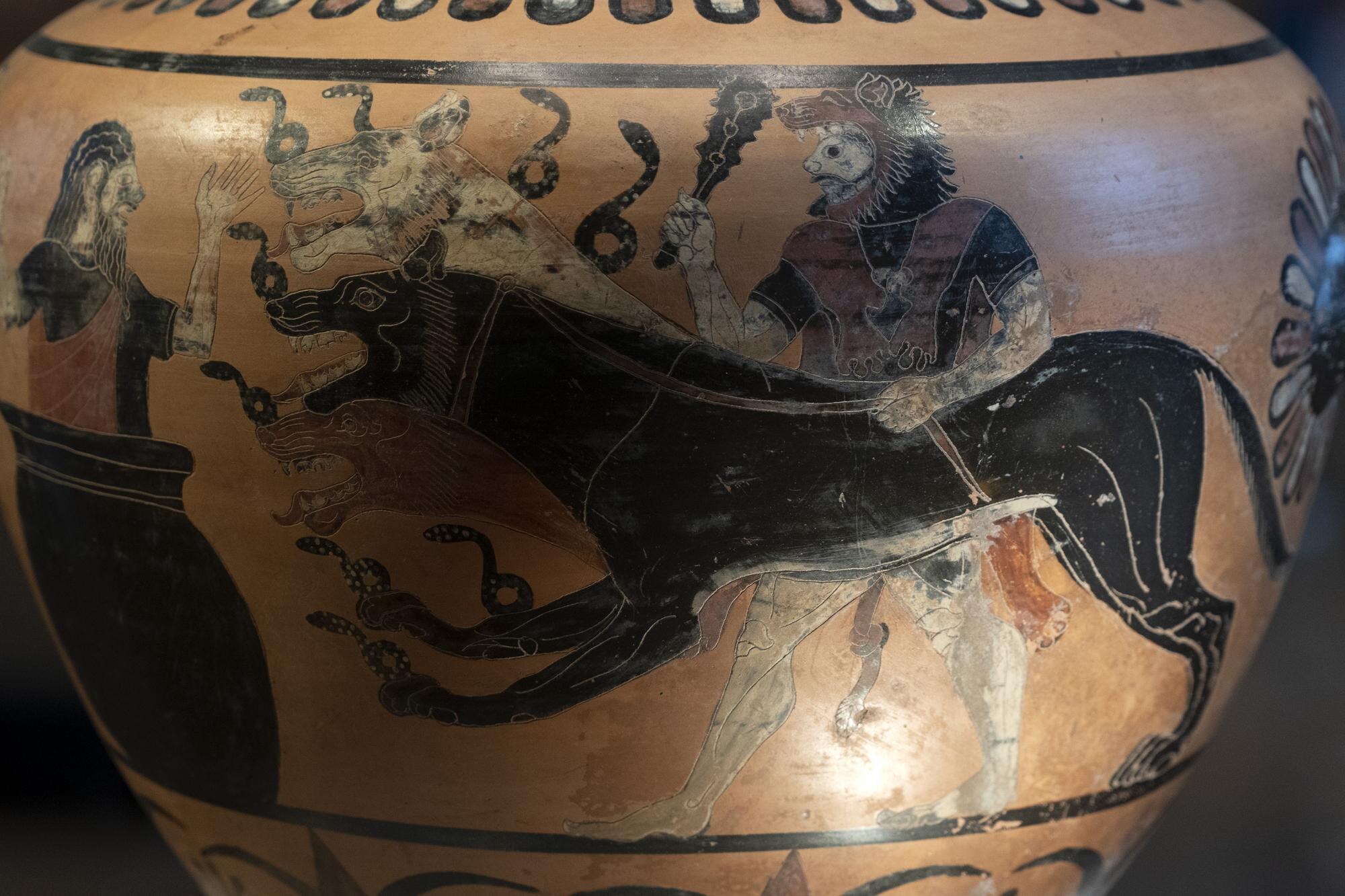
In Greek mythology, the Hydra was a many-headed water serpent that lived in the marshes of Lerna, near Argos in southern Greece. Killing it was the second labor Heracles performed for King Eurystheus. Each head he cut off grew back, often doubled, until his nephew Iolaus seared the stumps with fire. It came right after the Nemean lion, and it was the first labor Heracles could not finish alone. The sections below follow hydra mythology from the swamp and the monster's family through the fight itself, the stars and the poison that outlasted the beast.
In This Article
- Where the Name and the Swamp Come From
- The Hydra's Family and Hera's Grudge
- How Many Heads, and What Made Them Deadly
- How Heracles and Iolaus Won the Fight
- The Crab, Cancer, and the Constellation Hydra
- The Poison That Outlived the Hydra
- What Vase Painters and Later Retellings Changed
- Key Takeaways
- Frequently Asked Questions
- A Victory With Lasting Consequences
Where the Name and the Swamp Come From
Lerna was a district of springs and marshland on the Argolic Gulf, south of Argos, and its waters had a dark reputation. One pool, the Alcyonian Lake, was said to have no bottom at all. Pausanias reports that Dionysus went down through it to bring his mother Semele back from the underworld. He adds that the emperor Nero had long ropes lowered into it and never reached the floor.
The spring of Amymone fed the same marsh. It took its name from a daughter of Danaus, and the story went that Poseidon struck the ground with his trident and opened the spring for her. Apollodorus, whose Library is a mythological handbook usually dated to the first or second century CE, puts the Hydra's den on a rise beside this spring. He says the monster was raised in the Lernaean swamp and crept out onto the plain to kill cattle and ravage the countryside.
The Greek word hydra (ὕδρα) means "water snake" and shares a root with hydor, "water."
The Hydra's Family and Hera's Grudge
The earliest surviving account of the Lernaean Hydra is a few lines in Hesiod's Theogony, a poem usually dated to around 700 BCE. Its parents were Echidna, a half-woman, half-serpent nymph, and Typhon, the storm giant who challenged Zeus. Its brothers were Orthus, the two-headed hound of Geryon, and Cerberus, who guards the underworld. Heracles would face both of them in later labors.
The family runs further. Hesiod's next lines introduce the fire-breathing Chimera, and the Greek leaves it unclear whether her mother was Echidna or the Hydra itself. The same brood also produces the Nemean lion. When Heracles reached Lerna, he had just killed one of the clan and walked into the den of another.
That was no accident. Hesiod says Hera raised the Hydra because she was angry with Heracles, raising the monster as a weapon against him. Hesiod also says Heracles killed it with Iolaus and through the plans of Athena. Even in this oldest version, the hero does not win alone. What Hesiod leaves out is the head count and the regrowth.
How Many Heads, and What Made Them Deadly
No single picture of the Hydra monster ever became standard, and the head count shows this most clearly. Apollodorus gives it nine heads. Eight are mortal. The ninth, in the middle, cannot die. Other ancient writers and poets raised the number much higher, and some imagined dozens or even a hundred.
Pausanias, who toured Greece in the second century CE, went the other way. In his description of Lerna he says he believes the beast had only one head. To him it was a water snake larger than any other, with venom no remedy could cure. He blames the earlier epic poet Peisander of Camirus for giving it many heads to make it more frightening.
The powers vary as much as the heads. In Apollodorus, each head clubbed off is replaced by two. The later Latin handbook attributed to Hyginus claims that even its breath could kill a passerby. Venom is one of its recurring powers. Regrowth, poison and an unkillable central head appear together in Apollodorus' Library 2.5.2.
How Heracles and Iolaus Won the Fight
Apollodorus gives the fullest step-by-step account. Heracles drove to Lerna in a chariot with Iolaus at the reins. He found the den and shot flaming arrows into it to force the Hydra out. When it emerged, it coiled around one of his legs. He began smashing heads with his club, and every blow made the problem worse.
Then a giant crab came out of the marsh and bit Heracles on the foot. He killed it and called on Iolaus for help. Iolaus set fire to part of a nearby wood. As Heracles struck off each head, Iolaus used burning branches to sear the neck so nothing could grow back. Fire beat the doubling.
The ninth head remained, the immortal one. Heracles cut it off and buried it, still alive, beside the road from Lerna to Elaeus, and he set a heavy rock on top. Before leaving, he split open the body and dipped his arrows in its venom.
Iolaus' help cost Heracles. Eurystheus, the king of Tiryns who assigned the labors, refused to count the victory because Heracles had not worked alone. In Apollodorus, Eurystheus also rejected the cleaning of the Augean stables because Heracles had agreed to do it for a reward, although Augeas refused to pay. Those two refusals are why ten labors became twelve.
The Crab, Cancer, and the Constellation Hydra
The crab had a short part in the fight and a long afterlife. In the star myths collected under the names of Eratosthenes and Hyginus, Hera placed it in the sky to honor it for attacking her enemy. It became the constellation Cancer, Latin for "crab," one of the twelve constellations of the zodiac. Cancer's stars are faint. That suits a minor character crushed underfoot.
The constellation Hydra has more than one mythological association. It is the largest of the 88 modern constellations, a long, dim chain of stars winding across the southern sky. It is associated with the Lernaean beast; Hyginus' Astronomica 2.40 tells a different story involving Apollo's crow, a cup and a water snake.
In that story, Apollo sent his crow to fetch water in a cup. The crow lingered by a fig tree, waiting for the fruit to ripen, then flew back with a water snake in its claws and blamed the snake for the delay. Apollo saw through the lie. He set crow, cup and snake among the stars as Corvus, Crater and Hydra, with the snake placed so the crow can never drink from the cup.
The Poison That Outlived the Hydra
The arrows Heracles dipped in venom at Lerna carried the Hydra into later stories. Apollodorus says one of them accidentally wounded the wise centaur Chiron. The wound would not heal, and because Chiron was immortal, it could not kill him either. He eventually gave up his immortality to escape the pain.
The worst consequence came years later. The centaur Nessus offered to carry Deianira, Heracles' wife, across the river Evenus and then tried to assault her. Heracles shot him with one of the poisoned arrows. As he died, Nessus told Deianira to keep his blood as a charm that would preserve her husband's love. That blood now carried the Hydra's venom.
When Deianira feared Heracles had turned to another woman, she soaked a robe in the blood and sent it to him. The poison burned into his flesh. Sophocles' Women of Trachis ends with Heracles still alive, being carried toward his pyre on Mount Oeta. Apollodorus describes him mounting the pyre and being carried up to heaven in a cloud as it burns. The monster whose severed immortal head Heracles buried under a rock still had a hand in killing him.
What Vase Painters and Later Retellings Changed
Vase paintings give the fight a visible cast and setting. On a Caeretan water jar in the J. Paul Getty Museum (accession number 83.AE.346), dated to about 525 BCE, Heracles raises his club against the nine-headed Hydra while a crab pinches his heel. Iolaus attacks from the opposite side. The Getty's catalogue identifies the sickle in Iolaus' hand, not Heracles', and a small fire beneath him. Here the two fighters carry different weapons, and both take an active part in the battle.
That image was a public one. In Euripides' play Ion, the chorus admires temple sculpture at Delphi showing Heracles killing the Lernaean serpent with a golden sickle while a companion raises a torch. The torchbearer is Iolaus.
Roman writers called the hero Hercules, and Ovid's Metamorphoses has him boast about defeating the Hydra's doubling heads without mentioning Iolaus in that speech. The Latin name followed the story into European art. Antonio del Pollaiuolo painted Hercules and the Hydra around 1475.
Key Takeaways
- Hesiod's Theogony makes the Hydra a child of Typhon and Echidna, raised by Hera to destroy Heracles.
- Head counts run from Pausanias' single head to Apollodorus' nine to later writers' hundred.
- Iolaus' burning branches stopped the regrowth, and the immortal head went under a rock beside the road to Elaeus.
- Eurystheus refused to count the labor because Heracles had help.
- Arrows dipped in the venom wounded Chiron, killed Nessus and, through Nessus' blood, killed Heracles.
- The crab became Cancer. The constellation Hydra is associated both with the Lernaean monster and with a separate story about Apollo's crow.
Frequently Asked Questions
What powers did the Hydra have?
The Hydra's main power was regeneration. In Apollodorus' account, two heads grew back for every one destroyed, and the middle head could not die at all. Its venom was deadly enough to poison arrows and, later, the blood of Nessus.
Which Greek hero killed the Hydra?
Heracles killed the Hydra, with crucial help from his nephew Iolaus, who burned the severed necks. The Romans called the same hero Hercules.
What is the most famous Hydra?
The most famous is the Lernaean Hydra, the water serpent of Lerna that Heracles fought in his second labor. The constellation Hydra is associated with this monster, but Hyginus also tells a separate star myth about Apollo's crow and a water snake.
What is a hydra in mythology?
The Hydra Greek mythology describes is a single named monster, a many-headed water snake born to Typhon and Echidna. It is not a species.
Why did Eurystheus refuse to count the victory as a completed labor?
Eurystheus ruled that Heracles had not completed the task on his own, because Iolaus helped him. This refusal, along with the rejected Augean stables labor, is why the original ten labors became twelve.
A Victory With Lasting Consequences
The Hydra's defeat was not the end of its danger. Heracles found a way to stop the heads from returning, then carried the monster's poison into the rest of his life. The victory at Lerna and the suffering that followed belong to the same story.