
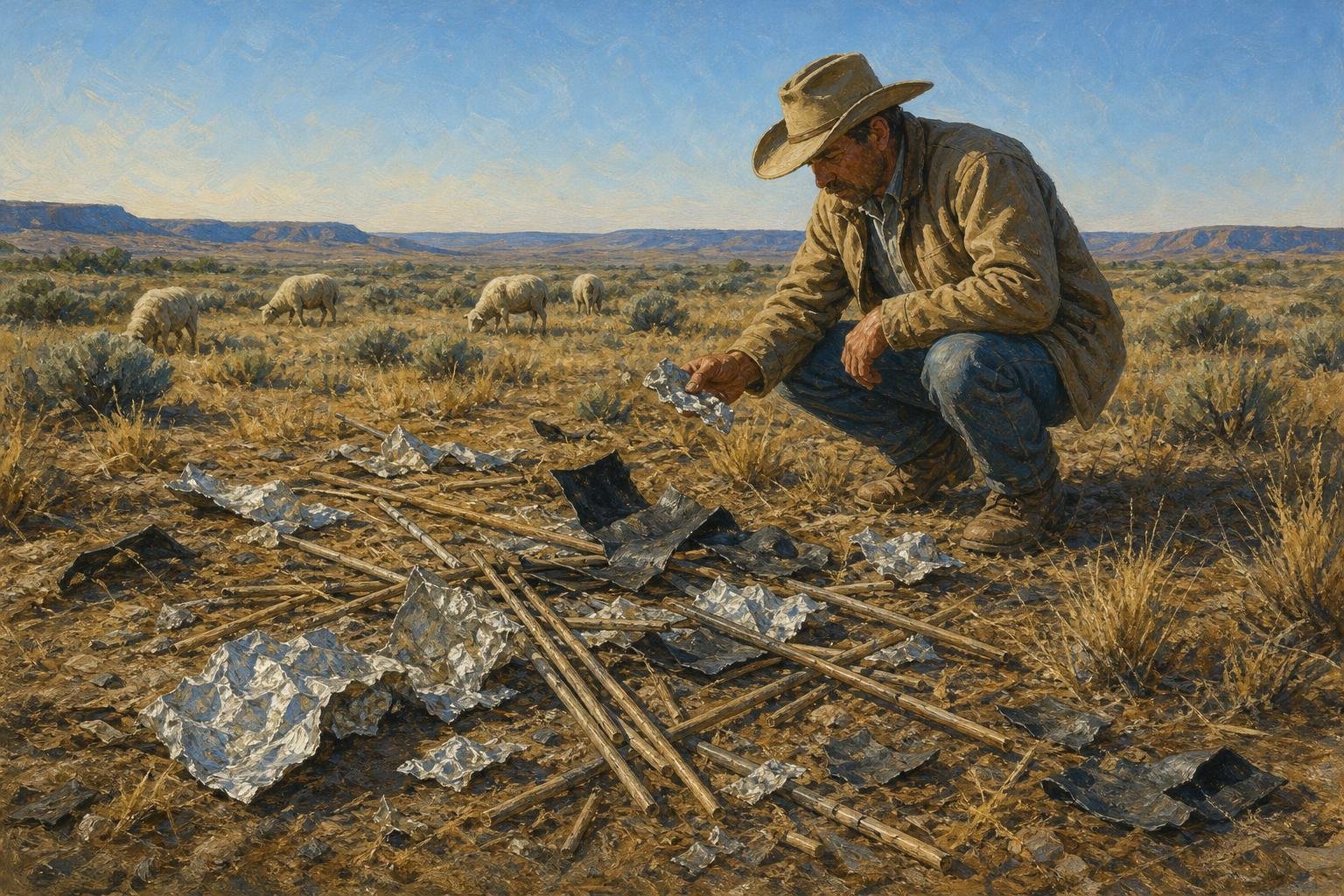
The Roswell UFO crash started in the summer of 1947 as a field of scattered debris on a New Mexico sheep ranch. The Army announced it had recovered a "flying disc," then said within a day that it was a weather balloon. More than 30 years later, Jesse Marcel's recollections revived claims of extraterrestrial debris. Authors combined his account with separate stories about crashed spacecraft and bodies to build the familiar legend.
The legend grew in layers. Each section below takes one layer and asks what it added and when it arrived.
In This Article
- What a Rancher Found in 1947
- The Flying Disc Announcement and the Reversal
- How Roswell Came Back in 1978 and 1980
- Alien Bodies and the Autopsy Film
- What the Air Force Investigations Found
- Where It Happened, and How Area 51 Differs
- Other Alleged UFO Crashes
- Key Takeaways
- Frequently Asked Questions
- How Roswell Became an Alien-Crash Legend
What a Rancher Found in 1947
W. W. "Mac" Brazel was working a sheep ranch near Corona, roughly 75 miles northwest of Roswell, when he came across the wreckage. It was spread over the pasture: strips of rubber, foil, tough paper and light wooden sticks. Contemporary reporting described those materials, but also quoted Brazel saying the wreckage did not resemble weather balloons he had previously found.
Brazel took some of it into town to Sheriff George Wilcox. Wilcox called Roswell Army Air Field, and the base sent its intelligence officer, Major Jesse Marcel, with counterintelligence agent Sheridan Cavitt.
The two men walked the field and loaded what they could carry. According to the Marcels' later accounts, Marcel stopped at home before returning to base and showed debris to his wife and his 10-year-old son. The home visit belongs to those later recollections, not the contemporary reporting.
The Flying Disc Announcement and the Reversal
That debris reached the press fast. On July 8, 1947, public information officer Walter Haut issued a statement saying the base had recovered a "flying disc." The Roswell Daily Record ran it under the headline "RAAF Captures Flying Saucer on Ranch in Roswell Region."
The country was primed for it. Two weeks earlier, on June 24, pilot Kenneth Arnold had reported nine fast objects near Mount Rainier, and "flying saucer" reports had spread nationwide since.
The material went on to Eighth Air Force headquarters in Fort Worth. There Brigadier General Roger Ramey looked at it and called it a weather balloon and a radar reflector. Photographers were called in, and Marcel crouched for the camera holding torn foil and sticks from a balloon radar reflector.
How Roswell Came Back in 1978 and 1980
After those photographs, Roswell went quiet for three decades. Then in 1978 UFO researcher Stanton Friedman tracked down the retired Marcel.
In later recollections, Marcel described unusual material and small beams with markings like hieroglyphics. He disputed the balloon explanation. The man in the Fort Worth photo was now saying the photo didn't tell the truth.
Those recollections became the foundation of the Roswell alien crash story. In 1980, Charles Berlitz and William Moore built them into The Roswell Incident, gathering memories more than 30 years after the fact. Its spacecraft narrative combined Marcel's debris recollections with separate crash-and-body stories, most of them secondhand. No 1947 document backed it.
Alien Bodies and the Autopsy Film
Marcel had described material, not bodies. A separate body story appeared in The Roswell Incident, attributed to civilian engineer Grady "Barney" Barnett and relayed by Vern and Jean Maltais. They told researchers that Barnett had described a crashed disc and bodies in western New Mexico. This was a secondhand account, not Marcel's testimony or a claim in the 1947 reporting. By the 1990s the Roswell alien crash meant a craft with a crew.
In 1995 that crew appeared on screen. A grainy black-and-white film showed a pale figure lying on a table, with a swollen belly, an oversized head and six fingers on each hand. Figures in white protective suits cut it open and lifted out organs. Fox broadcast it that August as "Alien Autopsy: Fact or Fiction?"
In 2006, promoter Ray Santilli admitted it was a staged reconstruction. He said he'd recreated original footage that had deteriorated. Sculptor John Humphreys had built the body as a dummy filled with sheep brains and chicken entrails. No original film has ever been produced, and the tape is treated as a hoax.
What the Air Force Investigations Found
The autopsy film arrived just as Washington was taking another look. A 1995 General Accounting Office inquiry found that some of the base's administrative records had been destroyed, but the disposition form did not identify who destroyed them, when, or under what authority.
The Air Force's 1994 report named the likely source of the debris: Project Mogul. Its classified balloon trains, launched from Alamogordo, New Mexico, carried equipment meant to detect Soviet nuclear tests. The Air Force report cited balloon-project personnel who recalled radar reflectors reinforced with patterned tape. The Roswell Daily Record's July 9, 1947, account of Brazel's discovery described "tape with flowers printed upon it." That offers a possible explanation for the later descriptions of hieroglyphics, not proof of what any witness remembered.
The bodies took a second report. Published in 1997 as "The Roswell Report: Case Closed," it linked some accounts to the 1950s, when the Air Force dropped life-size dummies from high-altitude balloons over New Mexico to test parachutes. Crews drove out to collect them where they landed. Its explanation also included a fatal 1956 aircraft accident and a 1959 balloon accident.
In March 2024 a Pentagon office set up to examine unidentified objects reported that it had found no evidence that the government ever recovered extraterrestrial technology, at Roswell or anywhere else.
Where It Happened, and How Area 51 Differs
The 1947 debris recovery was reported on the Foster Ranch near Corona. Archaeologist Bill Doleman’s report places the site investigated in 2002 on federal Bureau of Land Management land within the former ranch, while acknowledging disagreement over the debris field’s exact location. BLM describes its Alleged UFO Skip Site as a place where some people believe a crash occurred, not a confirmed recovery field. The later accounts moved things around. The Roswell Incident included a story placing a craft on the Plains of San Agustin, far to the west, and other witnesses named spots closer to Roswell. So there's no single agreed Roswell crash site, only the one field the 1947 record names.
The town took the legend anyway. Roswell's International UFO Museum and Research Center opened in 1992, and alien imagery is now part of the place's identity.
Area 51 is a separate story. It's a Nevada facility, set up in 1955 to test the U-2 spy plane, eight years after Brazel's discovery. No document supports the claim that Roswell material ever went there.
Other Alleged UFO Crashes
Roswell has an ancestor 50 years older. In April 1897, during a wave of "airship" sightings across the United States, the Dallas Morning News printed a dispatch from Aurora, Texas. It said an airship had struck the windmill on Judge J. S. Proctor's farm and exploded.
The story added a pilot. According to the dispatch, the remains found in the wreckage were "not an inhabitant of this world," and the townspeople buried him in the local cemetery. Papers covering the airship wave were full of that kind of invention, and the Aurora story is widely regarded as a hoax.
The two legends share claims of wreckage and nonhuman occupants; the burial belongs to the Aurora account. It shows that the idea of an alien UFO crash was in American newspapers before anyone flew a plane.
Key Takeaways
- The only physical material on record is what Marcel and Cavitt collected near Corona: rubber, foil, paper and sticks.
- The "flying disc" headline lasted about a day before Ramey's balloon explanation and the Fort Worth photographs.
- The spacecraft version starts with Marcel's 1978 interview with Friedman, 31 years after the recovery.
- Flower-patterned reflector tape offers a possible explanation for the later "hieroglyphics" descriptions.
Frequently Asked Questions
When did the Roswell UFO crash happen?
The debris was found in the summer of 1947, and the Army announced the "flying disc" on July 8 that year. No date for a spacecraft crash has been established, because no spacecraft has been shown to exist.
What is the most famous UFO incident?
Roswell is the most famous alleged UFO crash in the world. Its reputation owes most to the 1980 book The Roswell Incident and the 1995 autopsy film that followed it.
When was the first UFO crash?
No crash has been verified as involving an extraterrestrial spacecraft. The 1897 Aurora, Texas, airship story is one of the earliest well-known claims, and it's generally treated as a hoax.
Was the Roswell incident real?
The debris recovery was real, but the spacecraft was not shown to be. The Air Force traced the material to a Project Mogul balloon train. No verified physical evidence of an alien craft has emerged.
Have any UFOs actually crashed?
None has been shown to be extraterrestrial. The December 1965 Kecksburg, Pennsylvania, reports coincided with a widely observed meteor. At Shag Harbour, Nova Scotia, in October 1967, searchers found no wreckage after witnesses saw lights go into the water.
Where exactly did the Roswell UFO crash?
The documented debris lay on a ranch near Corona, about 75 miles northwest of Roswell. Later witnesses proposed other locations, so any exact spacecraft crash site is unproven.
How Roswell Became an Alien-Crash Legend
The Roswell crash comes down to two things that happened 31 years apart. In 1947 there was a field of balloon debris, most likely from Project Mogul, photographed in Fort Worth within days. In 1978 a retired officer remembered it differently. Flower-printed tape was described in July 1947 and resembles the markings recalled later. Bodies entered the 1980 book through a separate secondhand story about another alleged crash.