
Thunderbird mythology describes a powerful sky being whose wingbeats make thunder and whose eyes flash lightning. Its stories belong to distinct Indigenous nations, each with its own accounts and rules for telling them.
This article follows those differences through Ojibwe waters, Northwest Coast traditions and Lakota accounts, then considers art and sacred obligations.
In This Article
- How Thunderbird Makes Storms
- Thunderbirds and Underwater Beings in Ojibwe Tradition
- Thunderbird and Whale on the Northwest Coast
- The Lakota Thunder Beings
- Heyoka and Sacred Contrariness
- Black Elk and John Fire Lame Deer as Separate Voices
- Thunderbird in Art and Hereditary Crests
- Key Takeaways
- Frequently Asked Questions
- Sacred Power in Cultural Context
How Thunderbird Makes Storms
In many accounts, a thunderstorm is Thunderbird’s body at work: wings beat thunder, and eyes flash lightning. Some nations describe a bird large enough to darken the sky; others describe powers whose shape is harder to fix. Those differences matter.
Thunderbirds and Underwater Beings in Ojibwe Tradition
Ojibwe thunderbirds, called animikiig, belong to the upper world. They oppose water beings including Mishipeshu, the horned underwater panther associated with Lake Superior.
Storms express that continuing struggle. At Agawa Rock in Ontario, a red-ochre image of Mishipeshu appears on a cliff above the lake.
Thunderbird and Whale on the Northwest Coast
Some Northwest Coast accounts describe Thunderbird seizing a whale in its talons and carrying it toward the mountains, thunder sounding with each wingbeat.
In the Quileute tribal newsletter The Talking Raven, Jay Powell describes accounts of Thunderbird catching a whale at sea and carrying it toward its home at Blue Glacier. In some tellings, the whale struggles free and falls; its thrashing flattens trees, explaining the origin of some prairie areas. The encounter connects sea, mountain and open ground through the actions of the two beings.
The Lakota Thunder Beings
The Lakota thunder powers are the Wakinyan, usually translated as thunder beings. They belong to the West, where storms approach.
Their power is dangerous and sacred: lightning can kill, while the accompanying rain sustains the grass and the lives dependent on it.
Heyoka and Sacred Contrariness
In Lakota tradition, dreaming of the Wakinyan can oblige a person to become a Heyoka, a sacred contrary. A Heyoka might say yes for no or complain of cold in summer.
Such reversals provoke laughter, opening people to sacred power. The role carries obligations; it is not chosen for amusement.
Black Elk and John Fire Lame Deer as Separate Voices
In Black Elk Speaks, first published by William Morrow & Company in 1932, Black Elk’s childhood vision is conveyed through John G. Neihardt: the West’s powers gave him water associated with life and a bow associated with destruction.
John Fire Lame Deer collaborated with Richard Erdoes on Lame Deer, Seeker of Visions (1972). The National Park Service identifies Lame Deer himself as a Heyoka. These are separate testimonies from different generations.
Thunderbird in Art and Hereditary Crests
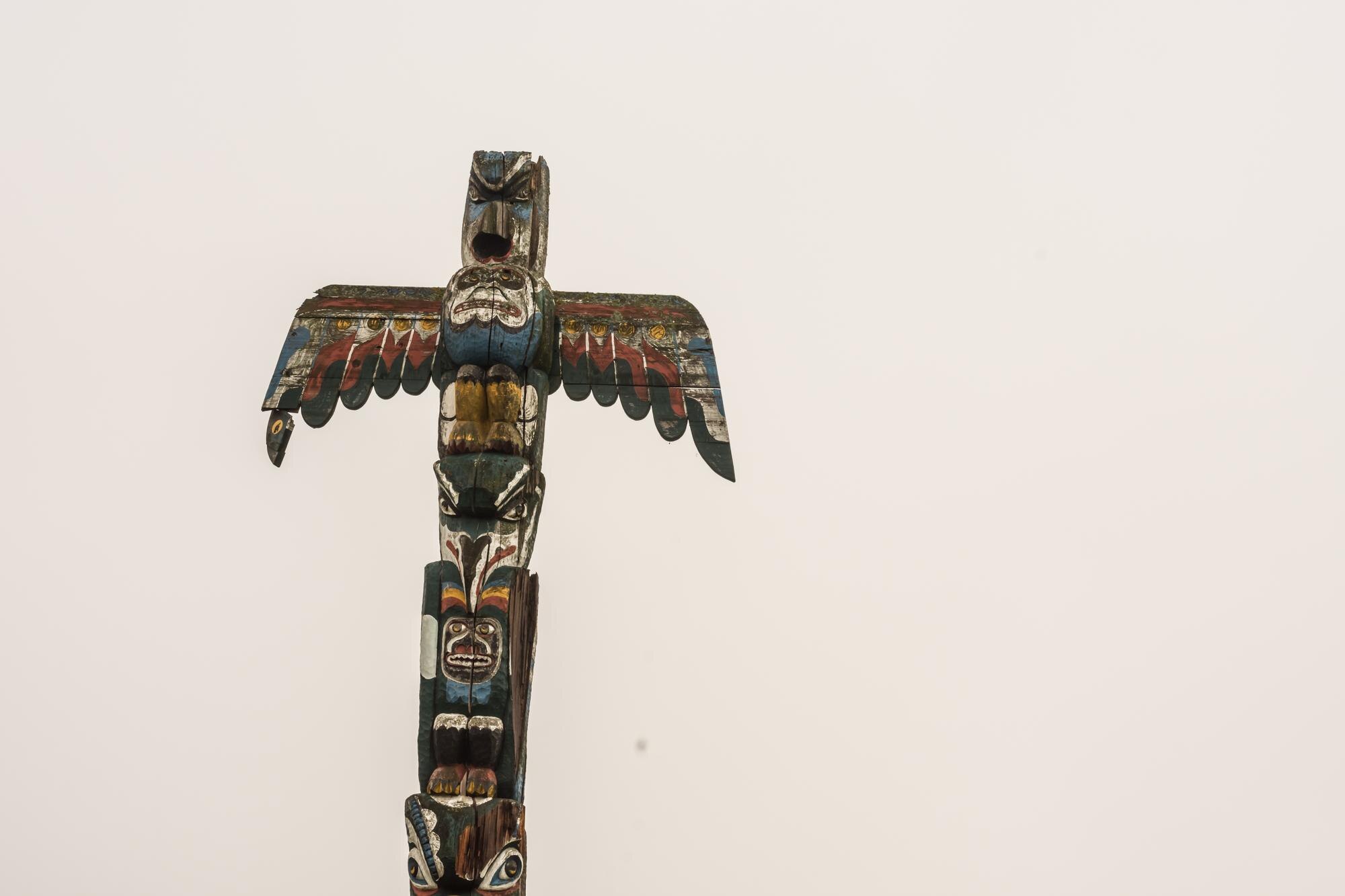
Northwest Coast carvers depict Thunderbird on cedar poles, masks and house fronts, often with spread wings and a hooked beak.
Among Kwakwaka'wakw peoples, Thunderbird also appears in hereditary crests and ceremonial masks. Displaying a crest expresses inherited family rights, not simply a choice of decoration.
Key Takeaways
- Thunderbird traditions belong to distinct Indigenous cultures.
- Storm power connects these accounts without making them interchangeable.
- Opposition to Mishipeshu belongs to particular traditions.
- Heyoka obligations connect Lakota thunder dreams with sacred contrariness.
- Black Elk and John Fire Lame Deer offer separate Lakota testimonies.
Frequently Asked Questions
Is the Thunderbird good or evil?
Neither label fits neatly. Its power can be deadly, while Ojibwe accounts describe thunderbirds opposing dangerous underwater beings.
Is Thunderbird a cryptid?
No. Thunderbird is a sacred being in specific Indigenous traditions. Cryptozoology’s use of the name for reported giant birds is a modern borrowing, not the same tradition.
What is the spiritual meaning of a Thunderbird?
Meaning depends on the nation. Lakota accounts connect thunder beings with sacred obligations; Northwest Coast hereditary crests connect Thunderbird with family lineage.
Are the Thunderbird and the phoenix the same thing?
No. The phoenix belongs to Old World traditions. Thunderbird belongs to Indigenous North American traditions and is associated with storms.
Sacred Power in Cultural Context
Thunderbird’s storm power takes different forms across these traditions: opposition to underwater beings in Ojibwe accounts, encounters with Whale in Quileute stories, and sacred obligations associated with Lakota thunder dreams. Together, these accounts place thunder and lightning within relationships among people, other beings and the land.