
Japanese gods include Shinto kami and deities worshipped through Japan’s Buddhist and folk traditions. Kami encompass mythic deities, deified people and sacred presences in mountains, rocks and waterfalls. Shinto tradition calls them yaoyorozu no kami, the “eight million kami,” meaning countless.
These ten entries follow roughly the order of their stories, from creation to later traditions of farming, scholarship and trade. Each connects the kami’s story with its worship. The oldest accounts come from the Kojiki, compiled in 712, and the Nihon Shoki, completed in 720.
In This Article
- 1. Izanagi and Izanami, the Creator Couple
- 2. Amaterasu, the Sun Goddess
- 3. Tsukuyomi, the Moon God
- 4. Susanoo, the Storm God
- 5. Ōkuninushi, Ruler of the Earthly Realm
- 6. Inari, Kami of Rice and Prosperity
- 7. Hachiman, Protector of Warriors
- 8. Raijin and Fujin, Thunder and Wind
- 9. Tenjin, Sugawara no Michizane as Kami
- 10. The Seven Lucky Gods
- Key Takeaways
- Frequently Asked Questions
- Understanding Kami Beyond a Fixed Pantheon
1. Izanagi and Izanami, the Creator Couple
In the Kojiki, Izanagi and Izanami stir the sea with a jeweled spear. Drops from its tip form Onogoro, where they marry before producing Japan’s islands and many kami. Izanagi Jingū on Awaji is traditionally associated with Izanagi’s final days.
Creation brings death when Izanami gives birth to Kagutsuchi, the fire kami, and dies from her burns. Izanagi follows her into Yomi, the land of the dead. Ignoring her warning not to look, he discovers her decaying body and flees.
He blocks the passage with a boulder. Izanami vows to kill 1,000 people daily; he promises 1,500 births.
Izanagi then washes away Yomi’s pollution. This misogi underlies Shinto purification, including shrine hand-rinsing. Amaterasu emerges from his left eye, Tsukuyomi from his right, and Susanoo from his nose. The Nihon Shoki’s main account instead makes them children born to the couple together.
2. Amaterasu, the Sun Goddess
Amaterasu rules the Plain of High Heaven. Her grandson Ninigi descends to earth with a mirror, jewel and sword; tradition makes his great-grandson Jimmu the first emperor. Her mirror, Yata no Kagami, is said to remain at Ise Jingū’s Inner Shrine in Mie Prefecture.
Ise’s last rebuilding was in 2013; the next is scheduled for 2033.
The mirror also figures in her cave story. After Susanoo wrecks her fields and throws a flayed horse into her weaving hall, Amaterasu retreats into Ama-no-Iwato, leaving the world dark.
Outside, Ame-no-Uzume dances until the assembled kami laugh. Amaterasu peers out, sees her reflection in a mirror, and is pulled free by Ame-no-Tajikarao. A sacred rope prevents her return.
3. Tsukuyomi, the Moon God
Tsukuyomi is honored at Tsukiyomi-no-miya in the Ise shrine network. His principal myth explains his separation from Amaterasu.
In the Nihon Shoki, the food kami Ukemochi serves him food produced from her mouth. Disgusted, he kills her; crops and useful animals emerge from her body.
Amaterasu refuses to face him again. The story explains why sun and moon live apart, separating day from night.
4. Susanoo, the Storm God
Susanoo begins as a disruptive sibling, mourning his mother and offending Amaterasu until he is expelled from heaven. The Kojiki also credits him with killing the food goddess Ōgetsuhime, a parallel to Tsukuyomi’s story.
In Izumo, exile turns him into a hero. He meets a family threatened by Yamata no Orochi, a serpent with eight heads and tails. He sets out eight vats of strong sake, waits until the serpent is drunk, and kills it.
Inside a tail he finds Kusanagi, the sword later carried to earth by Ninigi. Atsuta Jingū in Nagoya enshrines it. Susanoo marries the surviving daughter, Kushinadahime; tradition calls his verse about their palace Japan’s first poem.
At Kyoto’s Yasaka Shrine, Susanoo was identified with the Buddhist-associated plague deity Gozu Tennō. The Gion Matsuri traces its origins to epidemic rites held in 869.
5. Ōkuninushi, Ruler of the Earthly Realm
Ōkuninushi develops the earthly land while Amaterasu’s line rules heaven. The Kojiki makes him Susanoo’s sixth-generation descendant; the Nihon Shoki’s main text calls him Susanoo’s son.
His early kindness appears in the White Hare of Inaba story: he heals the injured animal with fresh water and cattail pollen. After surviving his brothers’ attacks and trials in Susanoo’s realm, he escapes with Suseribime, Susanoo’s daughter. With Sukunabikona, he shapes and settles the country.
Heaven then demands that country. Backed by the warrior Takemikazuchi, its envoys secure Ōkuninushi’s surrender on condition that a great palace be built for him. This transfer clears the way for Ninigi’s descent.
The palace is understood as Izumo Taisha in Shimane Prefecture. There, kami are said to gather during the tenth lunar month to decide human bonds, including marriages. That association makes Ōkuninushi a focus of matchmaking prayers.
6. Inari, Kami of Rice and Prosperity
Inari’s worship grew from rice farming into commerce as merchants adopted the harvest kami. Businesses still maintain Inari shrines on their grounds and rooftops.
Fushimi Inari Taisha in Kyoto dates its foundation to 711. Its vermilion torii climb Mount Inari, each donated gate bearing its donor’s name on the back. Many donors are businesses.
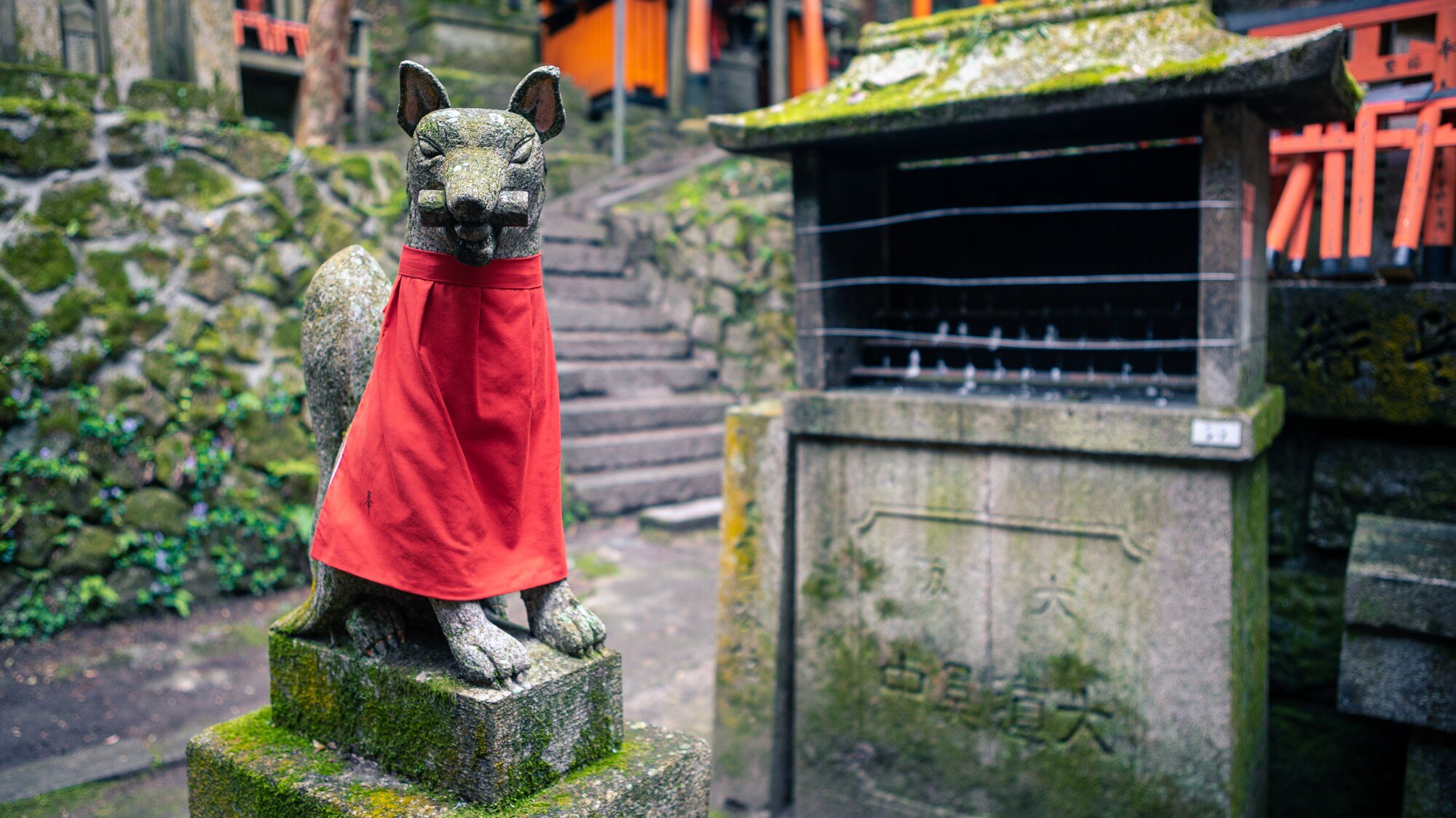
The fox statues are Inari’s messengers, not the deity. They often hold granary keys, jewels or scrolls. Their supposed fondness for fried tofu explains the names kitsune udon, noodles topped with tofu, and inari-zushi, rice wrapped in it.
Inari may appear as male, female or neither. Worship also crosses religious boundaries: Toyokawa Inari in Aichi Prefecture is a Sōtō Zen temple, where the deity is honored as Dakiniten.
7. Hachiman, Protector of Warriors
Hachiman does not appear under that name in the Kojiki. By the Heian period he was identified with the deified Emperor Ōjin. His head shrine is Usa Jingū in Ōita Prefecture.
His national importance grew during construction of Tōdai-ji’s Great Buddha. An oracle from Usa promised Hachiman’s support, and in 749 the kami was carried to Nara. The court later granted him the Buddhist title Hachiman Daibosatsu, “Great Bodhisattva Hachiman.”
This protector of the state became a warrior patron. Iwashimizu Hachimangū, founded south of Kyoto in 859 with its sanctuary completed in 860, guarded the capital. The Minamoto clan adopted Hachiman, and Minamoto no Yoritomo made Tsurugaoka Hachimangū the spiritual center of his Kamakura shogunate.
8. Raijin and Fujin, Thunder and Wind
Thunder kami appear in the Kojiki, but the familiar Raijin and Fujin owe much to Buddhist art. Raijin beats a ring of drums; Fujin carries a wind bag. Their muscular bodies and wild hair resemble oni more than courtly deities.
At Kyoto’s Sanjūsangen-dō, 13th-century statues of the pair guard a hall containing 1,001 Kannon images. Tawaraya Sōtatsu’s folding screens, owned by Kennin-ji, are a National Treasure. In Tokyo, the pair flank Sensō-ji’s Kaminarimon gate.
Raijin’s storms threaten homes and crops, yet bring essential rain. Children are traditionally warned to cover their belly buttons during thunderstorms lest he take them.
9. Tenjin, Sugawara no Michizane as Kami
Sugawara no Michizane (845–903) was a scholar, poet and court minister. Political rivals secured his demotion and exile to Dazaifu in 901.
After his death, deaths and unrest were blamed on his angry spirit. The court restored his office and rank in 923, following Crown Prince Yasuakira’s death. Lightning struck the imperial palace in 930, deepening fears of his spirit. Worship of him as Tenjin developed; Kitano Tenmangū was founded in Kyoto in 947. Dazaifu Tenmangū stands over his grave.
Fear gradually became devotion to learning. Students visit Tenmangū shrines before exams, writing wishes on wooden ema plaques. Ox statues serve as his messengers, their heads rubbed by visitors seeking wisdom.
Plum blossoms recall his attachment to a Kyoto garden tree. Legend says it uprooted itself and flew to join him in exile.
10. The Seven Lucky Gods
The Shichifukujin, or Seven Lucky Gods, appear on charms, shop signs and New Year decorations, often aboard their treasure ship, the takarabune.
Ebisu, patron of fishing and trade, carries a rod and sea bream. Usually considered the only native Japanese member, he is sometimes identified with Hiruko or Ōkuninushi’s son Kotoshironushi.
Daikokuten sits on rice bales holding a mallet. Derived from India’s Mahākāla, he merged with Ōkuninushi through an overlap in their written names. The armored Bishamonten carries a spear and pagoda; he is the Buddhist Vaiśravaṇa, guardian of the north.
Benzaiten plays a biwa lute. Derived from Saraswati, she retains associations with music and water, reflected in her waterside shrines at Enoshima, Itsukushima and Chikubushima.
The remaining figures come from China. Fukurokuju’s elongated head identifies the god of happiness, wealth and longevity. Jurōjin also represents longevity, carrying a staff and scroll, often beside a deer. The laughing, sack-carrying Hotei derives from the Buddhist monk Budai.
The group’s familiar membership settled during the Edo period. A ship picture beneath your pillow on New Year’s night promises a lucky first dream. January Shichifukujin meguri walks connect sites honoring each member, including a route through Tokyo’s Yanaka.
Their mixed origins reflect shinbutsu shūgō, the long intertwining of kami worship and Buddhism.
Key Takeaways
- Kami extend beyond personified deities to sacred places and deified humans.
- Amaterasu’s national importance does not establish a universal hierarchy.
- Creation stories also explain death and purification.
- Inari’s business patrons and Tenjin’s students show how worship develops beyond myth.
- Figures such as Benzaiten demonstrate the influence of imported traditions.
Frequently Asked Questions
Who is the Japanese god of life?
No kami exclusively holds that title. The creator couple comes closest. The Kojiki also names Takamimusubi and Kamimusubi, whose names contain musubi, the power of growth and creation.
Is Raijin good or bad?
Neither label fully fits. His destructive weather and life-giving rain belong to the same power. His protective role at Kaminarimon also differs from the threatening figure in children’s thunderstorm warnings.
Who are the big three Japanese gods?
Usually Amaterasu, Tsukuyomi and Susanoo, the “three noble children.” Their domains are the sun, moon, and sea or storms. Their sibling relationship does not make them an exclusive ruling trio.
Who is the main god in Japan?
Amaterasu has particular national importance through Ise and the imperial family. Locally, a community’s own shrine kami may matter more. Even Amaterasu consults other kami rather than ruling alone.
Who is the strongest Japanese god?
The Kojiki and Nihon Shoki establish no strength ranking. Susanoo’s serpent-slaying and Takemikazuchi’s victory over Ōkuninushi’s son demonstrate different kinds of power, not positions in an official hierarchy.
What does kami mean beyond the English word “god”?
Kami can encompass extraordinary beings or presences that inspire awe. The 18th-century scholar Motoori Norinaga included people, animals, trees, seas and mountains. The word does not require a human-shaped deity with a myth.
Understanding Kami Beyond a Fixed Pantheon
These ten entries show why Japanese religion resists a closed roster of gods. Tenjin’s transformation from feared spirit to patron of learning reveals how a community’s relationship with a kami can change. The Seven Lucky Gods show that religious exchange can reshape worship too.
A useful approach is to ask who honors a kami, where they do so, and what they seek. Those questions explain why a shrine remains meaningful even when its deity has little mythology, and why a familiar story is only part of a kami’s identity.