
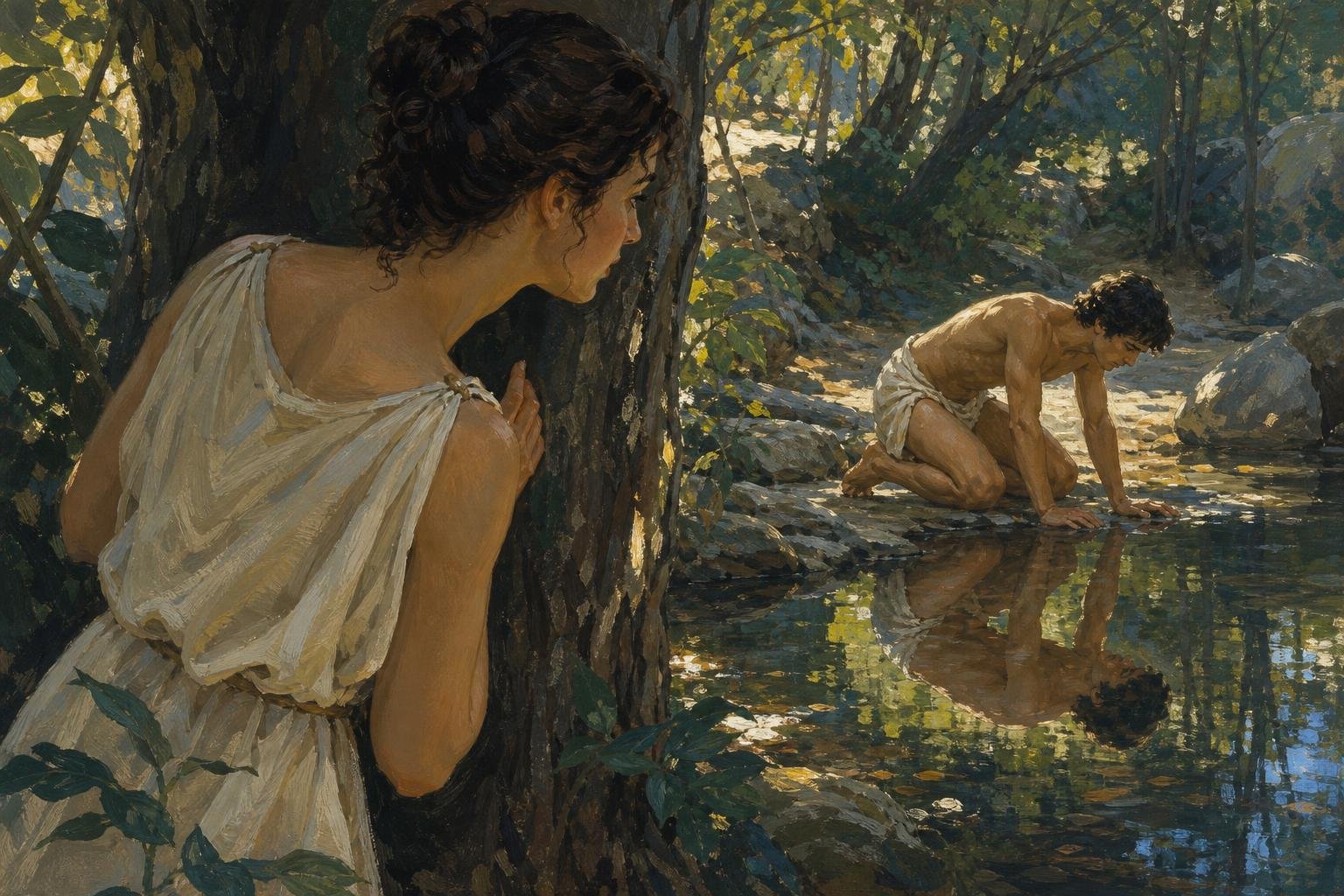
In Ovid's account, Echo is a mountain nymph who helped Zeus's lovers get away by keeping Hera talking in the woods. When Hera saw the trick, she cursed Echo so that she could never speak first and could only repeat the last words she heard. In the best-known version, told by the Roman poet Ovid, Echo then falls in love with the beautiful youth Narcissus. He rejects her, and she wastes away until only her voice is left. Longus's novel Daphnis and Chloe gives her a different death at the hands of the god Pan. Every part of the story comes back to one question: what Echo can still say.
In This Article
- Who Echo Was Before the Curse
- Why Hera Cursed Echo’s Speech
- How Echo Met Narcissus
- How Echo Faded Away
- Echo and Pan in Daphnis and Chloe
- Why the Versions Do Not Join Up
- Key Takeaways
- Frequently Asked Questions
- The Voice That Outlasted Echo
Who Echo Was Before the Curse
Ovid presents Echo as one of the nymphs, the female spirits of mountains, woods, springs and caves. Nymphs lived long lives, but they were not Olympians, and the stories treat Echo as someone who can suffer and die.
Ovid's Metamorphoses, a Latin poem finished around 8 CE, gives the fullest account. He calls her vocalis nymphe, a talkative nymph. When he introduces her watching Narcissus, she still has a body, but her speech is already restricted: she cannot speak first and can only repeat the final words she hears.
Ovid then looks back to explain how Hera imposed that restriction. Before the curse, Echo could choose her own words and hold the goddess in conversation. Her bodily existence and her freedom to speak are separate parts of the chronology: she loses free speech before she loses her body.
Why Hera Cursed Echo’s Speech
The trouble starts with Zeus, whom Ovid calls Jupiter. Zeus often went after nymphs in the mountains, and Hera (Ovid's Juno) came looking to catch him. Several times Echo met the goddess and held her with long, rambling conversation. Meanwhile the nymphs slipped away.
Hera worked it out. Her punishment matched the offense. The tongue that had fooled her would keep only a little power, and Echo's voice would have only the briefest use. From then on Echo could not stay silent when someone spoke. She could not speak first either. She could only send back the final words of what she heard.
Everything later in the Echo story depends on this rule. Echo can still feel, want and plan. She cannot say any of it in her own words. Anything she says has to be built from someone else's sentences.
How Echo Met Narcissus
Borrowed sentences become a torment once she falls in love. Narcissus was sixteen, the son of the river god Cephisus and the nymph Liriope. Young men and women alike wanted him, and he refused them all. Echo saw him while he was driving deer into hunting nets. She followed him through the woods. She could not call out.
Her chance came when Narcissus lost his companions and shouted, "Is anyone here?"
"Here!" Echo answered.
He called, "Come!" and she called the same word back. When he cried, "Let us meet here," she repeated it gladly, because the Latin word can also mean "let us come together." Then she ran out to throw her arms around his neck.
Narcissus pulled away. He told her to take her hands off him and said he would rather die than give himself to her. Echo could answer only with his last words: "I give myself to you." In this moment between Echo and Narcissus, the curse turns his refusal into her offer, spoken in his own sentence.
How Echo Faded Away
After that refusal, Echo hid in the woods and lived in lonely caves. Ovid says her love grew with the hurt. She could not sleep. She grew thin, and the moisture drained from her body. In the end only her voice and her bones remained, and the bones turned to stone. From then on, Ovid writes, she is seen on no mountain but heard on all of them.
The Echo and Narcissus story goes on past her. One of the youths Narcissus had scorned prayed that he too would love and never win what he loved. Nemesis granted the prayer, and Narcissus fell in love with his own reflection in a pool. Echo was still hurt, but she pitied him. When he cried "Alas," she cried "Alas" back. His last word to his reflection was "Farewell." She returned it as he died.
Echo and Pan in Daphnis and Chloe
Longus, a Greek novelist usually dated to the second century CE, tells a different version. In Book 3 of Daphnis and Chloe, the young herdsman Daphnis explains an echo to Chloe with this story.
In his account, Echo is the daughter of a nymph and a mortal father, and she inherits her father's mortality. Nymphs raised her and the Muses taught her music. She learned the pipe, the lyre and every kind of song. She stayed a virgin and avoided all males, mortal and divine.
Pan wanted her and could not have her. He also envied her music. So he drove the local shepherds and goatherds mad, and they tore her apart and scattered her limbs, which were still singing. Earth hid the pieces as a favor to the nymphs and kept their music.
Those buried limbs now copy every sound, even Pan's own pipe. When Pan hears his tune come back, he chases it over the mountains, looking for the pupil he cannot find.
Apuleius gives the pair a different scene in The Golden Ass 5.25: Pan holds Echo in his arms and teaches her to repeat songs.
Why the Versions Do Not Join Up
Hera and Narcissus never appear in Longus. Pan plays no part in Ovid. The two endings cannot both be true. Ovid's Echo is already stone and voice by the time Narcissus dies. Longus's Echo dies by violence while still whole.
These accounts of Echo offer alternative explanations for the familiar sound, not one life told in two installments.
Key Takeaways
- In Ovid, Echo is a mountain nymph, not an Olympian goddess.
- Hera's curse stops Echo from starting speech but lets her repeat others.
- Echo loves Narcissus, who pushes away her embrace.
- In Ovid, her body wastes away, her bones turn to stone, and her voice remains.
Frequently Asked Questions
Who did Echo fall in love with?
In Ovid's Metamorphoses, Echo fell in love with Narcissus, the son of the river god Cephisus. In Longus's version she loves no one, and Pan is the one who wants her.
Which goddess cursed Echo?
Hera cursed Echo. Ovid writes in Latin, so he calls the goddess Juno and her husband Jupiter.
Why did Hera punish Echo?
Hera punished Echo for keeping her busy with long conversations so the nymphs Zeus was chasing could escape. The curse targeted the very talk Echo had used to fool the goddess.
Did Echo cause Narcissus's punishment?
No. In Ovid's Metamorphoses, a rejected youth prays that Narcissus will love without winning his love. Nemesis grants the prayer; Echo does not ask for his punishment.
Is Echo's fate the same in every ancient account?
No. In Ovid's Metamorphoses, Echo wastes away after Narcissus rejects her: her bones become stone, and her voice remains. In Longus's Daphnis and Chloe, Pan drives herdsmen mad and they tear her apart. Earth hides her scattered limbs, preserving their music.
The Voice That Outlasted Echo
Later painters gave Echo visible form. Nicolas Poussin's Echo and Narcissus, dated about 1629 by the Louvre, shows her becoming rock behind Narcissus's outstretched body. John William Waterhouse's Echo and Narcissus (1903), in the Walker Art Gallery, shows her across the water from Narcissus, who is absorbed in his reflection.
Both versions of the myth take a sound everyone has heard and explain it with a rule about speech. Ovid's rule is narrow. Echo may answer but never begin, which is why the worst moment in his telling is a nymph offering herself to Narcissus in the words he used to refuse her. Longus's rule is wider: her scattered limbs copy any sound, Pan's pipe included.