
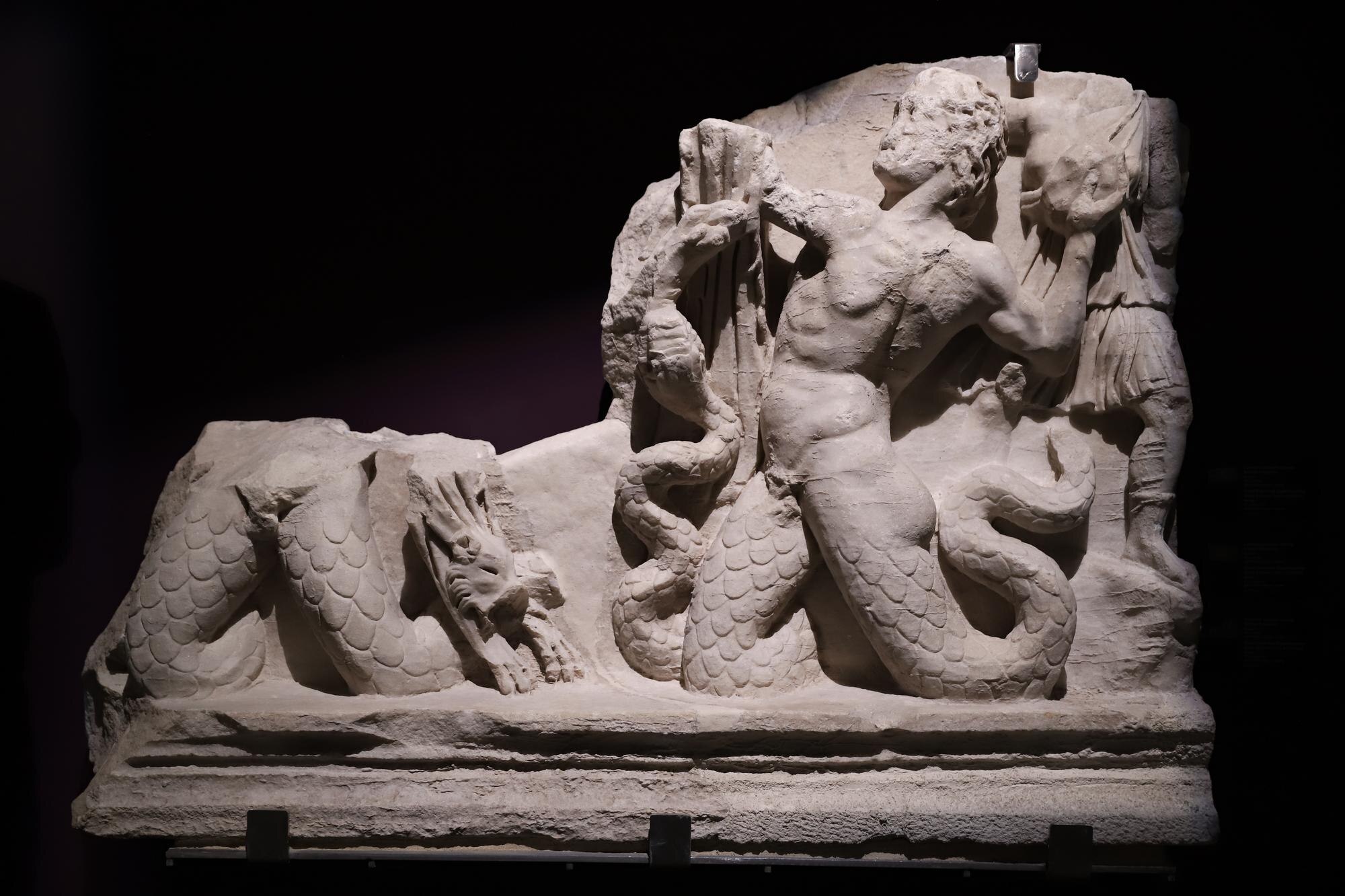
Echidna is the half-woman, half-serpent mother of some of Greek mythology’s most feared monsters. Through Echidna, mythology connects Cerberus and the Lernaean Hydra as offspring of her union with Typhon, bringing them into conflict with heroes such as Heracles. Her story reaches from a cave beneath the earth to the beasts her children become, with different accounts giving her different parents and endings.
In This Article
- Who Was Echidna?
- Who Were Her Parents?
- Why Is She Paired With Typhon?
- Which Monsters Belong to Her Family?
- Where Did She Live?
- Was Echidna Immortal, and Who Killed Her?
- Key Takeaways
- Frequently Asked Questions
- A Monster Lineage, Not One Version
Who Was Echidna?
The Echidna Greek mythology preserves has a beautiful woman’s upper body joined to an enormous serpent. Hesiod’s Theogony gives her fair cheeks and glancing eyes above a flesh-eating snake below. The two halves belong to one creature: the face does not soften the danger of the body beneath it.
That serpent half is huge and powerful, with a spotted skin in Hesiod’s description. Echidna is no woman merely carrying a snake or wearing its shape as a disguise. The snake is her flesh, and its appetite makes her a threat even before her children enter the story.
Her name means “she-viper.” Hesiod also calls her a nymph, a word that here offers no promise of gentleness. She is unmistakably a monster; her beauty makes that predatory body more unsettling, not less.
Who Were Her Parents?
One tradition makes Echidna the daughter of Phorcys and Ceto, ancient sea divinities whose family includes other extraordinary beings. That ancestry gives the serpent-woman roots in the sea’s monstrous generations. Another reading of Hesiod connects her birth to Chrysaor and Callirhoe, whose family appears just before hers in the poem.
The handbook attributed to Apollodorus gives her more elemental parents: Gaia and Tartarus. Gaia is Earth herself; Tartarus is the deep abyss beneath the earth, treated here as a parent capable of producing life. Their daughter brings together the solid ground and the terrible depth below it.
These are alternative ancestries, not four parents sharing one household. Hesiod leaves her parentage less certain than Apollodorus does, but both accounts place Echidna among beings older and stranger than the heroes who will confront her descendants.
Why Is She Paired With Typhon?
Typhon and Echidna are parents together in Hesiod’s account. Typhon is the immense, many-headed enemy of Zeus, an opponent whose scale belongs to battles over divine power. Echidna’s danger takes a different course: she bears creatures that occupy the places heroes must enter.
Those offspring do not form an army marching beside their parents. Cerberus guards the underworld, while the Hydra haunts Lerna. Their kinship joins widely separated dangers into one family without giving them a single shared adventure.
As the mother of monsters Greek heroes would later face, Echidna makes that family a recurring obstacle to heroic strength. Heracles meets it repeatedly: he fights the Hydra, confronts the Nemean Lion, and reaches even the underworld’s hound. The struggle with her brood cannot be settled by winning one battle.
Which Monsters Belong to Her Family?
Cerberus, Orthrus, and the Lernaean Hydra are Echidna’s children in Hesiod. Each makes a different kind of opponent. Cerberus bars the way through death’s domain; Orthrus, the two-headed hound, guards Geryon’s cattle. The Hydra is harder to finish than an ordinary serpent: in Apollodorus’s account, two heads grow where one is cut away.
The Chimera combines bodily impossibility with fire. Killed by Bellerophon, she has a lion’s front, a goat in the middle, and a serpent behind in Hesiod’s description. The Sphinx brings a different danger to Thebes: a riddle whose answer determines whether a person survives. The Nemean Lion resists the usual weapons with its impenetrable hide.
These beasts share a family, though their places within it differ. The table keeps those relationships visible alongside the dangers that made each creature memorable.
| Monster | Mythic role | Parentage in Hesiod’s Theogony | Parentage in Apollodorus’s Library | Relationship to Echidna |
|---|---|---|---|---|
| Orthrus | Two-headed guardian of Geryon’s cattle | Echidna and Typhon | Echidna and Typhon (2.5.10) | Direct son in both accounts |
| Cerberus | Hound guarding the realm of the dead | Echidna and Typhon | Echidna and Typhon (2.5.12) | Direct son in both accounts |
| Lernaean Hydra | Many-headed serpent fought by Heracles | Echidna and Typhon | Echidna and Typhon (2.5.2) | Direct daughter in both accounts |
| Chimera | Fire-breathing monster killed by Bellerophon | Usually read as a child of Echidna and Typhon | Echidna and Typhon (2.3.1) | Direct daughter in the standard genealogy |
| Sphinx | Riddle-setting monster of Thebes | Orthrus and a mother read as Chimera or Echidna | Echidna and Typhon (3.5.8) | Granddaughter or daughter, depending on the reading |
| Nemean Lion | Lion with an impenetrable hide fought by Heracles | Orthrus and a mother read as Chimera or Echidna | Typhon; no mother named (2.5.1) | Grandson or son in readings of Hesiod |
“Echidna mother of monsters” captures the reach of this family, including its later generations. In a common reading of Hesiod, the Chimera mates with Orthrus and bears the Sphinx and Nemean Lion. Echidna’s monstrous line thus continues through her children as well as beginning with them.
Where Did She Live?
Hesiod places Echidna in a cave beneath the earth at Arima, far from human beings and the immortal gods. Her home lies under a hollow rock. The distance matters: this is a dwelling set apart from both mortal society and divine company, where the serpent-nymph has her own place.
Arima belongs to ancient mythic geography. Ancient discussions associated it, or the Arimoi, with different regions, including parts of Anatolia. The cave’s role in Hesiod is clearer than its position: it gives Echidna a secluded home below the inhabited world.
That home is not identified as Tartarus. The abyss belongs to her ancestry in Apollodorus, and elsewhere to stories of divine punishment and confinement; it is not automatically the address of its daughter. Echidna occupies a cave, not a prison imposed on her by the gods.
Was Echidna Immortal, and Who Killed Her?
Hesiod calls Echidna immortal and ageless. In his account, age does not wear down the serpent-woman secluded beneath the earth. Apollodorus gives her a violent end instead.
Apollo’s dragon-slaying belongs to another story. In the Homeric Hymn to Apollo, he kills a female dragon near Delphi that has fostered Typhaon, Hera’s child in that poem. The hymn does not call the dragon Echidna. The Delphic creature is associated with Python in later discussions, and some retellings connect her with Echidna, but Apollo is not her named killer in Apollodorus.
That killer is Argus Panoptes. Echidna has been carrying off travelers, and the many-eyed Argus attacks when she cannot defend herself. He finds her asleep and kills her.
Key Takeaways
- Echidna’s beautiful human face belongs to a flesh-eating serpent’s body.
- Her family links threats encountered in otherwise separate heroic adventures.
- The table distinguishes direct children from possible later generations.
- Her isolated cave is a dwelling, not an established place of punishment.
- Her death at Argus’s hands belongs to a different account from Hesiod’s ageless Echidna.
Frequently Asked Questions
Who is the mother of monsters in Greek mythology?
Echidna is the figure commonly called the mother of monsters in Greek mythology. The title reflects her fearsome offspring, not a claim that she bore every Greek monster.
Does Hesiod explicitly identify Echidna’s parents?
No, Hesiod does not unambiguously name Echidna’s parents in her birth passage. Its wording has been read as pointing to Phorcys and Ceto or to Chrysaor and Callirhoe.
Is the Sphinx Echidna’s daughter in every ancient account?
No, the Sphinx can be Echidna’s daughter or granddaughter. The readings shown in the table allow another generation between them.
Where was Echidna’s cave believed to be?
Echidna’s cave was placed beneath the earth at Arima. Hesiod sets it apart from gods and humans, without giving a location that ancient interpreters unanimously recognized.
Is Echidna’s association with Python shared by all sources?
No, Echidna is not universally identified with the Delphic dragon associated with Python. The Homeric Hymn to Apollo leaves its female dragon unnamed.
How can one tradition describe Echidna as immortal while another recounts her death?
The accounts give Echidna incompatible fates. Hesiod leaves her ageless, while Apollodorus makes her vulnerable to a fatal ambush during sleep.
A Monster Lineage, Not One Version
Echidna matters because her family makes the monsters of separate adventures kin. The hound guarding the dead and the serpent at Lerna belong to the same lineage, although they threaten heroes in different ways. Their mother gives those encounters a connection that no single hero’s victory can exhaust.
That connection is firmer than the details of her own life. The Sphinx may stand one generation farther from her; Argus may end a life Hesiod calls immortal. Neither difference erases her central role. What it comes down to is a lasting family identity within a changing biography: Echidna is the mother at the root of a major monstrous lineage, not the mother of every monster or the subject of one agreed ancient story.