
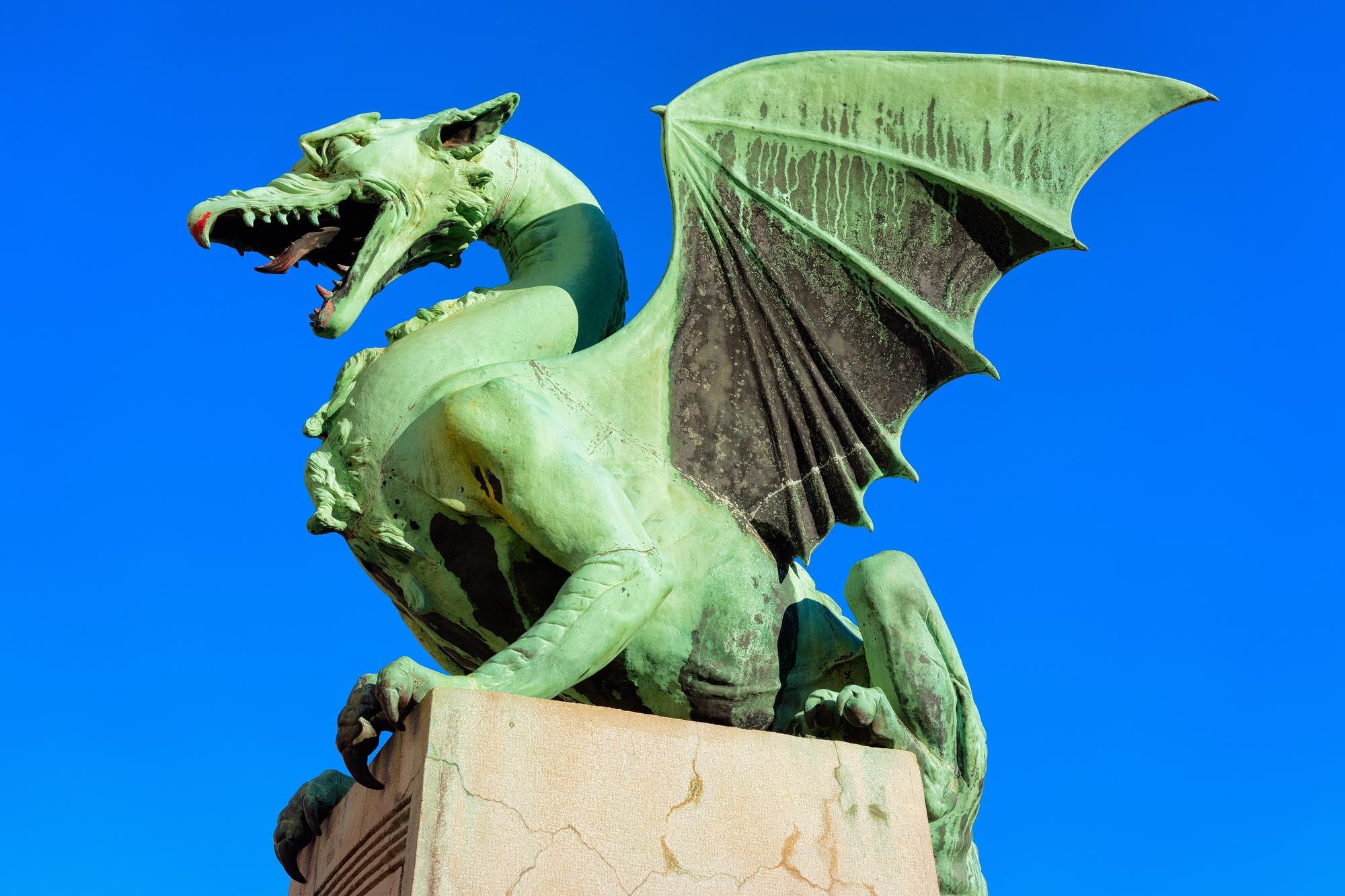
Mythical creatures are beings from myth, legend and folklore that never lived as real animals, such as dragons, unicorns, sphinxes and vampires. The ones most people can name became famous through specific stories. A saint spears a dragon outside a Libyan town. A winged horse leaps from Medusa's severed neck. A Transylvanian count sails to England in an 1897 novel.
This article covers nine mythological creatures, from dragons to vampires, and the legends that fixed each one in memory. Nearly every one of them changed between its first telling and its movie poster. Some were never monsters at all. One was never a species. One began as a bloated corpse in a village grave.
In This Article
- 1. Dragons
- 2. Unicorns
- 3. Mermaids and Sirens
- 4. Griffins
- 5. Centaurs
- 6. Sphinxes
- 7. Pegasus
- 8. The Phoenix
- 9. Vampires
- Key Takeaways
- Frequently Asked Questions
- Follow the Legends Behind the Creatures
1. Dragons
The dragon is two different animals sharing one English word. In Europe it is an enemy to be killed, and the story that set the pattern is Saint George and the dragon. George was a Roman soldier martyred around 303 CE, but his dragon arrives centuries later. Its best-known form comes from Jacobus de Voragine's thirteenth-century Golden Legend.
There the beast lives in a lake near Silene in Libya. The townspeople feed it sheep, then children chosen by lot. When the lot falls on the king's daughter, George wounds the dragon, and the princess leads it into town on her girdle like a pet.
Chinese tradition runs the other way. The Dragon Kings rule the four seas and command rain, rivers and lakes, and villages built temples to them and prayed there in times of drought. These dragons are wingless and serpentine. They are mostly benevolent, linked with the emperor and with good fortune, and the dragon is one of the twelve animals of the Chinese zodiac.
A European villager in these stories wanted a dragon killed. A Chinese farmer in a dry year prayed to one.
2. Unicorns
The earliest Greek account comes from Ctesias, a Greek physician at the Persian court. In his Indica, written in the fourth century BCE, he described wild asses in India as large as horses, with white bodies, dark red heads and a single horn on the forehead. Cups made from the horn, he claimed, protected drinkers from poison.
That one claim outlived his book by nearly two thousand years, because it created a market. The market needed supply. Traders in medieval and Renaissance Europe sold narwhal tusks, the long spiraled teeth of an Arctic whale, as unicorn horns, and the tusks fetched enormous prices. Denmark's kings were anointed from 1671 to 1840 on a throne built largely of narwhal tusk, still displayed at Rosenborg Castle in Copenhagen.
Christian allegory finished the picture. Only a maiden could tame a unicorn, and the animal came to stand for purity and for Christ. The seven woven panels known as The Hunt of the Unicorn, made around 1495 to 1505, hang at The Met Cloisters in New York. Scotland took the unicorn as its heraldic animal, and one still supports the royal coat of arms.
3. Mermaids and Sirens
They began as different creatures, although several languages now treat them as one. In Homer's Odyssey, the Sirens sing from an island. Odysseus has his crew plug their ears with beeswax while he listens, tied to the mast. Greek vase painters showed Sirens as birds with women's heads. Their danger was the song itself, which drew sailors to wreck and death.
Medieval artists and writers gradually gave sirens fish tails, and the change stuck. In Spanish and Italian, sirena means mermaid. So does sirène in French.
Mermaids come from separate roots, including the sea women of northern European ballads, but the modern image owes most to Hans Christian Andersen's "The Little Mermaid" (1837). Andersen's story is hard going. The mermaid gives up her voice for legs, and every step feels like treading on knives. The prince marries someone else. Offered a knife to kill him and return to the sea, she refuses, throws herself into the waves and turns to sea foam, rising afterward among the daughters of the air.
Disney's 1989 film gave her the happy ending Andersen withheld. Andersen made her pay for love with her voice and her life. The studio gave her the voice back and the wedding too.
4. Griffins
A griffin has a lion's body with an eagle's head and wings. Greek writers placed griffins in the far northeast, guarding gold against the one-eyed Arimaspians who tried to steal it. Herodotus repeats the story in the fifth century BCE, while saying he doubts the one-eyed men.
That gold may explain the guardian. Folklorist Adrienne Mayor proposed in The First Fossil Hunters (2000) that beaked dinosaur skeletons such as Protoceratops, which erode out of the ground in the Gobi region near ancient gold routes, fed the legend. No prospector left a written account of finding one, so her case rests on what the bones look like. A Protoceratops is a sheep-sized, four-legged animal with a hooked beak. Behind its skull a thin bony frill fans out, and to someone who had never heard of dinosaurs, that frill could pass for the base of a wing. Clutches of its eggs turn up in the same ground, and Mayor links them to stories of griffins guarding nests.
Medieval Europe gave the griffin a holier post. The Pisa Griffin, a large bronze probably made in the Islamic Mediterranean around the eleventh century, stood on the roof of Pisa Cathedral for centuries. Its metal body is engraved with feathers, scales and an Arabic inscription. It now stands in the cathedral's museum, the Museo dell'Opera del Duomo.
5. Centaurs
Centaurs are human from the waist up and horse below. Greek myth placed them in Thessaly, around Mount Pelion, and most were wild. At the wedding of Pirithous, king of the Lapiths, the centaurs got drunk and tried to carry off the bride. The battle that followed, the centauromachy, is carved on the metopes of the Parthenon in Athens.
Chiron is the exception that made the type memorable. Wise, skilled in medicine and immortal, he lived in a cave on Pelion and taught Achilles, Jason and Asclepius. Heracles accidentally wounded him with an arrow dipped in the Hydra's poison. Facing pain that could not end, Chiron gave up his immortality, and in some versions Zeus set him among the stars.
Of all the Greek mythology creatures, centaurs show most clearly how one figure can redefine a group. Modern fantasy usually keeps Chiron's wisdom and drops the wedding brawl. That is why centaurs in novels so often turn up as astronomers and teachers.
6. Sphinxes
Egyptian and Greek sphinxes share a lion's body and little else. The Egyptian sphinx is usually male, with a king's head often wearing the royal headcloth, and it guards temples, tombs and processional avenues. The Great Sphinx at Giza, generally dated to the reign of Khafre around 2500 BCE, poses no riddles. Its job is protection. Even its name is borrowed: "sphinx" is Greek, and it was applied to these statues later.
The Greek sphinx is female, winged and hostile. Sent to Thebes, she settled above the road into the city and stopped whoever passed. The terms were simple. Answer her riddle or die.
What walks on four legs in the morning, two at noon and three in the evening? Traveler after traveler failed, and she killed each one. Thebes grew so desperate that Creon, ruling after the death of King Laius, promised the throne and the hand of the widowed queen, Jocasta, to anyone who could rid the city of her.
Oedipus answered "man," who crawls as a baby, walks upright as an adult and leans on a stick in old age. She threw herself to her death. His prize was the throne and a queen who was secretly his own mother, and that is the tragedy Sophocles later staged.
7. Pegasus
Pegasus is one horse with a name and parents, not a species. When Perseus beheaded Medusa, Pegasus sprang from her neck along with his brother Chrysaor. Poseidon was their father.
The adventures that made the horse famous belong to Bellerophon. He caught Pegasus drinking at the spring of Peirene in Corinth, using a golden bridle from Athena, and riding him killed the Chimera. Then Bellerophon tried to fly up to Olympus, and Pegasus threw him. The horse went on to carry Zeus's thunderbolts and became a constellation. Hippocrene, the Muses' spring on Mount Helicon, was said to have opened where his hoof struck the ground.
Herds of "pegasi" in games and novels are a modern invention, and any fantasy creatures list that files Pegasus as a breed is following them. In myth there is only one.
8. The Phoenix
The phoenix most people know bursts into flame and rises from its own ashes. That bird came late. The fire and the rebirth belong to Roman and early Christian writing, where the phoenix became a symbol of resurrection.
Herodotus gives the earliest detailed Greek account, also in the fifth century BCE. His bird has red and gold plumage, is about the size of an eagle, and comes from Arabia to the temple of the sun at Heliopolis in Egypt once every 500 years. He admits he saw it only in paintings and did not believe every part of the story. He wrote it down anyway.
His bird has no fire in it. First it shapes an egg of myrrh as large as it can carry and tests the weight. Then it hollows the egg, lays its dead father inside and seals the opening with more myrrh, so the load weighs exactly what it did before. Then it flies to Egypt with its father's corpse shut inside a ball of perfumed resin.
9. Vampires
The vampire of folklore was a corpse from the village graveyard, not an aristocrat. In Slavic and Balkan belief, the returning dead were bloated and ruddy, and people blamed them for sickness that spread through a household. In the 1720s and early 1730s, Austrian officials in Habsburg-ruled Serbia reported cases such as Petar Blagojević and Arnaut Pavle. The reports were reprinted across Europe, and the word "vampire" entered English during the 1730s.
Literature turned the corpse into a gentleman. John Polidori's The Vampyre (1819) made the vampire a lord. Sheridan Le Fanu's Carmilla (1872) gave the form a female vampire and a slow, intimate menace. Bram Stoker's Dracula (1897) fixed the template: a Transylvanian count with a castle, the power to change shape and a fear of the crucifix. Stoker took the name from Vlad III of Wallachia and little else.
Film kept rewriting the rules. F. W. Murnau's Nosferatu (1922) killed its vampire with sunlight, while Stoker's Dracula walks by day with weakened powers. Robert Eggers remade Nosferatu in 2024. Screen vampires now range from the romantic leads of Twilight and The Vampire Diaries to the predators of 30 Days of Night, who attack an Alaskan town during its month without sunrise. Sunlight death, seductive charm and sparkling skin all come from fiction, not from the village folklore these fantasy creatures grew out of.
Key Takeaways
- One name can cover opposite creatures: the European dragon is a monster to slay, the Chinese dragon a rain-giver to thank.
- Many famous traits arrived late, including the sirens' fish tails, the phoenix's fire and the vampire's death by sunlight.
- Real objects kept belief alive, from narwhal tusks sold as unicorn horn to beaked skeletons in the Gobi.
- Pegasus and Chiron were individuals, and later fiction turned them into types.
- A single writer can fix a creature's image for generations, as Andersen did for mermaids and Stoker for vampires.
Frequently Asked Questions
What are some mythical creatures that start with the letter J?
Jinn, Jörmungandr and the jiangshi are three well-known mythical creatures that start with J. Jinn are spirits made of smokeless fire in Arabian and Islamic tradition. Jörmungandr is the Norse world serpent that encircles the earth, and the jiangshi is the stiff "hopping corpse" of Chinese folklore.
What mythical creatures appear in Harry Potter?
Harry Potter features centaurs, a phoenix, a basilisk, unicorns, merpeople, several breeds of dragon and a hippogriff. J.K. Rowling's magical creatures borrow heavily from older myth: the centaurs live in the Forbidden Forest and the phoenix is Dumbledore's Fawkes. The hippogriff Buckbeak, a horse-eagle hybrid, was already a literary invention centuries before Rowling used it.
What are some mythological races?
Elves, dwarves, giants, nymphs, satyrs, centaurs and nāgas are among the best-known mythological races. Many traditions describe whole peoples of mythical beings instead of single monsters. Norse myth has elves, dwarves and the giants called jötnar, Greek myth has nymphs, satyrs and centaurs, and Hindu and Buddhist traditions have the serpent-bodied nāgas.
Which mythical creatures have horns?
The unicorn is the best-known horned mythical creature, and Persian and Arabic sources describe a fiercer single-horned beast called the karkadann. The Chinese qilin is often shown with one or two horns. In Greek myth, the Minotaur had a bull's horns and satyrs had goat horns.
What mythical creatures are similar to dragons?
Wyverns, the Hydra, Jörmungandr, Quetzalcoatl and the nāgas are all close to dragons. Wyverns are two-legged winged dragons from European heraldry, and the Greek Hydra and the Norse Jörmungandr are serpentine monsters of the same family. Quetzalcoatl, the Feathered Serpent of Mesoamerica, and the nāgas of South Asia are often compared to dragons, though each belongs to its own tradition.
What is the difference between a mythical creature and a cryptid?
A mythical creature belongs to a story tradition, while a cryptid is an animal some people claim is alive today. Mythical creatures are known through myths, legends and art. Cryptids, such as Bigfoot or the Loch Ness Monster, are claimed as living animals that science has not confirmed.
Follow the Legends Behind the Creatures
All nine come down to one pattern: a creature survives by being retold, and each retelling serves its own audience. None of these legends belongs to the person who first wrote it down, and the creatures that lasted were the ones later tellers could reshape. Bram Stoker needed a name for his count, so he took the name of Vlad III of Wallachia, a fifteenth-century prince, and left nearly everything else about him behind. Every creature on this list went through some version of that borrowing. The earliest account shows what a creature meant to the people who first feared or worshipped it. The latest shows what a modern audience wants from it. Both belong to the legend, and neither one is final.