
Among the most famous Baroque paintings are Caravaggio’s The Calling of Saint Matthew, Rembrandt’s The Night Watch, and Velázquez’s Las Meninas. They make a biblical summons or a portrait sitting feel like an encounter whose outcome still matters. In Caravaggio’s room, men attend to their money while Christ reaches toward the table: an ordinary transaction is about to be interrupted. These 13 paintings tell very different stories. For each, follow the action first, then the detail that gives it force; dates and collections identify the particular work discussed.
In This Article
- 1. The Calling of Saint Matthew
- 2. Judith Slaying Holofernes
- 3. Timoclea Killing the Captain of Alexander the Great
- 4. The Night Watch
- 5. The Anatomy Lesson of Dr. Nicolaes Tulp
- 6. Las Meninas
- 7. Portrait of Innocent X
- 8. The Education of the Princess
- 9. The Penitent Magdalene
- 10. Landscape With a Calm
- 11. The Lamentation of Christ
- 12. The Supper at Emmaus
- 13. The Elevation of the Cross
- Key Takeaways
- Frequently Asked Questions
- Look First at Light and Gesture
1. The Calling of Saint Matthew
The men at the table are occupied with coins. Christ enters from the right, but the money still commands attention: Caravaggio makes the call compete with something solid and countable. His extended hand and a diagonal beam across the wall direct us toward the seated group.
The bearded man points, apparently asking whether the summons means him. He is usually identified as Matthew, though that identification remains debated. The more immediate tension needs no resolution: Christ has entered, yet the table has not become a gathering of believers. The room still belongs to everyday business.
Caravaggio painted the work in 1599–1600 for the Contarelli Chapel in San Luigi dei Francesi, Rome, where it remains. Its religious event takes place in a room that resembles an ordinary gathering place, with no grand setting to announce what is happening.
2. Judith Slaying Holofernes
Judith cannot do this at arm’s length. In Artemisia Gentileschi’s Florence painting, she and her maid press close to Holofernes, bracing themselves against his resistance. Their arms make the killing look like difficult physical work. The Assyrian commander’s death, told in the Book of Judith, will save Judith’s community from attack.
Gentileschi gives that deliverance a terrible cost in effort. Judith’s rich yellow dress does not distance her from the struggle; its wearer is fully committed to it. The maid is indispensable, not a spectator waiting for the heroine to finish.
This is the larger Florence treatment, generally dated around 1620 and held by the Uffizi Galleries, rather than the earlier Naples canvas. Its coordinated action gives the biblical story its force. Gentileschi’s biography alone cannot account for the painting’s argument about courage and deliverance.
3. Timoclea Killing the Captain of Alexander the Great
A captain goes headfirst into a well, his legs rising above its stone rim. Timoclea stays upright. Elisabetta Sirani makes the reversal brutally clear before the viewer knows either person’s history.
In Plutarch’s account of Alexander’s conquest of Thebes, the captain assaulted Timoclea and then demanded her hidden treasure. She directed him to the well. What he expected to be another act of obedience becomes the means of his defeat.
Sirani chooses the instant when that deception succeeds. She does not show the preceding assault; Timoclea’s purposeful action occupies the painting instead. The contrast between her planted figure and his upended body leaves no doubt about who now controls the encounter. Painted in 1659, the work is held by the Museo e Real Bosco di Capodimonte in Naples.
4. The Night Watch
Captain Frans Banninck Cocq advances beside Lieutenant Willem van Ruytenburch while figures around them handle weapons and turn toward the activity. Rembrandt van Rijn makes a commissioned militia portrait look as though the company cannot quite keep still long enough to be painted.
That movement has consequences for the sitters. Recognizable members of an Amsterdam civic guard company had to fit into the picture, but Rembrandt did not grant each man an equally clear patch of canvas. Bodies overlap. Light favors some faces and leaves others competing for attention. The group becomes an event, at the expense of tidy individual display.
Even the brightly lit girl, with company emblems including a chicken’s conspicuous claws, claims attention that a conventional portrait might reserve for a paying sitter. Completed in 1642, this famous Baroque painting belongs to the Rijksmuseum in Amsterdam.
5. The Anatomy Lesson of Dr. Nicolaes Tulp
Aris Kindt, an executed man, lies before the gathered observers. His exposed forearm is the focus: Dr. Nicolaes Tulp lifts its structures with forceps and uses his other hand to suggest how they work. One hand opens the dead body to inspection; the other translates it into movement.
The men crowding around do not share a single response. Some lean toward the dissection. Others look outward or toward the open book. Their attention breaks in different directions, leaving the viewer to move between the forearm and the faces above it.
Rembrandt’s 1632 portrait joins professional status to an unsettling dependence: the living men’s display of knowledge requires this dead man’s body. Kindt’s identity anchors the scene in the judicial as well as the medical institutions of the period. The painting is at the Mauritshuis in The Hague.
6. Las Meninas
Standing before Las Meninas can feel like entering a room where people have already noticed you. The Infanta Margarita occupies the center, surrounded by attendants. At the left, Diego Velázquez stands beside a large canvas. Farther back, a small mirror contains two figures whose presence changes the room.
The royal couple’s reflection puts you in an uneasy position: the place from which you look seems connected to the people everyone might be attending to. Are you observing the household, or occupying the space of its most important observers? The painting keeps that relationship unsettled.
The open doorway makes the room feel accessible, yet its inhabitants remain caught in a network of courtly attention. This is no private glimpse without consequences; looking itself carries rank. Painted in 1656, Las Meninas is held by the Museo del Prado in Madrid.
7. Portrait of Innocent X
Red surrounds Pope Innocent X: fabric behind him, the chair beneath him, the cap above his face. White clothing cuts through it. A sheet of paper rests in his hand, but the eyes are harder to leave.
Velázquez painted the portrait in Rome in 1650; it remains in the city’s Galleria Doria Pamphilj. The arrangement is restricted enough that small distinctions become commanding. The chair and cap have different textures, and the face refuses to disappear into the signs of papal office.
Nothing requires the sitter to move. His authority comes through watchfulness, as though your scrutiny has met an answering scrutiny. Surrounded by red, the pope’s glare feels suspicious of the person looking at him.
8. The Education of the Princess
Marie de’ Medici receives an education with gods in attendance. Minerva and Mercury help present her learning as evidence of royal fitness; the Three Graces associate her formation with cultivated beauty. Rubens gives the princess the kind of flattering company no ordinary classroom could supply.
The flattery is brazen because mythology makes her accomplishments appear worthy of divine supervision. This is a claim about her right to command admiration, dressed as a lesson.
Painted around 1622–1625, The Education of the Princess belongs to the cycle Marie commissioned for the Luxembourg Palace in Paris, now in the Louvre Museum. Within that larger account of her life, history repeatedly meets allegory. The cycle’s grand claims help explain why this young pupil needs such extraordinary teachers.
9. The Penitent Magdalene
A skull rests in Mary Magdalene’s lap. Beside her, a candle burns, and its reflection supplies a second flame in the dark mirror. Georges de La Tour brings death and light close enough to share the same small space.
The skull’s rounded surface, reflective glass, and soft fabric respond differently to that light. Those differences hold the eye while Magdalene’s turned head withholds part of her expression. We can inspect the objects more readily than we can read her thoughts.
La Tour’s painting, dated about 1640 and held by the Metropolitan Museum of Art in New York, gives repentance no public audience within the scene. Mortality is there to be contemplated at close quarters. Among famous Baroque artists, he makes an especially forceful case for how little movement a painting needs to become absorbing.
10. Landscape With a Calm
Water opens the middle of Nicolas Poussin’s landscape, carrying reflections beneath buildings on the farther shore. Wooded slopes frame the distance. Small figures and animals occupy the nearer ground, giving the broad terrain a scale the eye can measure.
From that ground, attention travels across the water and into successive stretches of country. The distances remain legible; nothing forces an abrupt leap from foreground to horizon. The calm comes from this sustained passage through the view, with each part given room.
Painted in 1650–1651, Landscape With a Calm is held by the J. Paul Getty Museum in Los Angeles. Its relationship to Poussin’s Landscape With a Storm makes the settled water more consequential: this is nature under one set of conditions, capable of another. Poussin builds the view carefully enough that its stability feels tangible.
11. The Lamentation of Christ
Christ’s pale body stretches across the foreground, but grief has brought another body down beside it. The Virgin collapses. Annibale Carracci makes her fainting a second crisis, turning the mourners’ attention between the dead son and his stricken mother.
Their gestures connect the two without merging their suffering. Christ remains exposed to view; the Virgin’s collapse shows what that sight does to someone who loves him. The figures have enough space for each response to register, so the grief passes from person to person instead of dissolving into a crowd.
Painted about 1604, the work is in London’s National Gallery, where it is also known as The Dead Christ Mourned (“The Three Maries”). Carracci’s control makes the loss harder to evade: the body is plainly visible, and so is its consequence.
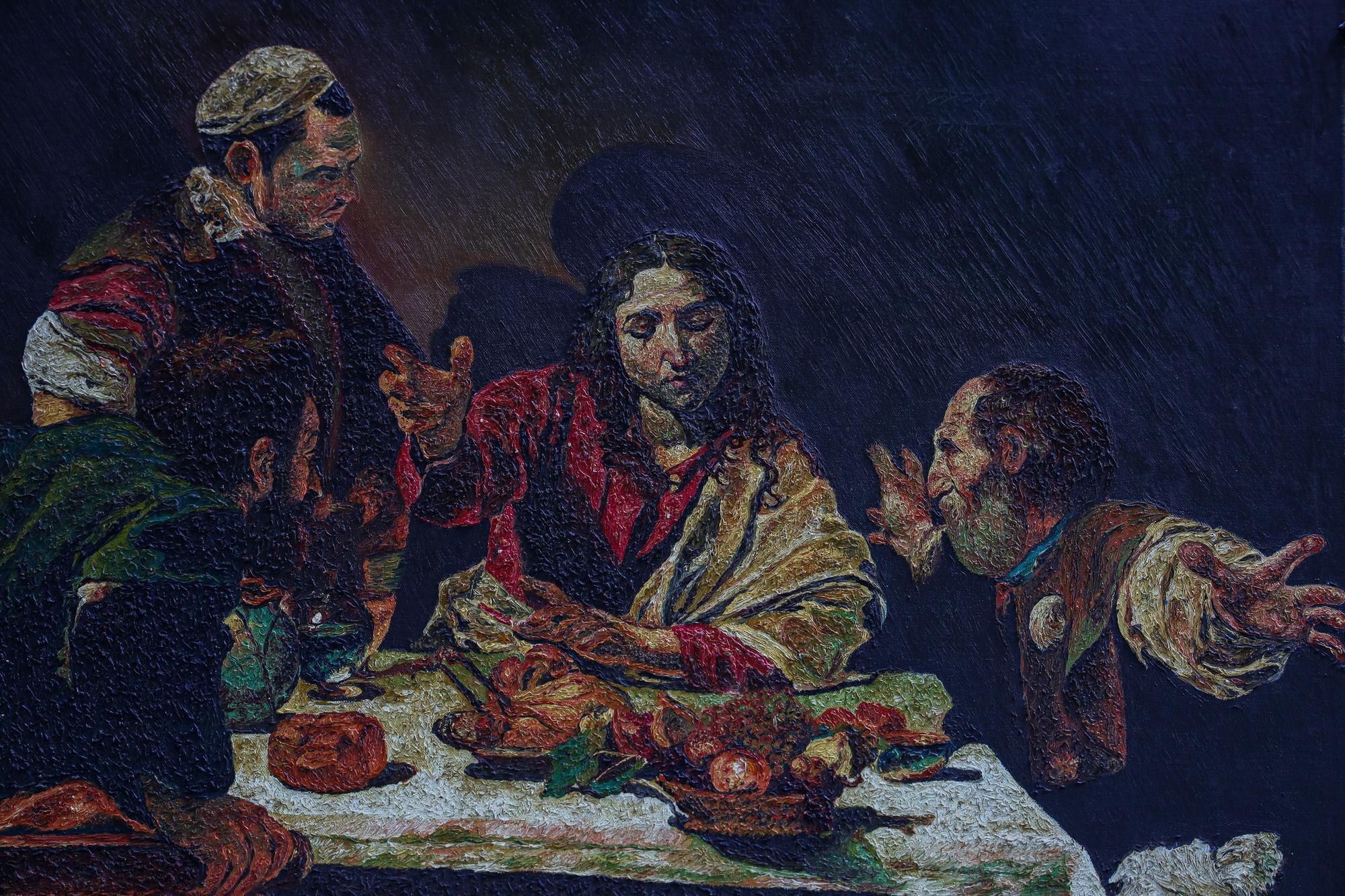
12. The Supper at Emmaus
One disciple pushes against his chair as though he might rise. The other throws his arms wide. In Caravaggio’s The Supper at Emmaus, recognition breaks into a meal so suddenly that the seated bodies seem unable to contain it.
The disciples have recognized the resurrected Christ. The standing innkeeper appears unaware, keeping ordinary observation in the same room as revelation. What transforms the meal for two people leaves another apparently untouched.
A fruit basket projects over the edge of the table, bringing that divided encounter close to the viewer’s space. Familiar objects give the event a physical footing; the gestures show understanding arriving faster than composure. Caravaggio painted this version in 1601. Now in the National Gallery, London, it makes recognition look less like a settled conviction than an involuntary bodily response.
13. The Elevation of the Cross
The men raising the cross cannot keep their bodies straight. Backs bend and arms strain against the timber’s weight. Rubens gives the central action a dominant diagonal through Christ’s body, but that rising line depends on the workers’ awkward, opposing efforts.
A rope adds another line of tension. The cross is an object they must lift before it becomes the upright instrument of execution: weight bears down while muscles work upward. The violence includes this labor, not only the wounds of the condemned.
Painted in 1610–1611, The Elevation of the Cross is a monumental triptych in the Cathedral of Our Lady, Antwerp. Its side panels bring witnesses and the other condemned men into the event. The central effort will end in Christ’s suspension; the men’s success is the terrible outcome toward which every strained limb works.
Key Takeaways
- Baroque paintings make decisions visible through bodies, whether a hand answers a summons or shoulders bear a weight.
- Gentileschi and Sirani give their heroines control over the action and its outcome.
- Portrait commissions leave room for friction between individual recognition and the demands of a larger picture.
- Stillness can concentrate attention as strongly as violent movement.
- Dates and collections distinguish versions when a painter returns to a subject.
Frequently Asked Questions
Why Does The Night Watch Have a Title That Suggests Darkness?
Accumulated dirt and darkened varnish made the painting look nocturnal, prompting its familiar title. The surprise is that this is not a nighttime patrol at all. Its fuller descriptive title identifies the militia company of District II under Captain Frans Banninck Cocq.
Are Gentileschi’s Naples and Florence Paintings of Judith the Same Work?
They are separate paintings of the same subject. The earlier canvas, generally dated around 1612–1613, is in Capodimonte, while the Florence version is the one discussed above. Their costumes and treatment of the action differ, so the collection is a useful part of the identification.
Why Do Different Paintings Share the Title The Penitent Magdalene?
The title names a religious subject, not one unique painting. La Tour returned to Mary Magdalene several times, changing the devotional objects and the arrangement of light. A collection and date help distinguish which work is meant.
What Is the Difference Between Chiaroscuro and Tenebrism?
Chiaroscuro models forms through light and shade; tenebrism makes extensive darkness a dominant setting for sharply lit figures. In Caravaggio’s scenes, ask how much of the surrounding room disappears: that gives the distinction a visible basis without requiring a label for every shadow.
Who Are the Figures Reflected in the Mirror in Las Meninas?
They are King Philip IV of Spain and Queen Mariana of Austria. What remains debated is the precise spatial explanation of their reflection, including its relationship to the canvas Velázquez is painting. Their identity is clearer than the mechanics of their appearance.
Why Does Poussin’s Restrained Style Still Belong to the Baroque?
Baroque painting encompasses contrasting approaches within a historical period, including Poussin’s classical restraint. He developed that approach within seventeenth-century artistic culture, especially in Rome, where he spent most of his career. Turbulent movement is not an admission requirement.
Look First at Light and Gesture
To understand famous Baroque art, give one painting sustained attention before comparing styles. Choose Caravaggio for an encounter that turns on recognition, or Rembrandt if you want to see how a group portrait distributes importance. Let your first question be practical: whose action changes what happens to everyone else?
Then look for resistance to that action. Someone may remain unaware; another figure may command attention without doing anything. These differences make the stories specific. A useful next comparison is between a work that shows effort and one that withholds movement. The label “Baroque” helps place them historically, but it does not replace the encounter. What matters is how the painter makes a particular event understandable, and why that way of telling it holds you.