
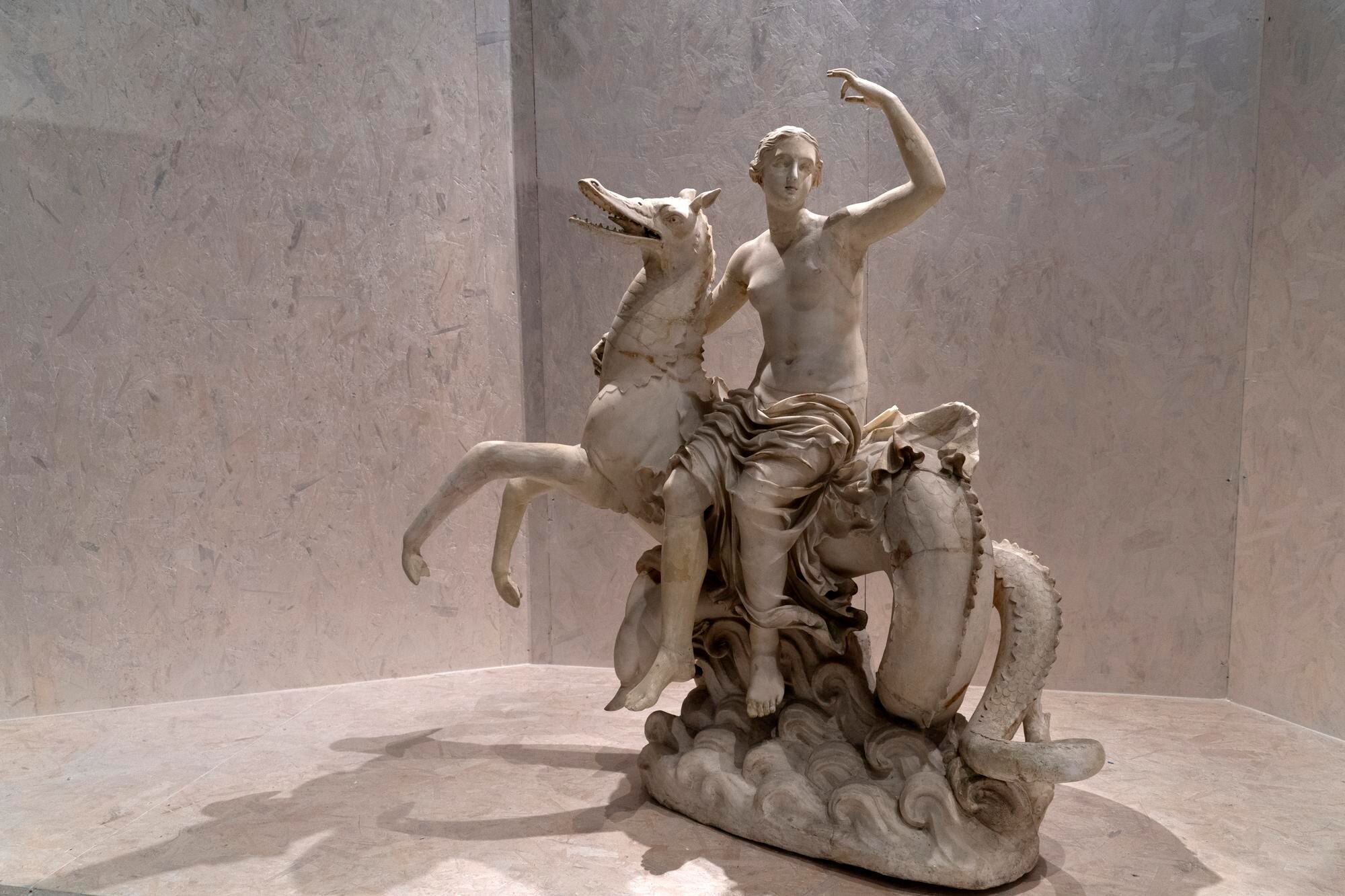
In Greek myth, the hippocampus is the sea horse that pulls Poseidon's chariot through the surf. It is a horse from the head to the forelegs, with a coiling fish tail behind. The Greek hippocampus belongs to the sea god's retinue, carrying him, his Nereids and later the Roman Neptune across the waves in painting, mosaic and stone. Homer describes Poseidon's sea-going horses without mentioning fish tails; Philostratus later contrasts them with painted hippocampi. Texts and images offer different evidence for the creature's form.
In This Article
- What the Hippocampus Looks Like
- Where the Name Comes From
- Poseidon's Horses in Texts and in Images
- An Ancient Description From Corinth
- Hippocampi Beyond Greece
- Why the Oldest Image Does Not Settle the Origin
- Seeing Hippocampi in Rome's Trevi Fountain
- Key Takeaways
- Frequently Asked Questions
- Recognizing the Horse of the Sea
What the Hippocampus Looks Like
From the head back to the shoulders, it is all horse: a long skull, a mane streaming in the wind, a deep chest and forelegs reaching out as if galloping on water. Some artists add fins to the hooves or webbing between them.
The horse's upper body gives way to a twisting, serpentine marine lower half.
That join moved from artist to artist. Some carried the horse back to the belly. Others started the scales almost at the neck. Describe it plainly as a fish horse and you have the whole body plan. The tail is what makes it a hippocampus.
Where the Name Comes From
The American Heritage Dictionary traces the name to Greek hippos, "horse," and kampos, "sea monster." This conventional breakdown describes the creature's mixed form. It does not connect its origin to a particular monster or to a story about Poseidon's anger.
The name describes a kind of creature, not an individual like Pegasus. In images, hippocampi appear in chariot teams, as mounts for sea nymphs, and among the companions of sea gods.
Poseidon's Horses in Texts and in Images
In Book 13 of the Iliad, Homer describes Poseidon yoking bronze-hoofed, golden-maned horses to his chariot and driving them over the sea. Sea creatures come up from the deep to greet their lord. The water parts with joy, and the bronze axle underneath never gets wet.
Homer does not describe fish tails or specify four ordinary legs. Philostratus the Elder makes the comparison explicitly in Imagines 1.8: he interprets Homer's team as land horses and contrasts them with the swimming hippocampi pulling Poseidon's chariot in a painting. His comparison distinguishes the poem from the picture; it does not establish that artists invented hippocampi by adding tails to Homer's horses.
An Ancient Description From Corinth
Pausanias records an explicit sculptural example in Book 2 of his Description of Greece. Writing in the second century CE, he visited the sanctuary of Poseidon on the Isthmus of Corinth, the narrow neck of land joining the Peloponnese to central Greece. The Isthmian Games were held there, and myth said they had first been held in honor of the drowned boy Melicertes, worshipped as the sea god Palaemon.
The temple was crowded with gifts. Pausanias names the wealthy Athenian Herodes Atticus as the donor of a statue group of Poseidon and Amphitrite standing in a chariot. He describes four gilded horses with ivory hoofs and, among the sanctuary's separate offerings, a horse shaped like a whale from the breast onward. Visitors to the god's own sanctuary would have seen a horse in sea-creature form.
Hippocampi Beyond Greece
Coins from Phoenician Tyre show a rider on a winged hippocampus. On the silver shekels the city struck in the fourth century BCE, a bearded god sits astride the creature, usually identified as Melqart, Tyre's chief deity. He holds a bow. Waves curl under the hippocampus and a dolphin swims below. The reverse shows an owl carrying the crook and flail of Egyptian kingship.
The hippocampus, waves and dolphin give the rider's scene a maritime setting. Tyre was an island city that grew rich on shipping, and its coins put the city's god on a sea beast with spread wings. The wings are not exclusive to Phoenician images: a fourth-century BCE Apulian red-figure plate also depicts a winged hippocampus.
Sea horse mythology took other forms in Italy. Etruscan artists depicted hippocampi in tombs and on bronzes, sometimes linking sea creatures with the dead's journey. Roman mosaics later put them in Neptune's chariot teams, alongside Nereids and Tritons, on the floors of baths and villas.
Why the Oldest Image Does Not Settle the Origin
The surviving evidence has a chronology. In his 2026 study in Greece & Rome, Ryan Denson identifies the earliest surviving Graeco-Roman depiction as a Thasian tripod from the late seventh century BCE. Hippocampi became prevalent in Etruscan art from the sixth century BCE, before the fourth-century BCE Tyrian coins discussed above.
These dates establish when the creature appears in surviving objects, not where it was first imagined. The Thasian example documents an early Greek depiction; the Etruscan and Phoenician examples show its wider Mediterranean distribution.
Seeing Hippocampi in Rome's Trevi Fountain
Rome's Trevi Fountain, designed by Nicola Salvi and completed in 1762, places two hippocampi beneath Oceanus, not Neptune. Two Tritons guide them. Their forms combine horse foreparts with marine tails.
The two horses do not match. One rears and thrashes while its Triton struggles to hold it back. The other moves forward calmly at the end of its rein, and viewers have long read the pair as the sea's two moods, storm and calm.
Key Takeaways
- A hippocampus is a horse to the shoulders and a scaled, coiling fish tail behind.
- The name joins hippos, "horse," with kampos, "sea monster."
- Homer's horses in Iliad Book 13 have bronze hooves and golden manes; he does not describe fish tails.
- Pausanias described four gilded horses with ivory hoofs and a separate whale-like horse at Poseidon's sanctuary on the Isthmus of Corinth.
- Tyre's coins give the creature wings and a divine rider; Etruscan tombs and Roman mosaics gave it other jobs.
- The Trevi Fountain's two hippocampi, one wild and one calm, carry the form into 1762.
Frequently Asked Questions
Are kelpies and hippocampi the same?
No, they come from different traditions. Scotland's kelpie is a shape-shifting water spirit associated with drowning riders. The classical hippocampus serves the sea god and has no taste for drowning anyone.
Why is a seahorse called a hippocampus?
The living seahorse genus bears the name Hippocampus, a word ancient writers also used for real seahorses. Whether the ancient name first referred to the fish or the mythical creature is uncertain; their shared horse-like features do not settle the direction of borrowing. In the sixteenth century, the anatomist Giulio Cesare Aranzi also compared a curved structure in the brain to a seahorse, which is why that part of the brain is called the hippocampus too.
Is Capricorn a hippocampus?
No, Capricorn is a sea-goat. It also has a fish tail, but its front half is a goat's.
Is a hippocampus a god or a kind of creature?
It is a kind of creature, not a god. Hippocampi serve gods, especially Poseidon and Neptune, by pulling their chariots or carrying sea nymphs.
What is the plural of hippocampus in mythology?
The usual plural is hippocampi. English writers also use hippocamp and its plural, hippocamps, especially for the mythical animal.
Recognizing the Horse of the Sea
To recognize a hippocampus, look for the horse's head and forelegs joined to a coiling marine tail. Do not assume every sea-going horse in a poem has that body: Homer does not describe it, while Philostratus explicitly identifies painted hippocampi. Wings, fins and the position of the join can vary without changing the creature's basic identity.