
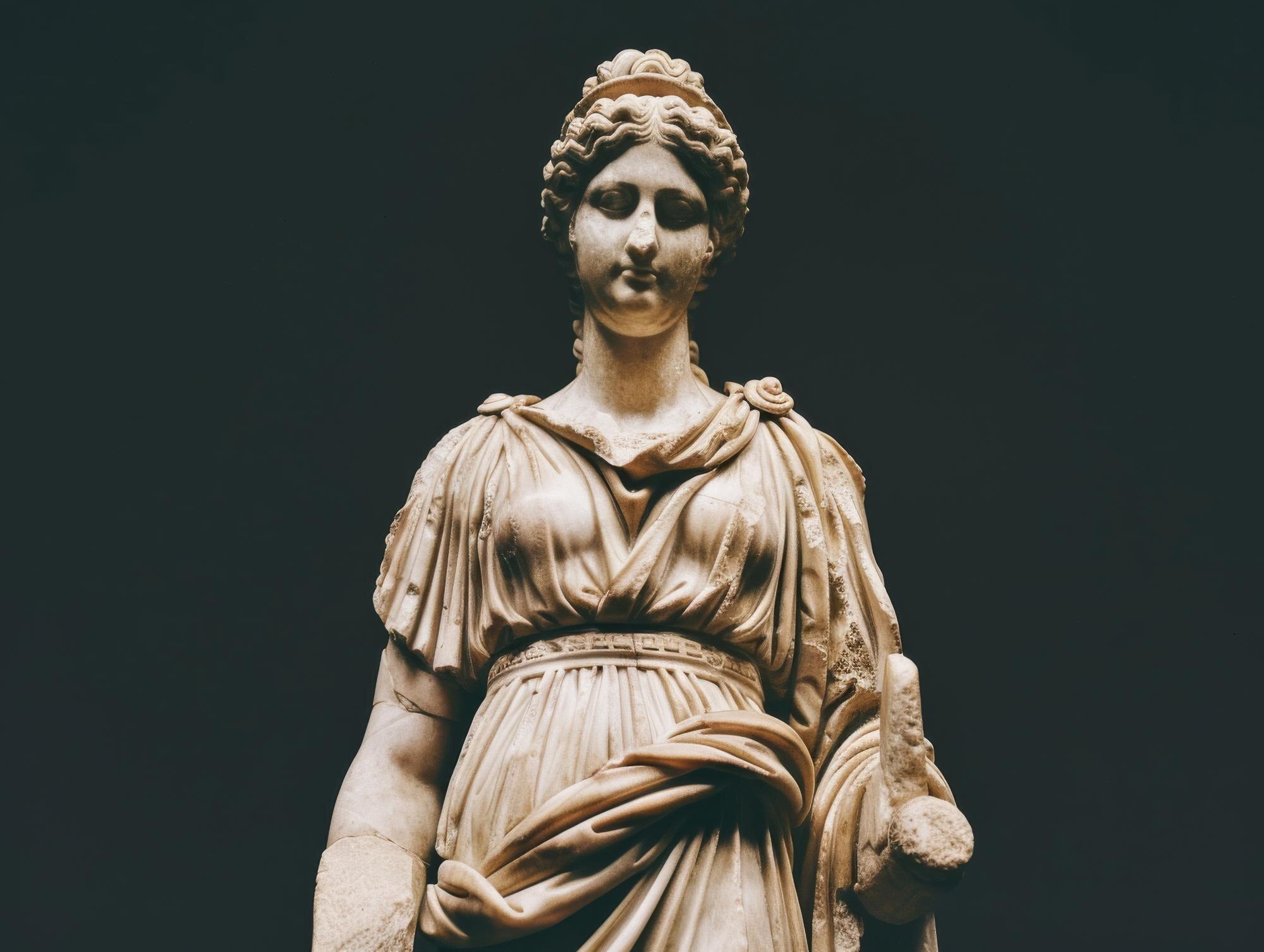
Hera is the queen of the Greek gods. She is Zeus's sister and his wife, and she guarded marriage and the lives of married women. The myths remember her for hounding Zeus's lovers and their children, yet the Greeks built her temples on Samos and at Argos that ranked among the largest in their world.
Both pictures are accurate. To Hera, Greek mythology gave both roles at once, the avenger and the queen. Her position as the lawful wife of the king of the gods helps explain many of the conflicts below, but not every act of anger or favor. Homer and Hesiod do not always agree on the details, and Roman poets such as Ovid added versions of their own. Most of what puzzles readers about her comes from those disagreements.
In This Article
- What Hera Ruled Over
- Her Parents, Marriage, and Children
- The Powers Hera Used
- The Revolt Against Zeus and the Golden Chain
- Hera and Zeus's Other Partners
- Hera at Troy and in Heroic Quests
- Where the Greeks Worshiped Hera
- Key Takeaways
- Frequently Asked Questions
- A Queen Beyond the Revenge Stories
What Hera Ruled Over
Every year, the people of Argos said, Hera bathed in the spring Kanathos at Nauplia and rose from the water a maiden again. Her marriage was renewed each year, as if it began over. The rite says plainly where her power lay.
As Zeus's wife, Hera was queen of the gods, and marriage was central to her worship. She was honored as goddess of marriage. Other goddesses and mortal women bore his children, but only she sat on Olympus as the wedded queen. Greek brides and wives prayed to her because she stood for the legal union that founded a household.
That union followed a woman through her whole life. At Stymphalus in Arcadia there were three sanctuaries of Hera, described by Pausanias, the travel writer of the second century AD. One honored her as Girl, one as Fulfilled (the married woman), and one as Widow. The Greek goddess of marriage watched over the years before a wedding and the years after a husband died.
Childbirth came under her reach through her daughter Eileithyia, the goddess of labor. In the Homeric Hymn to Apollo, Hera obstructs Leto's delivery by keeping Eileithyia nearby and unaware of Leto's labor.
Her Parents, Marriage, and Children
Hera was born to Cronus and Rhea, according to Hesiod's Theogony, composed around 700 BC. Her siblings were Hestia, Demeter, Hades, Poseidon, and Zeus. Cronus swallowed his children as they were born, afraid that one would overthrow him. Hera spent her childhood inside her father. When Zeus, the youngest, escaped and forced Cronus to vomit up his brothers and sisters, she came back into the world, which makes her Zeus's older sister.
Zeus married several goddesses in turn, beginning with Metis, and Hera was the last. The Iliad adds that the pair first slept together without their parents knowing. Argos kept a courtship story. The gold-and-ivory statue of Hera there held a scepter topped by a cuckoo, because Zeus had taken that bird's form to win her.
Their children had little of the peace their mother's office promised. Hebe, goddess of youth, poured for the gods and would one day marry a man Hera had tried to destroy. Ares, god of war, was so savage that Zeus in the Iliad calls him the most hateful of the gods and blames it on his mother's temper. The third, Eileithyia, held the power over childbirth that Hera would turn into a weapon.
Hephaestus is where the traditions split. Hesiod says Hera bore him alone, without Zeus, in anger after Zeus produced Athena from his own head. Homer makes him the son of both parents and tells two different stories of his fall from heaven. Ancient audiences kept both, and neither cancels the other.
In Iliad 1, Hephaestus recalls trying to defend his mother. Zeus seized him by the foot and threw him out of heaven, and he fell for a whole day before landing on Lemnos at sunset. In Iliad 18, Hera herself threw him out, ashamed because he was born lame. He dropped into the sea, and two goddesses caught him: Thetis and the Oceanid Eurynome. They hid him in a cave for nine years, where he made them jewelry.
The Powers Hera Used
At Troy, Hera sends the sun down before its time to end a day of slaughter. She gives a human voice to Achilles's horse Xanthus, and the horse uses it to warn his master that death is near. Neither act needs a thunderbolt, which belonged to Zeus alone.
Her strongest tool was cunning. In Iliad 14 she borrows a charmed band from Aphrodite and bribes Sleep, the god Hypnos, to help her. Then she goes to Zeus on Mount Ida, beds him, and lets Sleep close his eyes. While the king of the gods dozes, Poseidon rallies the Greeks. Hera has turned the battle without once defying her husband to his face.
The same cunning shaped her claims on cities. In Iliad 4 she names Argos, Sparta, and Mycenae as the cities she loves most, and she tells Zeus he may destroy them one day if he grants her the fall of Troy. Her favorite cities become stakes in the bargain, but she acknowledges that Zeus is stronger and that she cannot prevent him from destroying them.
Hesiod adds one more power: Hera raised monsters. The Theogony says she nursed the Hydra of Lerna and the Nemean Lion, and Heracles later killed both. Her power to send madness also belongs to his story.
The Revolt Against Zeus and the Golden Chain
Two episodes in Hera's mythology are often merged into one, but the Iliad keeps them apart.
The first is a revolt. In Iliad 1, Achilles reminds his mother Thetis of a service she once did for Zeus. Hera, Poseidon, and Pallas Athena had plotted to bind him. Thetis called up the hundred-handed giant the gods call Briareus and mortals call Aegaeon. He sat down beside Zeus, proud of his strength, and the plotters lost their nerve. Homer says nothing more. He gives no motive and no punishment.
The second is a punishment Zeus recalls in Iliad 15. He reminds Hera that he once hung her from the sky with two anvils tied to her feet and a golden band around her wrists. His reason has nothing to do with the revolt. Hera had sent storms to drive Heracles off course to the island of Cos after his first sack of Troy.
Many modern retellings join the two and make the hanging the price of the uprising. Homer's text does not. In the Iliad, Hera's plot against Zeus ends with no recorded penalty. She is strung up for a different offense, her persecution of a son born from one of his affairs.
Hera and Zeus's Other Partners
The stories in this section share a pattern. Zeus pursues a woman, and Hera goes after the woman, her child, or both.
Io and Argus Panoptes
Io was a priestess of Hera at Argos, and Zeus wanted her. In Ovid's Metamorphoses, he turns her into a white heifer to hide her. Hera is not fooled. She asks for the animal as a gift, and Zeus cannot refuse without giving himself away. She sets the many-eyed giant Argus Panoptes to guard it.
Hermes, sent by Zeus, lulls Argus to sleep and cuts off his head. Hera takes the giant's eyes and sets them in the tail of her peacock. Then she sends a gadfly to sting Io across the world. Aeschylus's Prometheus Bound follows the heifer's wanderings as far as Egypt, where Io is finally made human again.
Semele and Leto
Semele, a princess of Thebes, was carrying Zeus's child when an old woman came to visit. In Ovid's telling, it was Hera disguised as Semele's own nurse, Beroe. The two talked as old friends do, and the nurse warned her gently. Plenty of men claim to be gods to get into a girl's bed, she said. Make him prove it. Ask him to come to you in the full glory he shows to his wife.
Semele asked. Zeus had already sworn to give her whatever she wanted, so he came in his full divine form, and the sight burned her to death. He saved the unborn child, Dionysus, and carried him to term himself.
Leto's case used Hera's power over labor. In the Homeric Hymn to Apollo, Hera keeps Eileithyia close on Olympus, unaware of Leto's labor. Leto labors for nine days and nine nights on Delos. The other goddesses send Iris, who calls Eileithyia aside and secretly persuades her to come; Apollo is born when she reaches Delos.
Heracles
Heracles drew Hera's longest hostility. In Iliad 19 she delays his birth and hurries along that of his cousin Eurystheus, after tricking Zeus into an oath that power will go to the child born that day. Heracles spends his labors serving the lesser man.
Pindar says she sent two snakes into the infant's cradle. In Euripides's tragedy Heracles, she sends a madness that drives him to harm his own family. The feud still ends in peace. After his death and deification, the Odyssey and Hesiod both say Heracles married Hebe, Hera's daughter, and became part of her household.
Hera at Troy and in Heroic Quests
The Trojan War began, in one sense, with a beauty contest. Hera, Athena, and Aphrodite each claimed the prize, and the Trojan prince Paris was asked to choose. Hera offered him rule over a vast kingdom. Aphrodite offered Helen, and won. The Iliad mentions the judgment only in its final book, yet Hera's hatred of Troy runs through the whole poem.
Her favor could be as decisive as her anger. In Apollonius of Rhodes's Argonautica, written in the third century BC, Hera is Jason's chief protector on the quest for the Golden Fleece. She explains why. She had gone down among mortals disguised as an old woman to test them, and she stood on the bank of the Anaurus while the river ran in flood. Jason was coming back from hunting. He lifted the old woman onto his shoulders and waded across with her.
The poem sets that crossing beside a warning. The river kept one of Jason's sandals in its mud, and King Pelias had been told by an oracle to fear a man wearing only one sandal. Jason walked into the king's feast half-shod, and the quest began. From the far bank of the Anaurus, Hera backed him to the end.
Her marriage drew one notorious assault. Pindar tells how the king Ixion, a guest at Zeus's table, tried to seduce her. Zeus shaped a cloud in her likeness, and Ixion lay with the cloud. Here Hera is the injured party, and Zeus defends her honor. Ixion was bound to a four-spoked wheel that turns forever.
Where the Greeks Worshiped Hera
The Heraion of Argos, between Argos and Mycenae, stood at the center of the region Hera claimed in the Iliad. Inside sat the gold-and-ivory statue by the sculptor Polykleitos, as Pausanias saw it: the goddess enthroned, holding a pomegranate in one hand and the cuckoo scepter in the other. Today the site survives as foundations and terraces on a hillside.
The Heraion of Samos was the other great center. Samians said Hera was born there under a willow tree by the river Imbrasos, and Pausanias reports that the tree still stood in his day. The Archaic temples built on the site were among the largest in Greece. The Heraion and the nearby ancient town of Pythagoreion are listed together as a UNESCO World Heritage Site.
Art and hymn kept her regal image alongside the conflict stories. The short Homeric Hymn to Hera praises her as golden-throned queen and says the gods honor her equally with Zeus. Sculptors and vase painters gave Hera attributes of kingship, the scepter and the tall crown called a polos, and often seated her beside Zeus on the throne.
At Olympia, the Temple of Hera is one of the oldest Doric temples in Greece, and the Olympic flame is lit in front of it, a tradition begun for the Summer Games in 1936 and the Winter Games in 1964. The site also held a festival run by women, the Heraia. Every fourth year sixteen women wove Hera a new robe. Unmarried girls ran footraces split by age, and winners took home crowns of olive and a share of a cow sacrificed to the goddess.
Key Takeaways
- Hera was Zeus's lawful wife, queen of Olympus, and patron of brides, wives, and widows.
- Her children include Hebe, Ares, and Eileithyia, while Hephaestus is either her son alone (Hesiod) or the son of both parents (Homer).
- She worked through cunning, as on Mount Ida, more often than through open force.
- The Iliad keeps the revolt against Zeus and her hanging from the sky as two separate episodes.
- Her temples at Argos, Samos, and Olympia, and the women's Heraia, show the honor the Greeks paid her beyond the revenge stories.
Frequently Asked Questions
Did Hera have a child without Zeus?
Yes, several sources say she did. Besides Hesiod's account of Hephaestus, the Homeric Hymn to Apollo says she bore the monster Typhaon alone, furious over Athena's birth. In Ovid's Fasti, the Roman Juno conceives Mars after the goddess Flora touches her with a magic flower.
Why did Zeus marry Hera?
No ancient source gives one clear reason, but the stories present her as the wife who completed his reign. Hesiod makes her the last and lasting wife after a string of divine marriages. In the Argive story, Zeus courted her as a cuckoo, and a later tale says he came as a storm-soaked bird that she warmed in her lap.
What did Hera do to Zeus's lovers?
She tricked, transformed, and hunted them. Beyond Io, Semele, and Leto, Ovid says she turned the nymph Callisto into a bear. When Zeus set Callisto among the stars as the Great Bear, Hera asked the sea gods never to let her bathe in the ocean, which is why the constellation never sets.
Are Hera and Juno exactly the same goddess?
No, Juno took Hera's myths but kept Italian roles of her own. As Juno Lucina she helped women in childbirth. Rome's mint stood beside her temple as Juno Moneta on the Capitoline Hill, and her title gave English the word "money."
Why is Hera called ox-eyed in Homer?
The epithet praises her large, beautiful eyes. Homer's word is "boopis," literally cow-eyed or ox-eyed. It was a compliment, and he uses it for mortal women too, such as Helen's attendant Clymene.
A Queen Beyond the Revenge Stories
Hera's position as queen offers one way to read the revenge stories. The goddess Hera whom the Greeks worshiped did not stand outside the scandals of Zeus's household. His affairs can be read as challenges to her marriage, and her tricks, curses, and patience as attempts to defend it. That reading does not explain every story or the full range of honor she received. The Greeks built her a temple big enough to rival any in Greece on Samos and sent their girls racing for her olive crowns. Hera stood for marriage, while many of her myths show the harm she inflicted on others.