
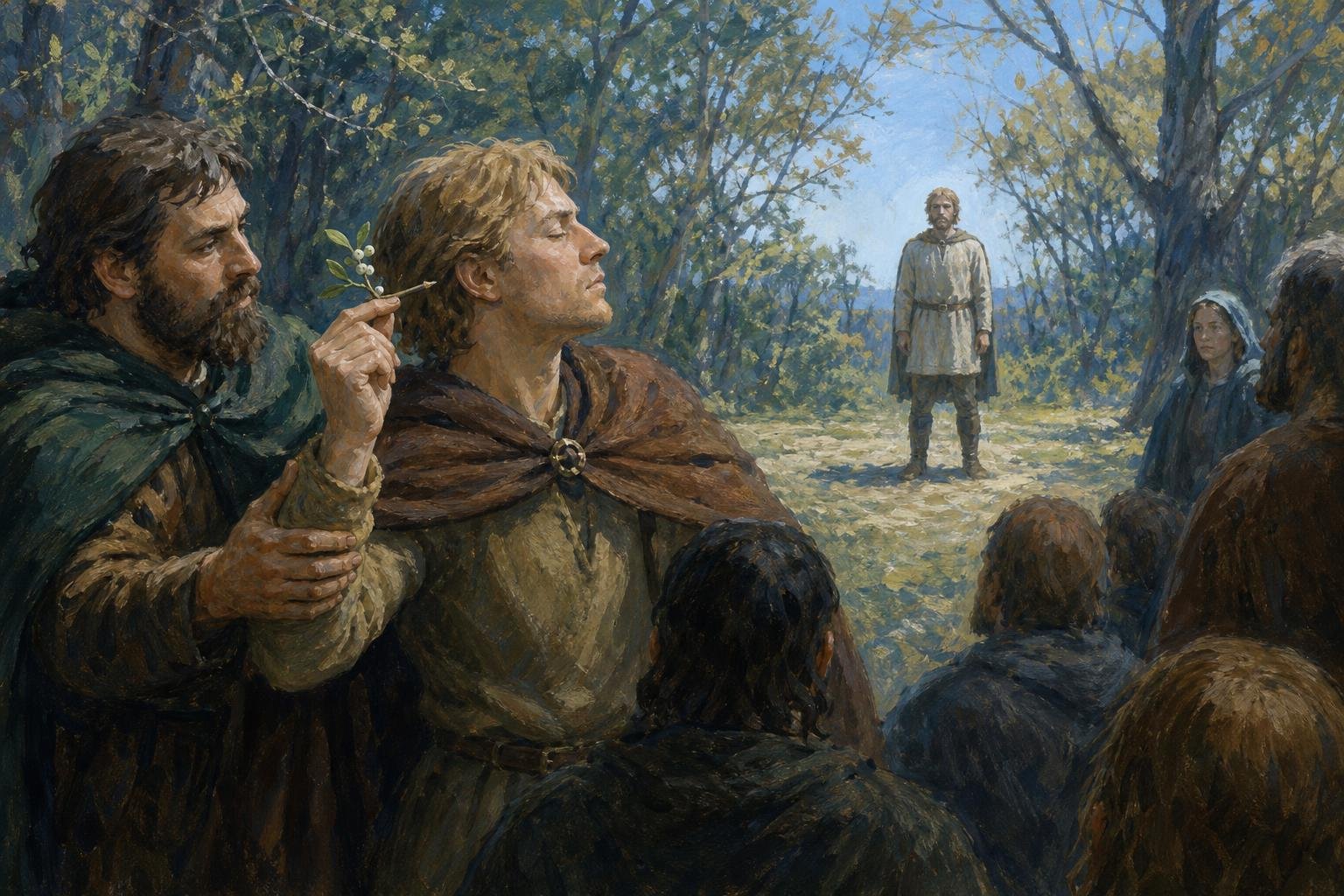
Baldr was Odin's son and the best-loved of the Norse gods. The gods saw his death coming and tried to prevent it, but their precautions failed. A dart of mistletoe killed him in front of them. His blind brother Höðr threw it and Loki guided it, and when the gods tried to bring him back from Hel, one refusal kept him there. Baldr is remembered above all for his death, but the poems promise his return after Ragnarök. The fullest account is Snorri Sturluson's Prose Edda, written in Iceland around 1220. Older poems and a Danish history tell parts of the story differently.
In This Article
- His Parents, Wife, and Son
- Why He Is Called a God of Light
- The Dreams That Warned of His Death
- Loki, the Mistletoe, and Höðr's Throw
- Hringhorni and the Funeral Pyre
- Hermóðr's Ride and Váli's Revenge
- A Different Version From Denmark
- Key Takeaways
- Frequently Asked Questions
- Death Is Not Baldr's Ending
His Parents, Wife, and Son
Baldr is the son of Odin and Frigg. Thor is his half-brother, born to Odin and the giantess Jörð. Höðr, the brother who will kill him, is another of Odin's sons.
His wife is Nanna, daughter of Nep. Their son Forseti keeps a hall called Glitnir, and anyone who brings a dispute there leaves reconciled.
Baldr's own hall is Breidablik. Nothing unclean can exist there.
Why He Is Called a God of Light
Snorri describes Baldr as radiant but does not assign him control over light. What the sources describe is how he looks: he is so fair of face and so bright that light shines from him. The whitest of plants is called Baldr's brow after him.
Snorri's account praises more than Baldr's appearance: he is also the wisest of the gods, gracious and fair-spoken. Those qualities establish what the gods stand to lose. Their admiration for him makes the killing during their game, and their failed attempt to recover him, especially bitter.
The Dreams That Warned of His Death
Baldr dreamed that his life was threatened. Frigg answered the dreams with oaths. Fire, water, iron and all metals, stones, earth, trees, diseases, animals, birds, poisons and snakes each swore not to harm him.
The gods then turned his safety into a game. They threw weapons and stones at him and watched each one fail.
The poem Baldrs draumar ("Baldr's Dreams") tells the warning another way. Odin rides Sleipnir down toward Hel and wakes a dead seeress from her grave, giving his name as Vegtamr. She tells him the mead is already brewed for Baldr's arrival among the dead. Then she names the killer: Höðr.
Loki, the Mistletoe, and Höðr's Throw
Frigg's oaths had one gap, and Loki found it. Disguised as a woman, he visited Frigg at her hall, Fensalir, and asked whether everything had sworn. She told him about a young shoot growing west of Valhalla, the mistletoe. It had seemed too young to ask.
Loki pulled it up and went looking for Höðr. He found him standing apart from the game, because Höðr was blind and had nothing to throw. Loki offered to guide his aim.
Snorri calls the death of Baldr the worst misfortune ever to befall gods and men. The mistletoe passed through him. Baldr fell dead, and the gods were struck speechless.
Hringhorni and the Funeral Pyre
The gods carried Baldr's body to his ship, Hringhorni, to burn him on it, but they could not move it. They sent to the land of the giants for the giantess Hyrrokkin. She arrived riding a wolf with vipers for reins and launched Hringhorni with a single push, so hard that fire flew from the rollers.
Nanna saw her husband's body and died of grief. She was laid on the pyre beside him. Thor consecrated the fire with his hammer and, in a flash of temper, kicked a dwarf named Litr into the flames.
Odin placed his gold ring Draupnir on the pyre. Every ninth night, eight rings of equal weight drip from it. Baldr's horse went onto the fire in full harness.
Hermóðr's Ride and Váli's Revenge
Vengeance, at least, came quickly. Váli, the son of Odin and Rindr, kills Höðr when he is one night old. Baldrs draumar adds that he would not wash his hands or comb his hair until he had brought Baldr's killer to the pyre.
The rescue mission began earlier. In Snorri's account, Frigg asked for a volunteer soon after Baldr fell, before the funeral. Hermóðr, another of Odin's sons, rode Sleipnir to Hel. Baldr sent Draupnir back to Odin. Nanna sent linen to Frigg and a ring to Frigg's attendant Fulla.
Hel told Hermóðr that she would release Baldr only if every creature and object wept for him. The gods sent messengers throughout the world to ask all things to weep. The rescue failed when a giantess calling herself Þökk refused to weep, leaving Baldr with Hel. Gylfaginning, chapter 49, reports that people believed she was Loki in disguise. If so, Loki had not only brought about Baldr's death but also blocked his release.
A Different Version From Denmark
In Saxo Grammaticus's Gesta Danorum, written in Latin around 1200, the story is a feud between rivals. Balderus is a demigod son of Othinus, portrayed differently from the beloved god in Snorri's account. Høtherus is a human hero. Both want Nanna, and she marries Høtherus.
There is no mistletoe and no Loki. Høtherus wounds Balderus with the help of a magic sword, and Balderus dies three days later.
The avenger is Bous, son of Othinus and Rinda. Like Váli, he avenges Baldr, but Bous dies from wounds received fighting Høtherus, while Váli survives Ragnarök. Saxo's Baldr is killed by a rival in love. Høtherus uses deception and receives supernatural help, but Loki's mistletoe plot is absent, and Balderus does not return.
Key Takeaways
- Snorri praises Baldr's beauty, wisdom and gracious speech.
- Loki used the one thing Frigg never asked, the mistletoe, and Höðr's blind throw to kill him.
- The whole world wept for him except Þökk, so the rescue failed. He returns only after Ragnarök.
Frequently Asked Questions
What is Baldr the god of in Norse mythology?
Baldr is best known for his radiance, wisdom and death. For the distinction behind the "god of light" label, see "Why He Is Called a God of Light" above.
Is Baldur a real Norse god?
Yes. Baldur is a modern spelling of Baldr, a god found in medieval Icelandic sources and in Saxo's Danish history. If you know only the video-game Baldur, the medieval texts show a gentler figure. Much less survives about how people worshipped him than about the stories told of him.
How is Thor related to Baldur?
Thor is Baldur's half-brother through their father, Odin. Thor's mother is Jörð and Baldr's is Frigg. At the funeral, Thor consecrates Baldr's pyre with his hammer.
Are Baldr, Balder, and Baldur different gods?
No. They are one god under three spellings. Baldr is the Old Norse form, Baldur follows modern Icelandic spelling, and Balder is familiar from older English books. Matthew Arnold's poem Balder Dead was published in 1855. Saxo's Latin Balderus is the same figure too, though his story differs sharply.
Does Baldr return to life after Ragnarök?
Yes. According to Völuspá and Snorri, he comes back from Hel once the old world has ended. Völuspá says that in the new world fields bear grain without being sown. Baldr and Höðr live together in peace in Odin's old halls.
Death Is Not Baldr's Ending
Frigg's protection and Hel's condition have the same weakness: each depends on having no exceptions. Mistletoe breaks the first safeguard; Þökk defeats the second. Baldr's return after Ragnarök offers a different resolution. He lives alongside Höðr rather than remaining separated from the brother who killed him. Where vengeance answers death with another death, the renewed world allows both brothers a future. That reconciliation distinguishes the Icelandic ending from Saxo's account of rival lovers.