
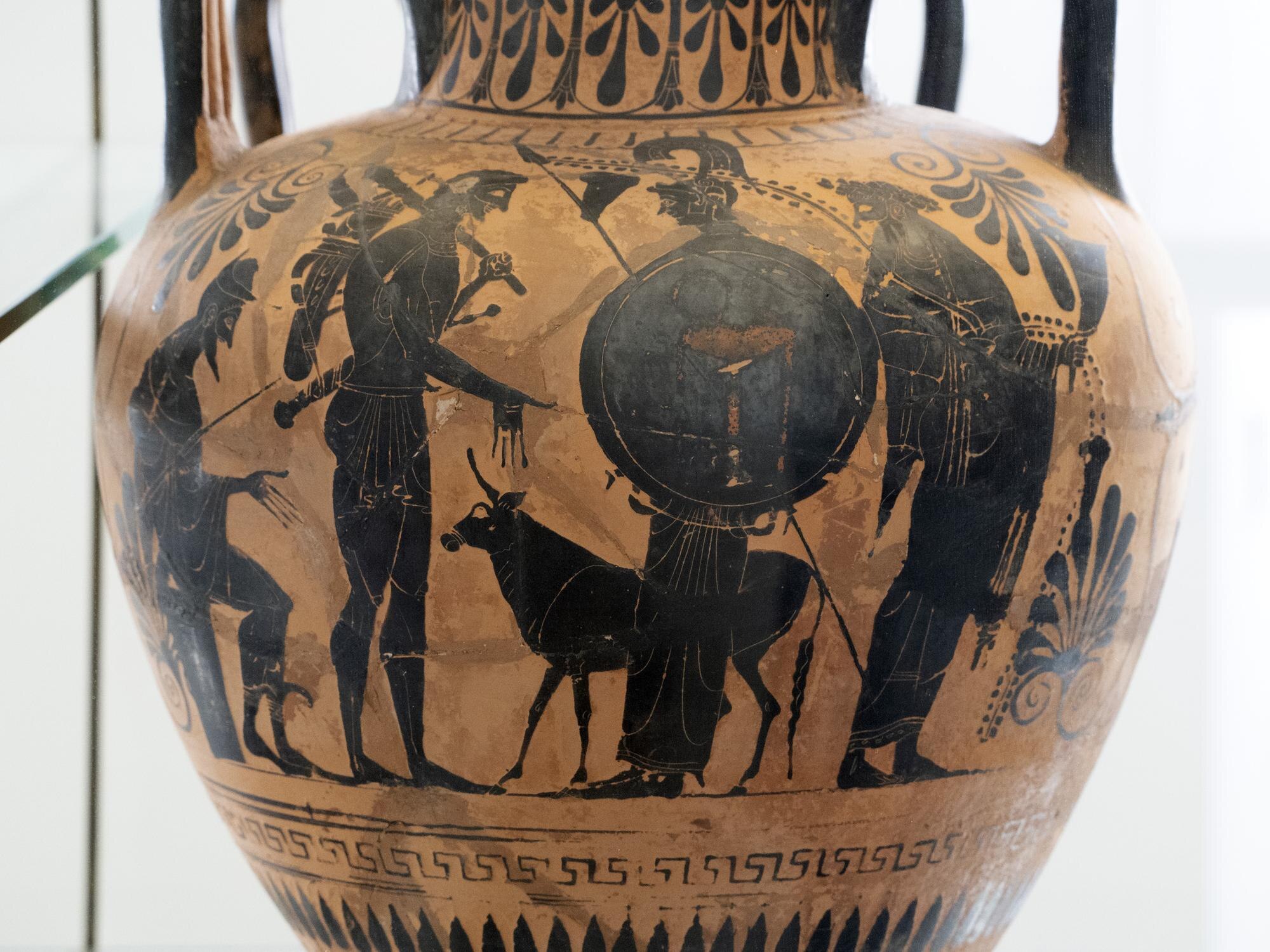
What is mythology? It is a people's traditional stories about gods, heroes, and beginnings, and the study of those stories. This article follows how myths explain the world and express values, from Greek tales to living Hindu traditions.
In This Article
- What the Word Mythology Means
- What Myths Do for the People Who Tell Them
- How Myths Differ From Legends and Fables
- Common Kinds of Myths
- How Myths Were Passed Down
- Three Classical Examples: Atlas, Echo, and the Phoenix
- Myths From Other Traditions
- Key Takeaways
- Frequently Asked Questions
- Understand the Culture Behind the Story
What the Word Mythology Means
Mythology comes from Greek mythologia: mythos, “story,” and -logia, “account” or “discourse.” For Homer, mythos could mean forceful speech, such as a battlefield command. Plato later contrasted it with reasoned argument, yet ended his Republic with the Myth of Er, a soldier's account of judgment after death.
What Myths Do for the People Who Tell Them
Myths connect an explanation with a value. They can also support ritual, affirm social rules, and guide people through life's transitions. Scholars emphasize different mechanisms: Max Müller traced gods to poetic names mistaken for beings; James Frazer linked myths of dying and reviving gods with vegetation rituals; Bronisław Malinowski treated myth as a charter validating customs; Claude Lévi-Strauss examined how narrative structures mediate contradictions. Joseph Campbell proposed four functions: evoking awe, picturing the cosmos, supporting social order, and guiding individuals. These are interpretive approaches, not a single agreed explanation.
In the Homeric Hymn to Demeter, Hades carries Persephone underground. Her grieving mother, Demeter, stops the crops growing. Zeus orders Persephone's return, but eating a pomegranate seed binds her to spend part of each year below. The story links the farming year to a mother's loss: Demeter's grief can starve the world.
How Myths Differ From Legends and Fables
Myths concern gods and extraordinary beings; legends attach to supposedly historical people, such as King Arthur. Fables teach morals: Aesop's fox dismisses unreachable grapes as sour. The boundaries overlap. Achilles fights at Troy, a war Greeks treated as history, yet his divine mother, Thetis, reveals his choice between lasting glory and a long life. Myth gives a soldier's decision consequences beyond ordinary time.
| Form | Typical distinction |
|---|---|
| Myth | Often sacred; concerns gods, origins, or an earlier world. |
| Legend | Presented as historical; usually concerns human figures in a recognizable world. |
| Folktale | In a narrower sense, a traditional story told as fiction rather than history. |
| Fable | A brief story teaching a moral, often through animal characters. |
These are tendencies, not fixed boundaries; “folktale” can also be an umbrella term that includes fables.
Common Kinds of Myths
Creation and origin myths explain beginnings; hero stories test exceptional figures. Flood and end-of-world myths describe destruction. In Hesiod's Theogony, Kronos swallows his children to prevent his overthrow. Rhea saves Zeus by substituting a swaddled stone. Creation unfolds through a family's struggle over succession. In the Epic of Gilgamesh, Ea warns Utnapishtim to build a boat. After the flood, a raven finds food and does not return, signaling that the waters are falling.
How Myths Were Passed Down
Before writing, myths circulated through performances at festivals and rituals. Retellings changed details; writing preserved particular versions without making them universal. Around 1220, the Christian Icelandic poet Snorri Sturluson wrote the Prose Edda to explain old poetic references. Understanding why gold could be called “Sif's hair” required knowing the myths. His handbook preserved them for poets while framing the gods as ancient human kings.
Three Classical Examples: Atlas, Echo, and the Phoenix
After the Titans lose their war against Zeus, Atlas must hold up the sky. His punishment explains its support while showing the cost of opposing the Olympians. In Ovid's Metamorphoses, Juno condemns Echo to repeat others' last words. Rejected by Narcissus, she wastes away until only her voice remains. The returning sound becomes a story of consuming love. Herodotus records an Egyptian account of the phoenix arriving from Arabia every 500 years, carrying its dead father in myrrh. He doubts the story; later writers add rebirth from the old bird's remains. The changing account shows myths crossing borders.
Myths From Other Traditions
Beyond these classical examples, stories give different weight to sacrifice and renewal. Odin's pursuit of wisdom and Osiris's fate connect divine suffering with human concerns.
Norse Mythology
Odin gives an eye for wisdom at Mímir's well. In Hávamál, he hangs wounded for nine nights on the world tree before taking up the runes. Fenrir swallows him at Ragnarök, yet Völuspá describes earth rising green afterward. Knowledge costs dearly, and courage matters even when defeat is known.
Egyptian Mythology
In Plutarch's On Isis and Osiris, Set traps Osiris in a chest and throws it into the Nile. Isis recovers him, but Set scatters his body across Egypt. Her search restores Osiris, who becomes ruler of the dead. Their son Horus challenges Set for the throne, linking rightful succession with hope after death.
Hindu Traditions
Vishnu's avatars include Rama and Krishna. In the Bhagavad Gita, Krishna says he appears whenever dharma, or right order, declines. Shiva embodies destruction and transformation; as Nataraja, he dances within a ring of fire. These stories remain part of living worship, not only texts preserved from antiquity.
Key Takeaways
- Mythology means a culture's traditional stories and their study.
- Myths explain origins, express values, support rituals, and guide lives; theorists interpret these functions differently.
- Myths overlap with legends and fables, while retelling and recording shape the versions that survive.
Frequently Asked Questions
What is world mythology?
World mythology studies cultures' myths side by side. Comparing flood stories or heroes' trials reveals shared questions without treating each culture's answers as interchangeable.
What is the purpose of mythology?
Mythology explains origins, expresses values, supports rituals and social order, and helps people navigate life's changes. At Eleusis, the Mysteries honored Demeter and Persephone for centuries, giving stories about death a communal form.
Is a myth a true story?
“Myth” describes a story's cultural role, not a verdict on whether events happened. A sacred narrative can function as myth when understood literally or symbolically.
Is the Bible considered mythology?
Some scholars apply “myth” to biblical narratives. Many Jews and Christians reject that label, understanding scripture as revelation or history. Usage depends on the interpretive framework.
What is a myth, in simple words?
A myth is a traditional story, often about gods or heroes, that explains something important about life. Its importance helps keep it in circulation.
Which kind of mythology belongs to a whole culture instead of a single author?
Cultural mythology belongs to a people's shared tradition. Homer and Snorri recorded inherited material; a modern novelist's invented world remains authored fiction, even when it borrows mythic forms.
Understand the Culture Behind the Story
A teller's purpose shapes what survives. Reading Snorri as a poet teaching other poets, for example, helps explain his choices. Demeter's story connects divine grief with the farming year, bringing the gods into the daily need for food. Ask who told a myth and for whom: those questions connect the story to the culture that carried it.