
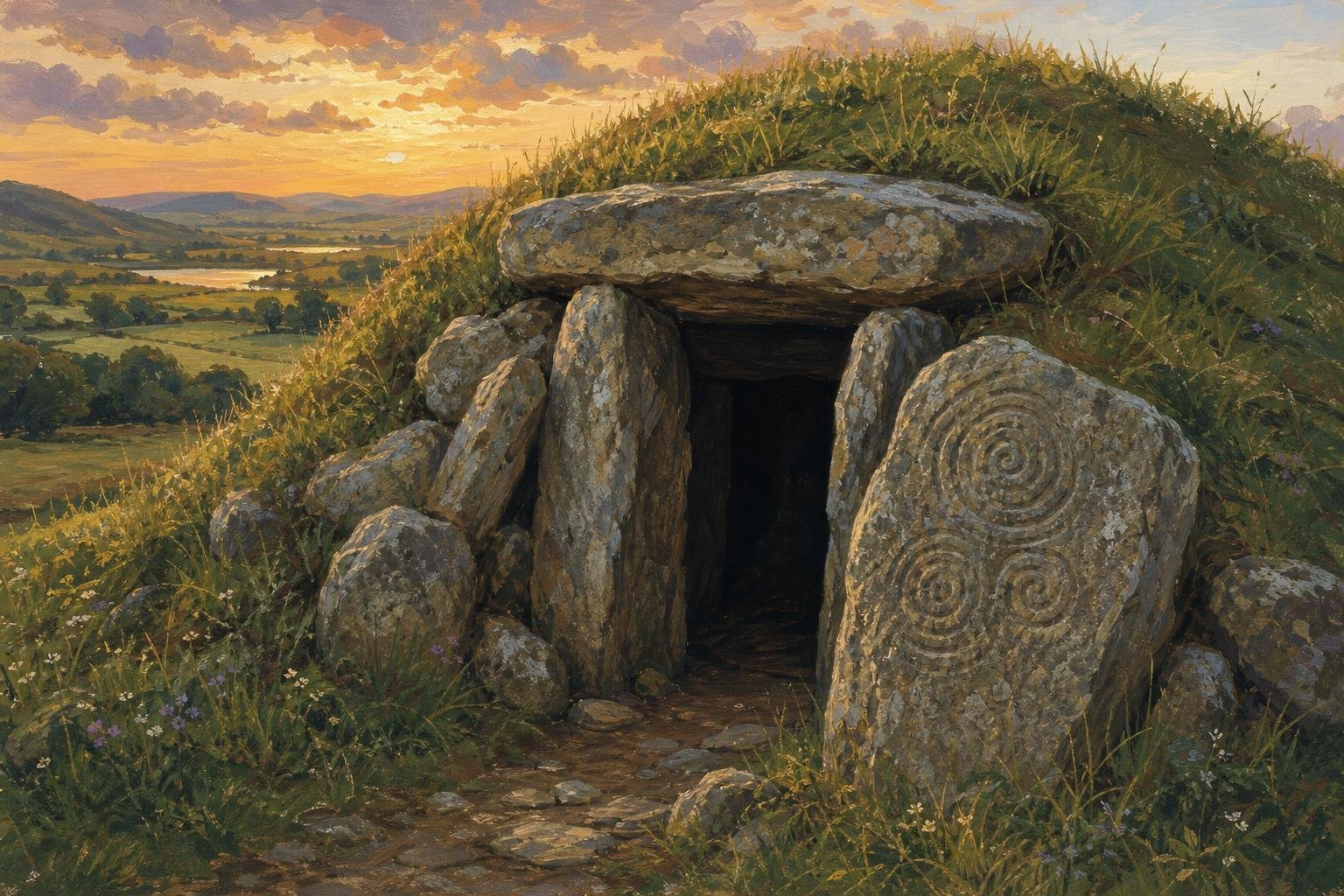
Celtic mythology brings together the stories of gods, heroes, and supernatural encounters told in Ireland, Wales, and other Celtic-speaking regions. Its memorable moments include Cú Chulainn defending Ulster alone and a king losing his right to rule when he loses a hand. The stories below offer a route through those adventures, from Ireland’s battles of Mag Tuired to the Welsh tales of Rhiannon and Blodeuwedd.
In This Article
- Why the Regional Differences Matter
- Where the Stories Survive
- How the Four Irish Story Cycles Work
- The Irish Gods and the Battles of Mag Tuired
- The Irish Heroes and Journeys to Know
- The Welsh Tales and Their Central Characters
- What the Otherworld Means
- Key Takeaways
- Frequently Asked Questions
- Start With a Story Cycle
Why the Regional Differences Matter
Ériu meets the incoming sons of Míl with a request: let the island they are claiming bear her name. The poet Amergin promises that it will. Ireland’s name is connected with hers, making this encounter between a supernatural woman and newcomers a story about the land itself. A name on a map becomes the outcome of a negotiation.
That connection to a particular place runs throughout Celtic mythology. Irish and Welsh belong to different branches of the Celtic language family, and their stories give supernatural figures distinct homes and relationships. Across the sea, Epona’s association with horses appears in inscriptions and images from parts of the Roman world. Her surviving evidence takes us into a different setting from Ériu’s encounter with the sons of Míl.
Place is the first useful thread to follow; the second is what survives of the story. Much of what readers encounter as ancient Celtic mythology comes through medieval Irish and Welsh writing. Celtic folklore also includes later local customs and storytelling. Moving between them means following traditions that continued to grow, with a particular river, court, or community giving each tale its shape.
Where the Stories Survive
The Book of the Dun Cow puts Irish mythology on a physical page: dark writing on parchment, arranged in columns, with enlarged initials marking divisions in the text. Its pages preserve an important early witness to the Táin Bó Cúailnge. The Book of Leinster preserves another major version. Read a translation of either and you enter a story that reached its surviving form through the work of scribes.
Those scribes gathered more than adventures. Heroic narrative shares manuscript space with genealogy and religious learning. Earlier writing and oral traditions fed these collections, which were copied in Christian societies. Their variety helps explain why a tale can move comfortably between a supernatural encounter and a concern with ancestry or rightful rule.
Welsh stories survived through similar acts of preservation. The White Book of Rhydderch and the Red Book of Hergest both contain the Four Branches of the Mabinogi. Editions called The Mabinogion include additional tales alongside those branches, giving readers a wider collection.
Other evidence is briefer but striking. On the Roman-period Pillar of the Boatmen from Paris, the name Cernunnos appears alongside an antlered figure. Here the surviving encounter is with a named image, while the manuscripts give us dialogue and extended plots. Each preserves something the other cannot supply.
How the Four Irish Story Cycles Work
The four cycles offer four different ways into Irish narrative. In the Mythological Cycle, Nuadu’s battle injury becomes a crisis of kingship among the supernatural peoples who settle Ireland. In the Ulster Cycle, Cú Chulainn stands against the invasion of his province while its other warriors lie incapacitated.
The Fenian Cycle follows Fionn mac Cumhaill and the fíanna, warrior bands whose hunting and adventures take them beyond settled courts: Diarmuid’s flight with Gráinne turns companionship into pursuit. In the Historical Cycle, also called the Cycles of the Kings, Suibhne’s clash with sacred authority costs him his royal place and sends him into exile. These rulers inhabit stories where dynastic memory meets supernatural consequence.
Choose the conflict that interests you most:
| Irish story cycle | Best for readers who enjoy | Central figures | Representative tale | Signature conflicts |
|---|---|---|---|---|
| Mythological Cycle | Gods, magical treasures and supernatural battles | Tuatha Dé Danann; the Dagda; Lugh | Cath Maige Tuired (The Second Battle of Mag Tuired) | Tuatha Dé Danann versus Fomorians; rivalry over rule of Ireland |
| Ulster Cycle | Heroic combat, honour and tragic loyalties | Cú Chulainn; Conchobar mac Nessa; Medb | Táin Bó Cúailnge (The Cattle Raid of Cooley) | Ulster versus Connacht; individual duty versus personal ties |
| Fenian Cycle | Wilderness adventures, warrior bands and doomed romance | Fionn mac Cumhaill; Oisín; Diarmuid; Gráinne | Tóraíocht Dhiarmada agus Ghráinne (The Pursuit of Diarmuid and Gráinne) | Loyalty to Fionn versus love; pursuit and survival |
| Historical Cycle / Cycles of the Kings | Legendary rulers, royal legitimacy and supernatural encounters | Cormac mac Airt; Niall of the Nine Hostages; Suibhne | Buile Shuibhne (The Frenzy of Suibhne) | Kingship versus sacred authority; exile and loss of status |
Following a character across several tales reveals another pleasure of the cycles: a familiar reputation can acquire fresh weight in a new conflict. Versions differ and groupings sometimes overlap, so each tale also rewards attention on its own. These are routes through Irish stories; the Welsh narratives have their own connected sequence.
The Irish Gods and the Battles of Mag Tuired
Nuadu wins a battle and loses a kingship. In the first battle of Mag Tuired, the Tuatha Dé Danann defeat the Fir Bolg, but their king loses a hand. His bodily injury makes him unfit to rule. Even a silver replacement cannot make that loss a simple matter of repairing a weapon or replacing armor.
The question of fitness returns under Bres, whose oppressive rule helps drive the conflict with the Fomorians in the second battle. Lugh offers a different claim to authority: an exceptional combination of skills. The coming struggle needs craft as well as force, and the supernatural people’s survival depends on bringing their abilities together.
Then Balor’s eye opens. Attendants raise its heavy lid so its destructive power can strike the opposing army. Lugh answers with a slingstone, driving the eye through the back of Balor’s head. The weapon meant to destroy Lugh’s side turns against the Fomorians. Balor falls through the very feature that makes him terrifying.
Other Celtic gods become memorable through possessions and actions. The Dagda’s great cauldron belongs with his abundance, physical power, and authority. The Morrígan intervenes in battle and proclaims its outcome. Brigid’s associations in medieval learned tradition include poetry, healing, and smithcraft. The following figures show how closely such powers attach to particular encounters:
| Mythological figure | Tradition | Principal associations | Named narrative evidence | Interpretive caution |
|---|---|---|---|---|
| The Morrígan | Irish | Battle, prophecy and the fate of warriors | Cath Maige Tuired: aids the Túatha Dé Danann and proclaims the battle’s outcome | Her battlefield role includes prediction and supernatural intervention, not fighting alone. |
| Núadu | Irish | Kingship, martial leadership and bodily wholeness | Cath Maige Tuired: loses an arm in battle; receives a silver replacement | A warrior king of the Túatha Dé Danann, not an exclusive ruler of war. |
| Bóand (Boann) | Irish | River Boyne, a supernatural well and dangerous knowledge | Dindshenchas: waters from Nechtan’s well pursue her, forming the Boyne | The association concerns a named river and its origin, not authority over all water. |
| Manannán mac Lir | Irish | Sea travel and passage into an Otherworld landscape | Immram Brain: crosses a flowering plain where Bran sees the sea | Sea and Otherworld imagery overlap; neither forms an exclusive divine jurisdiction. |
| Arawn | Welsh | Annwfn, supernatural kingship and encounters across worlds | First Branch of the Mabinogi: exchanges appearances and kingdoms with Pwyll | Annwfn is an Otherworld realm, not simply a synonym for the land of the dead. |
Danu is harder to meet through an episode. Her familiar description as a mother goddess rests heavily on interpreting names and reconstructing relationships. Ériu, by contrast, speaks and negotiates in the encounter described earlier. The difference matters most when you want a story to read: some names come with extensive action, others with unresolved questions.
The Irish Heroes and Journeys to Know
A bull sets the Táin Bó Cúailnge, or Cattle Raid of Cooley, in motion. Queen Medb of Connacht wants the great brown bull of Cooley, and her invasion makes Cú Chulainn Ulster’s chief defender. The repeated single combats narrow a provincial war into encounters between individuals. Victory becomes painfully personal.
Its sharpest cost emerges when Cú Chulainn faces Fer Diad, his former companion in arms. Their shared past makes the fight more than another test of strength. Across the wider Ulster Cycle, a geis, a binding prohibition or obligation, can likewise turn an honorable commitment into danger. A hero may possess extraordinary power and still have no safe choice.
The Children of Lir places endurance at the center instead. Lir’s wife Aoife transforms his four children into swans. They spend 300 years on the Sea of Moyle. They retain human speech and their loyalty to one another. The familiar tale eventually carries them into a Christian setting, making their long exile a passage between worlds as well as places.
Oisín’s journey to Tír na nÓg gives separation a different shape. In a familiar later version, Niamh brings him to the Otherworld, but he longs for Ireland. He returns on horseback with a warning not to touch the ground. When he falls, elapsed time catches up with him. His return answers the longing for home while taking away the life he hoped to recover.
The Welsh Tales and Their Central Characters
Pwyll, prince of Dyfed, takes another ruler’s place in the First Branch of the Mabinogi. His exchange of appearances and responsibilities with Arawn, ruler of Annwn, makes honor a practical test: how will he behave when he wears someone else’s identity? His later relationship with Rhiannon brings another test of judgment. After their infant disappears, she is wrongly accused and endures a degrading punishment before the truth emerges.
Rhiannon’s marvelous arrival and associations with horses have encouraged readings of an earlier divine identity. Within the tale, however, her ordeal develops through a household’s response to an apparent crime. Reputation can be damaged by what others think they know, and restoring it takes more than her own testimony.
Branwen’s marriage to the Irish king Matholwch carries that problem into relations between kingdoms. Mistreatment and failed reconciliation lead her brother Bendigeidfran, also called Bran the Blessed, to bring an expedition to Ireland in the Second Branch. A cauldron that restores dead warriors to life prolongs the catastrophe. The Third Branch follows survivors into an emptied, enchanted Dyfed, where Manawydan’s patient reasoning achieves what military force cannot.
In the Fourth Branch, Math and Gwydion make Blodeuwedd from flowers as a wife for Lleu Llaw Gyffes, who is forbidden to marry a human woman. She conspires with Gronw Pebr to kill Lleu by exploiting the unusual conditions under which he can be attacked. After the plot fails, Gwydion transforms her into an owl. The wife made to answer one prohibition receives another existence as punishment for betraying her husband.
What the Otherworld Means
In The Voyage of Bran, Manannán mac Lir travels across a flowering plain where Bran sees the sea. What looks to the human voyager like water is, to Manannán, country he can cross. The force of the encounter lies in that simultaneous difference: Bran has reached a place whose nature his own sight cannot fully disclose.
Such encounters give the Otherworld several forms. Irish supernatural dwellings may lie within or beneath síd mounds; other tales lead across water to islands or distant lands. The aos sí, the supernatural people associated with these dwellings, can grant favors or cause serious harm. An agreement with them carries consequences, just as an agreement with a human ruler does.
Time can make those consequences devastating, as Oisín’s return shows. Tír na nÓg means “Land of Youth,” and the promise contained in that name creates the cost of leaving it. Welsh Annwn, also spelled Annwfn, gives encounters across worlds a courtly setting in the First Branch, where hospitality and honor govern Pwyll’s exchange. Other Welsh texts give it different associations. Across Celtic myths, crossing a boundary often means becoming responsible to rules you did not make.
Key Takeaways
- Follow a figure’s home and surviving story: Ériu’s naming encounter and Epona’s inscriptions offer different kinds of evidence.
- Choose an Irish cycle by its central conflict, then follow its characters across individual tales.
- Read supernatural powers through their consequences: Nuadu’s injury changes who can rule.
- The Four Branches connect personal decisions with consequences that reach households and kingdoms.
- Otherworld journeys test agreements and belonging, with Oisín’s return showing the cost of crossing back.
Frequently Asked Questions
Who Was the Main Celtic God?
Celtic traditions had different divine leaders, with the Dagda a major authority among Ireland’s Tuatha Dé Danann. Nuadu and Lugh also hold central leadership roles in the Mag Tuired stories.
What Is Celtic Mythology Known For?
Celtic mythology is known for supernatural transformations and heroes caught in binding obligations. The Children of Lir makes transformation especially moving by allowing the swan-children to retain human speech and family attachments.
Who Are the Gods of the Celts?
They include Irish figures such as the Dagda and Brigid, alongside deities such as Epona known from the Roman world. The stories above show the Irish figures acting within a supernatural community, while Epona’s surviving inscriptions and images document her horse associations.
Is Celtic Mythology the Same as Irish Mythology?
Irish mythology is one part of the broader Celtic tradition, which also includes Welsh stories and evidence from other Celtic-speaking regions. The Four Branches provide a substantial Welsh starting point alongside Ireland’s story cycles.
Are These Stories Records of Ancient Religious Beliefs?
These stories preserve material relevant to earlier beliefs through medieval literary versions. The Christian setting in the familiar Children of Lir shows how inherited supernatural material could become part of a story shaped by later religious life.
Start With a Story Cycle
Choose the Táin if you want heroic conflict whose cost grows with every encounter; the fight between Cú Chulainn and Fer Diad gives its loyalties their hardest test. Choose the Four Branches if you prefer a connected sequence in which household decisions become public disasters. Read them in order, beginning with Pwyll’s exchange with Arawn.
For gods and supernatural warfare, begin with the second battle of Mag Tuired. Follow Lugh from his demonstration of skills to his confrontation with Balor: ability becomes a claim to leadership, then a means of survival. If you want one scene first, read Lugh’s arrival at the court in Cath Maige Tuired.