
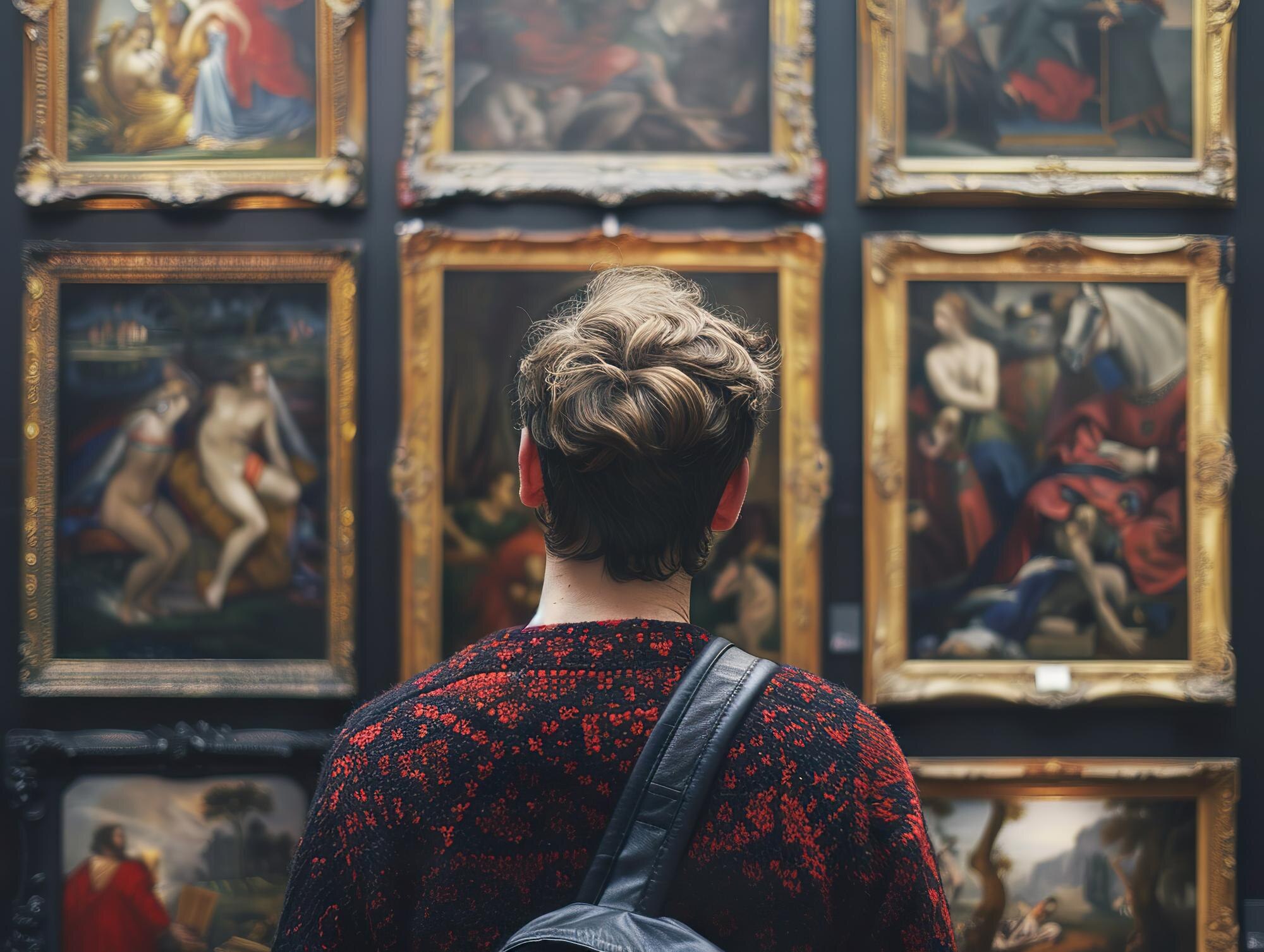
Masaccio makes a tax payment feel physically convincing in The Tribute Money, one of the famous Renaissance paintings in which perspective becomes part of the drama. Botticelli’s The Birth of Venus and Leonardo’s Mona Lisa make figures compelling through very different uses of paint. These five artist-led highlights follow those differences through individual works: what happens in each picture, and what makes that action persuasive or strange.
In This Article
- 1. Masaccio
- 2. Sandro Botticelli
- 3. Leonardo da Vinci
- 4. Michelangelo and Raphael
- 5. Titian and Agnolo Bronzino
- Key Takeaways
- Frequently Asked Questions
- Start With What You Can See
1. Masaccio
In The Tribute Money, c. 1425–1427, Christ tells Peter to find a coin in a fish’s mouth to pay a tax. Masaccio’s fresco in Florence’s Brancacci Chapel gives this unlikely solution the solidity of an ordinary encounter. The figures stand on shared ground, their robes and faces shaped by light. They have weight.
Peter appears more than once. At the center, he receives Christ’s instruction; at the left, he finds the coin; at the right, he pays. Pointing arms carry the story between these moments without borders separating them. The architecture helps establish depth through linear perspective, but the space contains several stages of one action.
That combination makes the miracle unusually practical. The coin must pass from the fish to Peter and finally into someone else’s possession. After the central gathering and the discovery at the water, Masaccio brings the story to its businesslike finish: Peter paying the tax collector.
2. Sandro Botticelli
Sandro Botticelli’s The Birth of Venus, painted around 1484–1486, brings the goddess toward shore on a shell. Wind carries her forward; a waiting attendant holds out a flower-patterned cloak. Everything prepares for her arrival, yet Venus herself seems suspended within the movement.
Her pose recalls ancient statues of the modest Venus. Botticelli stretches that inherited body into something less securely balanced: the neck lengthens above sloping shoulders, and the figure’s elegance matters more than its ability to bear weight. The anatomy bends to the line.
That line continues through her streaming hair and into the fluttering cloak. Unlike Masaccio’s measurable setting, the sea offers little depth to settle into. Your attention keeps returning to edges and curves. Classical mythology supplies the subject, but Botticelli’s idealized beauty depends on liberties taken with the body. The goddess belongs to a world where a flowing contour can exert more force than gravity.
3. Leonardo da Vinci
Leonardo da Vinci’s Mona Lisa, begun around 1503, portrays Lisa Gherardini, wife of the Florentine merchant Francesco del Giocondo. Her folded hands secure the foreground. Her turned shoulders prevent that stability from becoming stiffness, while the expression gives you much less to hold onto.
Around the mouth and eyes, Leonardo uses sfumato: softened transitions that avoid hard edges. Small changes in shadow do work that a sharply drawn line would otherwise perform. The face is carefully constructed, but its expression remains difficult to name. Precision does not produce certainty here.
In The Last Supper, painted in 1495–1498, uncertainty spreads across a whole table. Commissioned under Ludovico Sforza for a Milanese refectory, the painting shows Christ announcing that one disciple will betray him. The apostles react in groups, their hands and faces carrying the shock outward from his still central figure. Perspective lines draw attention back to Christ.
The wall itself could not sustain Leonardo’s experiment. He worked on dry plaster instead of using standard wet-plaster fresco, leaving the paint unusually vulnerable to deterioration. The figures hold together as a drama; the paint layer does not. His experimental method failed to give the image a durable bond with its support.
4. Michelangelo and Raphael
Michelangelo’s The Creation of Adam belongs to the Sistine Chapel ceiling, painted in 1508–1512 for Pope Julius II. God reaches to give Adam life, and the narrow gap between their fingers holds the action in suspense. Adam’s muscular body lies against the earth. God advances within a crowded, wind-filled grouping.
The hands identify the encounter, but the bodies make its force intelligible: one rests while the other approaches with energy. This is High Renaissance art concentrating meaning in idealized anatomy. Raphael’s The School of Athens, painted in 1509–1511 for Julius II’s Vatican rooms, gives bodily gesture a different task.
There, grand classical architecture contains an imagined assembly of thinkers, not a meeting that actually happened. Spacing and balanced groups make the community legible without reducing everyone to the same activity. At the center stand Plato and Aristotle. Their disagreement needs no written exchange: Plato points upward, while Aristotle extends his hand toward the earthly world, his palm facing down.
5. Titian and Agnolo Bronzino
Titian’s Bacchus and Ariadne, painted in 1520–1523, catches its protagonists before either has settled into a pose. Ariadne, abandoned by Theseus, turns toward Bacchus as he leaps from his chariot. A small departing ship establishes what she has just lost. Above her, a constellation anticipates her place among the stars.
Made for Alfonso I d’Este’s rooms in Ferrara, the painting compresses a learned myth into sudden physical action. The art that Renaissance patrons commissioned could display knowledge of the classical past; here, that knowledge arrives with a leap. Strong blues and warm flesh tones separate the protagonists from the noisy procession, giving the encounter clarity without calming it.
Bronzino’s Portrait of Eleonora of Toledo with Her Son Giovanni (1545) refuses that kind of release. Its polished finish and reserve belong to the Mannerist culture that developed beyond the High Renaissance’s balanced ideals. Status and dynastic continuity depend on controlled appearances, not an unfolding adventure.
Eleonora’s composed expression keeps intimacy at a distance. Her richly patterned dress occupies much of the surface, demanding attention without suggesting ease. Where Titian sends a body into the air, Bronzino holds his sitter inside the rigid, unyielding presence of her dress.
Key Takeaways
- Masaccio makes successive events inhabit one convincing space.
- Botticelli’s departures from bodily balance serve his ideal of beauty.
- Leonardo’s expressive control coexists with the material failure of an experiment.
- Michelangelo and Raphael give gestures different kinds of authority.
- Titian’s sudden encounter and Bronzino’s controlled portrait show how far Renaissance painting could stretch without sharing a single style.
Frequently Asked Questions
Who are five famous Renaissance artists?
Leonardo da Vinci, Michelangelo, Raphael, Sandro Botticelli, and Titian are five famous Renaissance artists. Their paintings include religious commissions as well as mythological scenes and portraits, so choosing among them begins with the kind of subject that interests you.
Are all Renaissance paintings painted on canvas?
No: Renaissance paintings also survive on wooden panels and plaster walls. The Mona Lisa uses a poplar panel, while The Birth of Venus uses canvas. Those supports make these movable pictures fundamentally different objects from a painted chapel ceiling.
What is the difference between a fresco and a panel painting?
A true fresco binds water-mixed pigment into wet lime plaster as it sets, while a panel painting uses a prepared wooden support. The distinction concerns how the image is made, not whether its subject is religious. As Leonardo’s damaged wall painting demonstrates, being painted on a wall does not automatically make a work true fresco.
How does Mannerist painting differ from High Renaissance painting?
Mannerist painting can turn the preceding generation’s bodily assurance into conspicuously artificial elegance, as Bronzino’s court portrait shows. Eleonora’s face offers little emotional access despite the extraordinary attention lavished on her appearance. This refinement does not require visibly elongated anatomy to feel remote.
Where can readers see the paintings discussed here?
Readers can see the movable paintings in museums, while the wall paintings remain part of their architectural settings. The Louvre Museum holds the Mona Lisa on its wooden support; the Uffizi Galleries hold Botticelli’s canvas and Bronzino’s portrait, and London’s National Gallery holds Bacchus and Ariadne. The Vatican Museums preserve Michelangelo’s ceiling and Raphael’s painted rooms as spaces you enter. The Last Supper remains at Santa Maria delle Grazie in Milan, where its fragile survival makes Leonardo’s choice of technique a present concern.
Start With What You Can See
For a first encounter, Masaccio offers a story you can follow, while Leonardo’s portrait suits anyone drawn to an expression that resists a settled reading. Neither requires a complete history of the period before it can matter. The visible decisions are already doing the work.
What these paintings share is ambition, not a single destination called realism. Botticelli’s unstable body can be as persuasive as Masaccio’s grounded figures; Bronzino’s reserve can command attention as firmly as Titian’s movement. The remaining puzzle is why such different inventions feel convincing. Historical context explains their subjects and commissions, but it does not settle how much a painted person allows you to know.