
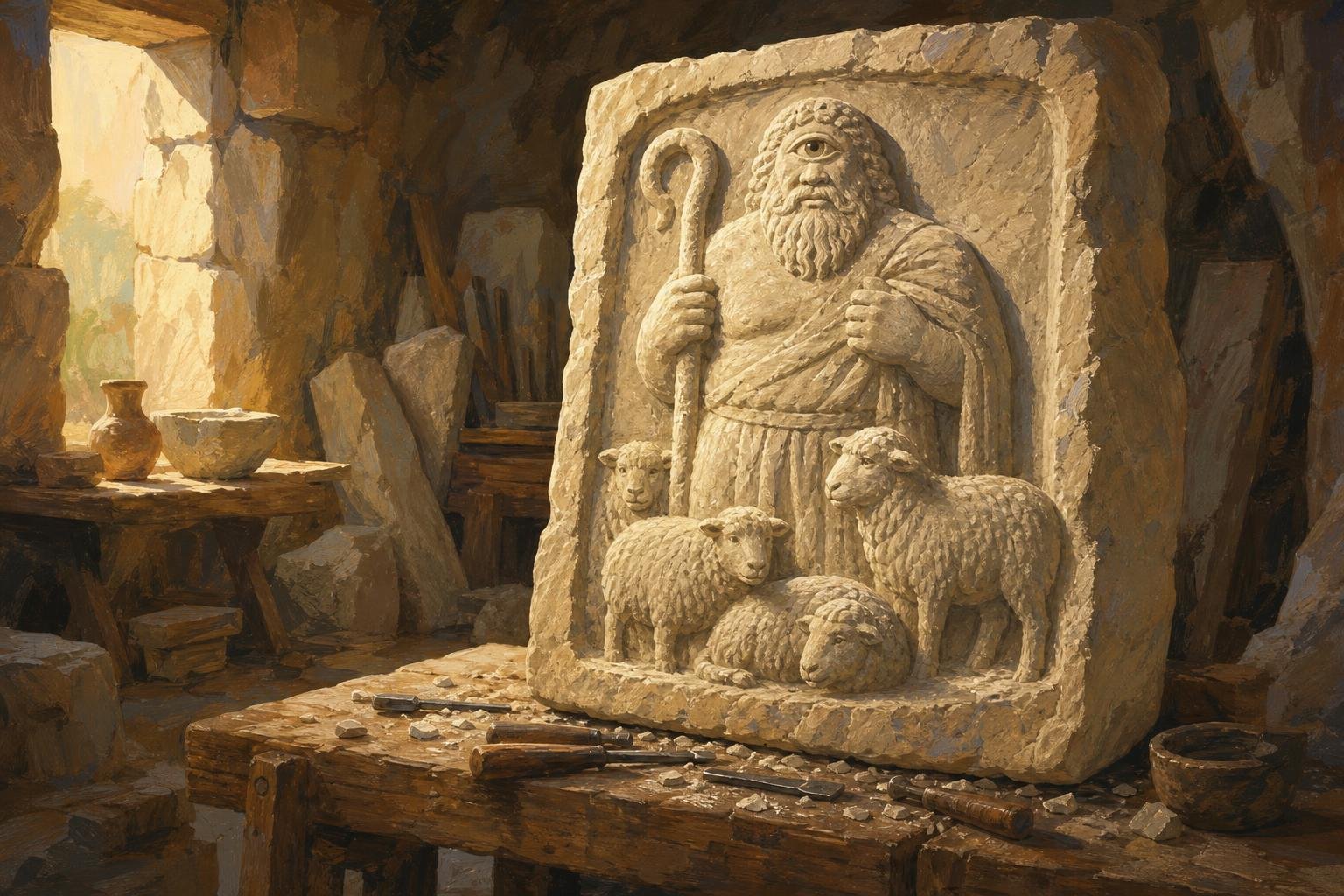
In Greek mythology, a Cyclops is a one-eyed being: some forge Zeus’s thunderbolts, while the most famous, Polyphemus, eats men trapped in his cave. Hesiod’s divine craftsmen and Homer’s enormous shepherd share a single eye, but have different parents and powers. Their stories turn on what extraordinary strength can accomplish, from arming the gods to sealing a cave with a stone the prisoners cannot move.
In This Article
- What Is a Cyclops?
- Where the Divine Cyclopes Come From
- What Powers the Cyclopes Have
- What Happens Between Polyphemus and Odysseus?
- How Later Writers Changed Polyphemus
- Why Ancient Walls Are Called Cyclopean
- Key Takeaways
- Frequently Asked Questions
- One Eye, Different Mythic Roles
What Is a Cyclops?
A single round eye sits in the middle of the Cyclops’s forehead, occupying the center of the face instead of one of two eye sockets. Hesiod explicitly gives his divine craftsmen this feature. The name itself points to it: “Cyclops” comes from Greek words meaning “circle” and “eye,” commonly understood as “round-eyed.” “Cyclops” is singular; cyclopes is the Greek-derived plural.
That eye makes the creature recognizable before you know its story. The familiar description “one-eyed giant” captures its appearance, but leaves its character open. The Cyclops, Greek mythology tells us, can display the skill of a divine smith or the appetite of a man-eating shepherd. Cyclops mythology draws much of its force from that range: the same exceptional strength can make a weapon for a god or leave human beings helpless behind a blocked doorway.
Where the Divine Cyclopes Come From
In Hesiod’s Theogony, the divine Cyclopes are children of Gaia, Earth, and Uranus, Sky. The Cyclops names Brontes, Steropes, and Arges are associated with thunder, lightning, and brightness. Before they ever put weapons into Zeus’s hands, their names announce the force of a storm.
Their first home is a prison inside their own mother. Uranus hides his children within Earth, forcing them down into the darkness instead of letting them emerge. The Cyclopes belong to the early divine generation alongside the Titans and the Hundred-Handers. They share the Titans’ parents, though Hesiod treats them as a distinct group.
Freedom comes through the struggle between those generations. Hesiod credits Zeus with releasing his father’s brothers from their bonds. The mythographic Library, attributed to Apollodorus, gives their imprisonment another turn: Uranus confines them, Cronus releases them, then Cronus imprisons them again. Zeus finally sets them free. The imprisoned craftsmen now have someone to reward, and the weapons they provide help their liberator secure his rule.
What Powers the Cyclopes Have
The divine Cyclopes’ greatest power lies in their hands. In the Theogony, they give Zeus thunder and fashion his thunderbolt. Hesiod joins strength with skill: these beings can make the weapon through which Zeus exercises sovereignty. Their craftsmanship helps establish the new divine order.
The Cyclopes also give Poseidon his trident and Hades his helmet. Each gift equips another divine ruler. Later, in Virgil’s Aeneid, Cyclopes work under Vulcan in a volcanic workshop near Sicily, making divine equipment. The Roman poem gives their labor a setting as formidable as the workers themselves.
Making a god’s weapon also exposes them to a god’s revenge. In the prologue of Euripides’s Alcestis, Apollo explains that Zeus struck down his son Asclepius. Apollo retaliated by shooting the Cyclopes who had made the thunderbolt. Zeus then made him serve the mortal Admetus as punishment. The smiths had armed Zeus; when Apollo could not undo his son’s death, he killed the makers of the weapon.
What Happens Between Polyphemus and Odysseus?
Homer’s Polyphemus is the son of Poseidon and the nymph Thoosa, whose father is the sea deity Phorcys. He keeps sheep and goats in a cave, apart from the other Cyclopes. Their wider community has households and neighbors, but lacks the assemblies and shared laws familiar to Homer’s audience. Polyphemus rules his own household without answering to a common authority.
In Odyssey Book 9, Odysseus enters that household with twelve companions. His men want to take provisions and leave. Odysseus stays, hoping to meet the owner and receive a guest gift. When Polyphemus returns, he rolls a huge stone across the entrance. The visitors have become prisoners.
Odysseus appeals to the obligations of hospitality. Polyphemus refuses them and eats two of his companions. Across three meals, he consumes six men. The cave’s supplies and livestock offer no safety: everything inside belongs to a host who treats guests as food.
Killing that host would trap the survivors. Odysseus realizes that none of them can move the stone, so Polyphemus must remain alive long enough to open the cave. The escape requires a narrower attack. Odysseus gives him powerful wine and says that his name is “Nobody.” Once the Cyclops falls asleep, the men drive a heated wooden stake into his eye.
His cries bring the neighboring Cyclopes to the cave. Asked who is attacking him, Polyphemus answers that Nobody is hurting him. They take the answer as a denial that he is under attack and leave. The false name has defeated the help his own voice summoned.
Blindness still leaves Polyphemus in control of the doorway. As his animals go out, he feels their backs for escaping men. Odysseus binds his companions beneath groups of rams, then clings beneath the largest ram himself. The Cyclops’s hands pass over the animals while the men hang below. Their escape depends on where he fails to reach.
Once aboard his ship, Odysseus throws away the protection of anonymity. He taunts Polyphemus and reveals his real name. Now the injured Cyclops can name his enemy in a prayer to Poseidon. He asks his father to prevent Odysseus from reaching home; if homecoming is fated, let him arrive late and in distress, with all his companions lost, aboard another’s ship, and find trouble waiting at home.
How Later Writers Changed Polyphemus
Polyphemus sings of love in Theocritus; in Ovid, he crushes a rival beneath a massive rock. The singing shepherd appears in Theocritus’s Idyll 11, where the young Cyclops longs for the sea nymph Galatea. He tries to make his appearance and rural possessions sound attractive. The humor comes from his awkward courtship, but his distress is recognizable: strength cannot make someone return his affection.
That frustrated desire becomes murderous in Ovid’s Metamorphoses, Book 13. Jealous of Galatea’s lover Acis, Polyphemus crushes him beneath the rock. Acis is then transformed into a river god. This later Roman treatment gives the giant’s physical power a terrible use: he can destroy the rival he cannot outshine.
Euripides takes the encounter with Odysseus onto the stage in Cyclops, a surviving satyr play. Silenus and a chorus of satyrs enter the escape story, bringing comic behavior into its violence. Between the play and the love poems, Polyphemus acquires more than another adventure. He can be ridiculous or lovesick while remaining dangerous, because the enormous body that makes his courtship awkward also gives his anger deadly force.
Why Ancient Walls Are Called Cyclopean
At Tiryns, the stones themselves explain the appeal of a giant builder. Pausanias says that even the smallest stone in the wall could not be moved by a pair of mules. Faced with blocks of that scale, ancient writers credited the work to Cyclopes. They also associated Cyclopes with the fortifications of Mycenae.
These builders turn exceptional strength toward construction. In ancient Greece, the Cyclopes associated with such walls could handle stones beyond ordinary human lifting power, giving a mythic answer to the question of how the fortifications rose. Pausanias’s description makes the weight, not merely the height of the wall, the astonishing feature.
“Cyclopean masonry” remains an architectural term for construction using very large stones, especially in discussions of Mycenaean fortifications. The walls are human construction; their mythological builders express ancient admiration for the labor involved. Unlike the shepherd’s movable cave barrier, these enormous stones were placed to stay.
Key Takeaways
- Identify the Cyclopes by their story: divine craftsmen, shepherds, and legendary builders have different roles.
- The smiths’ release gives Zeus allies whose skill helps establish his power.
- Odysseus’s plan requires Polyphemus to survive and open the cave; killing him would leave the men trapped.
- The false name protects Odysseus, while revealing his real name gives Polyphemus the means to curse him.
- Later writers make the giant’s strength serve comedy, courtship, and murderous jealousy.
Frequently Asked Questions
How does Poseidon have a Cyclops son?
Poseidon fathers Polyphemus with the nymph Thoosa. Homer names both parents without explaining their son’s single eye; a divine child need not share a parent’s appearance.
Are all Cyclopes sons of Poseidon?
No: Hesiod’s divine Cyclopes are sons of Gaia and Uranus. Poseidon’s famous Cyclops son is Polyphemus, the shepherd who imprisons Odysseus’s men.
What did Zeus do to the Cyclopes?
Zeus freed the divine Cyclopes from imprisonment and received their thunder weapons. When Apollo later killed the craftsmen in revenge for Asclepius’s death, Zeus punished Apollo with service to Admetus.
What did Odysseus do to the Cyclops?
Odysseus blinded Polyphemus with a heated wooden stake after getting him drunk. He escaped beneath the Cyclops’s livestock, then revealed the name Polyphemus used to call down Poseidon’s vengeance.
What is a cyclops?
A cyclops is a one-eyed being from Greek mythology, usually shown as exceptionally large and strong. Its defining feature is the single eye in the middle of its forehead; its occupation might be smith, shepherd, or legendary builder.
One Eye, Different Mythic Roles
The Cyclops brings overwhelming power within reach of a human question: what can strength accomplish, and where does it fail? Zeus’s craftsmen make that power useful through skill. Polyphemus can close a cave with a stone, yet cannot stop men escaping beneath his own animals. His defeat is incomplete because Odysseus then gives him something strength could not win: the name of his enemy.
For understanding these stories, begin with what each Cyclops does with his power. That makes the differences meaningful instead of troublesome. The smith creates authority; the shepherd abuses his own. Their shared eye identifies a kind of being, while their actions determine what each story asks us to admire or fear.