
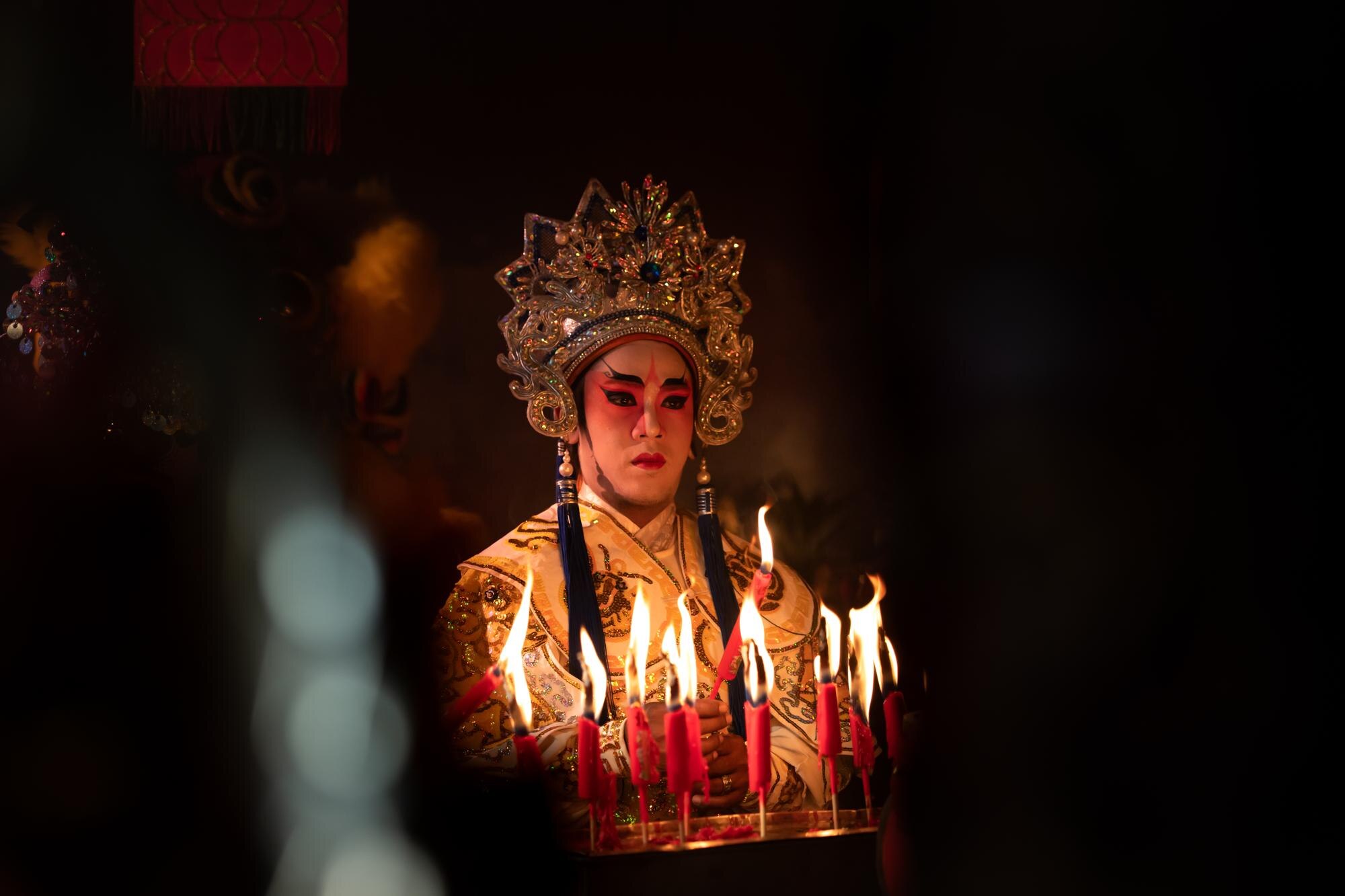
Chinese mythology brings together stories of the world's beginnings, powerful gods, and heroes who change human life. In these stories, a giant's body becomes the earth, and a woman repairs the broken sky with melted stone. They draw on ancient texts and local storytelling, with Daoist and Buddhist traditions shaping how people understand their characters. From creation to the Monkey King's rebellion, the question is often what power should be used for.
In This Article
- Where the Stories Come From
- How Pangu and Nüwa Explain Beginnings
- Who the Gods Are—and Why Their Roles Differ
- How Culture Heroes Shape Human Life
- Why the Moon and Stars Have Human Stories
- What Happens in the Monkey King's Story
- How Festivals and Retellings Keep Stories in Use
- Key Takeaways
- Frequently Asked Questions
- Living Traditions Beyond the Legends
Where the Stories Come From
Chinese myths survive in books, but many have also passed from person to person through storytelling and religious practice. One of their strangest storehouses is the Shanhaijing, or Classic of Mountains and Seas. It describes sacred mountains and extraordinary peoples alongside creatures such as the nine-tailed fox of Qingqiu. A mountain is more than a backdrop here: it can be a deity's home, with unfamiliar life inhabiting its slopes.
That world of encounters takes a different form in the Chu Ci, or Songs of Chu, poetry associated with the ancient state of Chu. Its “Heavenly Questions” presses question after question about cosmic origins and legendary events. Who arranged the world? How did its wonders happen? The poem preserves the excitement of asking, even where the full stories behind its references have been lost.
The Huainanzi, presented at court in 139 BCE, brings myth into discussions of philosophy and government. Nüwa's rescue of the world belongs in that setting: repairing cosmic damage also offers a way to think about restoring order. Later collections carried other accounts forward, while religious traditions gave familiar figures new duties and relationships.
Ming-dynasty novels gave those relationships room to become extended adventures. A brief encounter with a supernatural being could grow into a struggle with motives and consequences. These different forms help explain why a creature catalogue, a poem, and a novel can all preserve Chinese mythology without telling it in the same way.
How Pangu and Nüwa Explain Beginnings
Pangu (盘古) begins inside an enclosed cosmos where Heaven and Earth have not yet separated. As they pull apart, he grows between them, keeping the gap open. The labor lasts as long as his life. When he dies, his body becomes the world: his breath becomes wind, his eyes become the sun and moon, and his limbs become mountains. Creation costs him everything.
That transformation gives the earth a bodily origin. Its features are the remains of a being whose work made room for life. Pangu's account answers the vast question of how an ordered world takes shape; Nüwa's stories move closer to the people who inhabit it.
Nüwa (女娲) makes human beings from yellow earth, shaping them by hand. In a familiar continuation, she speeds the work by dragging a cord through mud, scattering drops that become more people. Some tellings use the difference between the hand-shaped figures and the scattered drops to explain social distinctions. A humble material becomes both the substance of humanity and a way of talking about inequality.
Humanity then needs saving. In Nüwa's repair of the sky, a cosmic disaster leaves the heavens damaged. She melts five-colored stones to close the breach and cuts the legs from a giant turtle to support the sky. Her tools are startlingly physical: molten rock overhead, enormous legs holding the structure upright. Some later versions connect the damage with Gonggong's rebellion. Here Nüwa's work is restoration, protecting an inhabited world that can no longer hold itself together.
Who the Gods Are—and Why Their Roles Differ
The gods of Chinese mythology have different kinds of authority, and the Jade Emperor (玉皇大帝) makes the workings of heavenly government especially clear. He presides over a court where offices have ranks and duties. In Journey to the West, that government tries to contain Sun Wukong by making him keeper of the heavenly horses. An appointment meant to put the troublesome newcomer in his place instead gives him another reason to rebel.
The insult depends on rank. A court can offer a title without offering the respect its recipient expects, and celestial administration becomes a source of comedy as well as power. The Jade Emperor rules this popular heavenly court, while some Daoist systems place other divine figures above him.
Guanyin (观音) answers a different need. Known in Buddhism as the bodhisattva Avalokiteshvara, Guanyin embodies compassion and responds to suffering. Devotees seek protection or help with family concerns. Chinese representations developed over centuries, often showing Guanyin in female form, though depictions vary. The Buddhist identity matters because compassion, rather than command over a heavenly department, defines this figure's role.
Dragon Kings exercise authority over water and rain, making their power urgent for communities dependent on agriculture. The Dragon Kings of the Four Seas are several rulers, each with a court; stories can cast them as helpers or opponents of a disruptive hero. Daoism, Buddhism, and local worship have long interacted, so a figure's place in a temple need not match a novel's hierarchy. Guanyin seated on a lotus offers a different expression of sacred authority from the Jade Emperor receiving officials at court.
How Culture Heroes Shape Human Life
Culture heroes bring extraordinary power into the work of sustaining a community. Fuxi is associated with the eight trigrams, patterns of broken and unbroken lines used in divination and interpretation. Art and storytelling also pair him with Nüwa, sometimes as her partner or sibling. Together they connect the ordering of the world with the ordering of human life.
Shennong's knowledge comes at a bodily cost. Associated with agriculture and medicinal plants, he tastes plants to learn their effects, exposing himself to poison in the process. The useful remedy and the dangerous weed must be distinguished through experience. His story makes the acquisition of knowledge risky work performed for other people's benefit.
Huangdi, the Yellow Emperor, represents civilization on a broader scale. Traditions credit him with cultural innovations and make him an important figure of ancestral identity. Where Shennong's testing focuses on what a body can endure, Huangdi's legendary achievements help communities explain their shared origins.
Yu the Great faces a threat to those communities: floodwater. His father Gun tries to contain the floods; Yu opens routes through which the water can flow. The difference is practical and political. Successful rule begins with understanding the force that threatens people's homes, then working with its behavior. Yu's association with the founding of the Xia dynasty turns that service into a claim to govern. Authority has to accomplish something people need.
Why the Moon and Stars Have Human Stories
Among famous Chinese myths, Hou Yi's encounter with ten suns begins with unbearable heat. The suns appear together, scorching the earth below. Hou Yi raises his bow and shoots down nine, leaving one to light the world. The archer restores the conditions for life through an act that is both violent and precise.
Saving the world does not save his household from separation. His wife, Chang'e, takes an elixir of immortality and ascends to the moon. In some versions, she acts to prevent its theft; in others, her choice is more troubling. Either way, the ascent puts an immense distance between husband and wife. Immortality brings loss as well as escape from death.
That distance gives the full moon its emotional force. Family members far apart can look toward the same moon, making its roundness an emblem of reunion. The Moon Rabbit, often shown pounding an elixir, adds another familiar inhabitant to lunar storytelling. Its patient labor belongs to a different strand of tradition gathered around the same celestial body.
The Cowherd and Weaver Girl have a chance of return. Niulang, a mortal cowherd, and Zhinü, a celestial weaver, form a family before heavenly authority separates them across the celestial river, identified with the Milky Way. Magpies make a bridge so the lovers can meet. These stories from Chinese mythology turn the sky into a measure of human longing: Chang'e remains distant, while the lovers receive a reunion whose rarity makes it precious.
What Happens in the Monkey King's Story
Sun Wukong begins Journey to the West as a monkey born from stone. He becomes king of a monkey community, then seeks a way to escape death. Training gives him transformations and supernatural travel. Those abilities enlarge his ambitions as quickly as they enlarge his freedom: he can change his form, cross extraordinary distances, and challenge anyone who tries to put him in his place.
The heavenly court discovers how badly he takes an insult. Claiming the title “Great Sage Equal to Heaven,” he disrupts its order and eats the peaches of immortality. Heaven's precious resources become the Monkey King's meal. His rebellion turns the court's concern with rank into a contest with someone who refuses to respect its rules.
The Buddha finally subdues him and imprisons him beneath a mountain. After this defeat, Sun Wukong gains another purpose as protector of the monk Xuanzang, who travels to obtain Buddhist scriptures. Other companions join them in encounters with monsters and deceptive appearances. The pilgrimage draws on the historical Xuanzang's journey to India, giving a real journey the scale of supernatural adventure.
Among popular Chinese myths, this story offers an unusually long relationship with its hero. Strength that once served his own defiance must now keep someone else alive. Spiritual discipline becomes a prolonged, often comic struggle, because his sharp judgment remains as useful as his power. The pilgrimage gives his energy a task. His temper stays.
How Festivals and Retellings Keep Stories in Use
Festivals give Chinese folklore a recurring place in family life. The Mid-Autumn Festival falls on the fifteenth day of the eighth lunar month, bringing lunar stories into celebrations of reunion and moon viewing. Sharing mooncakes makes that reunion tangible: something round is divided so everyone can have a piece.
Qixi Festival, on the seventh day of the seventh lunar month, turns attention to the celestial lovers. Its older associations include weaving skills and wishes for dexterity, linking Zhinü's work with skills people hoped to develop themselves. The story's meaning reaches beyond the lovers' meeting into the work of human hands.
Hands also drive the boats of the Dragon Boat Festival, held on the fifth day of the fifth lunar month. Paddles strike the water as crews propel their narrow boats forward. Qu Yuan, the poet associated with Chu, stands at the center of its best-known commemorative account. Regional traditions give the occasion other meanings, including customs concerning seasonal health. Festival practices vary by community, and their Gregorian dates change from year to year.
Retellings carry the stories beyond the calendar. The 2024 video game Black Myth: Wukong draws on the Monkey King's literary world while creating its own narrative. Film and animation also give familiar figures new audiences. Knowing the older story lets a reader recognize what an adaptation changes: a rebellious protector can become the center of a new adventure without exhausting the possibilities of the novel that made him famous.
Key Takeaways
- Follow the source: ancient poetry and a Ming-dynasty novel offer different ways into the tradition.
- Keep Nüwa's two achievements distinct: making humans and rescuing their world.
- Read divine authority through each figure's work, from compassion to control of rain.
- Look for the human stakes in cosmic events, especially separation and responsibility.
- Treat festivals as practices people share, with stories woven into them.
Frequently Asked Questions
What Are the Most Popular Chinese Myths?
The Monkey King's adventures, Nüwa's repair of the sky, and the stories of Chang'e and the celestial lovers are among the most familiar Chinese myths. The Monkey King offers a sustained adventure, while the creation and lunar stories make shorter starting points. Knowing or enjoying them does not require religious belief.
Who Are the Gods of Chinese Mythology?
The Jade Emperor, the Dragon Kings, Mazu, and Guan Yu are important divine figures in Chinese traditions. Mazu protects seafarers, while Guan Yu was a historical military figure who became an object of religious devotion. Guanyin is also widely revered, with the distinct Buddhist identity of a bodhisattva.
Does China Have One Main God?
No single deity is the main god of all Chinese religious traditions. Some Daoist traditions place the Three Pure Ones above the popular heavenly court. Heaven, or Tian, can express moral or cosmic authority without being a humanlike ruler.
Who Is the Chinese Equivalent of Zeus?
The Jade Emperor is the closest broad comparison to Zeus as a ruler of a heavenly court. Their religious backgrounds and relationships with other divine figures differ, so the comparison concerns a role, not an identical character. Leigong is associated with thunder, the narrower trait readers may have in mind when asking about Zeus.
Why Do Different Versions of the Same Chinese Myth Exist?
Different versions exist because stories move between oral performance, written collections, religious teaching, and entertainment. A local storyteller may emphasize a community's concerns, while a novelist develops motives that sustain a longer plot. Chang'e's reason for taking the elixir shows how one changed decision can alter a story's emotional meaning.
Living Traditions Beyond the Legends
For a first encounter, choose the kind of story you enjoy. Journey to the West suits readers who want a long adventure with a difficult, funny hero. The lunar stories offer a shorter route into the meanings attached to Mid-Autumn and Qixi. Readers interested in religious life can begin with the different kinds of help people seek from Guanyin and the Dragon Kings.
What these traditions come down to is a continuing concern with how life can be sustained. Nüwa's turtle-leg supports make that concern wonderfully concrete: a damaged world needs someone to hold it up. Across the stories, extraordinary power matters most when its use changes the lives of others. That is their enduring human question.