
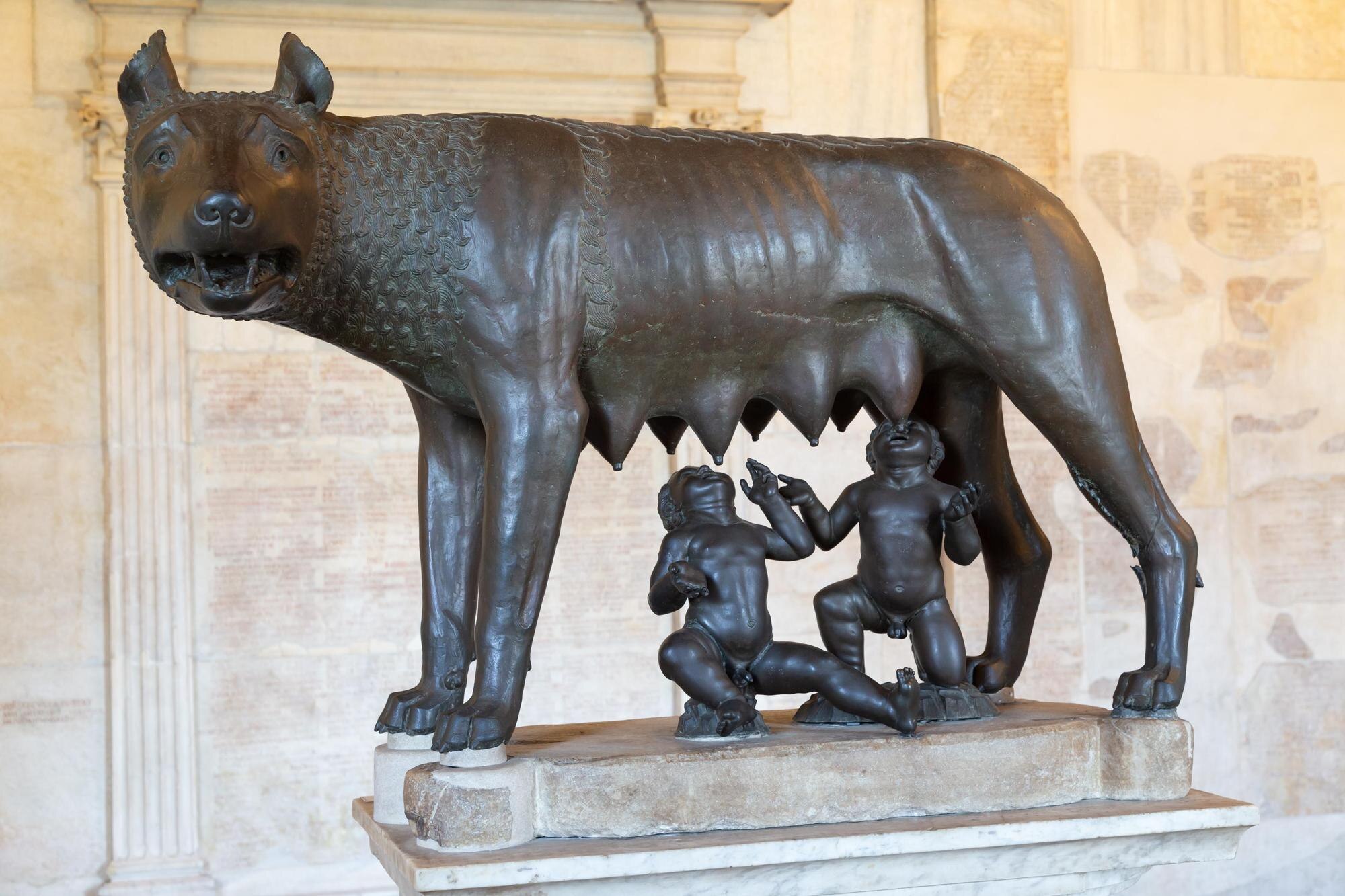
Roman mythology is the body of stories Romans told about their gods and origins, including the twins whom a she-wolf nursed before one founded Rome. It combines Greek traditions with Italian beliefs, turning inherited tales toward Roman questions about family and power. Those stories also touched daily worship: at Janus’s shrine, open doors signaled war, while closed doors marked peace.
The gods and legends below connect a memorable action with what it meant for Rome, from Mars protecting a farmer’s crops to Aeneas carrying Troy’s future toward Italy.
In This Article
- How Roman Mythology Took Shape
- Which Gods Matched Greek Gods?
- What Made Some Gods Distinctively Roman?
- How Aeneas Connected Rome to Troy
- Why Romulus and Remus Founded a Different Story
- Which Other Myths Should You Know?
- Where the Stories Survive—and How to Read Them
- Key Takeaways
- Frequently Asked Questions
- Greek Roots, Distinct Roman Purposes
How Roman Mythology Took Shape
Ancient Roman mythology grew among Latin-speaking communities in central Italy, alongside Etruscan neighbors and Greek settlements farther south. Stories crossed those boundaries with worshippers. Sometimes a god’s move became a story in its own right.
Livy describes one such transfer during Rome’s capture of the Etruscan city of Veii in 396 BCE. The Roman commander Camillus invited its goddess Juno to leave her city and accept a home in Rome. After the victory, soldiers approached her statue and asked whether she wished to come. Livy reports the tradition that she nodded; some accounts even gave her a spoken answer. Juno Regina received a temple on Rome’s Aventine Hill.
That invitation made conquest into a religious negotiation: Rome sought the defeated city’s divine protector as well as its territory. Greek stories entered through longer contact, and by the time Latin literature became extensive, poets could expect readers to recognize many Greek plots beneath Roman names.
Which Gods Matched Greek Gods?
A counterpart chart helps you recognize those names. Jupiter corresponds to Zeus, for example, while Venus corresponds to Aphrodite. The final column shows where the familiar pairing takes a specifically Roman turn.
| Roman god | Greek counterpart | Principal domains | Distinctive Roman role or worship |
|---|---|---|---|
| Jupiter | Zeus | Sky, thunder, sovereignty | Head of the Capitoline Triad with Juno and Minerva; guardian of state oaths |
| Juno | Hera | Marriage, childbirth, queenship | Worshipped as Juno Regina, “Queen,” and Juno Moneta on the Capitoline |
| Neptune | Poseidon | Sea, waters, horses | Honoured at the Neptunalia festival on 23 July |
| Minerva | Athena | Wisdom, crafts, skilled work | Member of the Capitoline Triad; patron of artisans |
| Mars | Ares | War, military protection | Father of Romulus and Remus in Rome’s foundation tradition |
| Venus | Aphrodite | Love, beauty, fertility | As Venus Genetrix, claimed as an ancestor of Julius Caesar’s family through Aeneas |
| Mercury | Hermes | Trade, travellers, messages | Patron of merchants; celebrated at the Mercuralia on 15 May |
| Vulcan | Hephaestus | Fire, metalworking, destructive flames | Honoured at the Volcanalia on 23 August, a festival concerned with fire danger |
| Diana | Artemis | Hunting, wild animals, childbirth | Worshipped at major sanctuaries on Rome’s Aventine Hill and at Lake Nemi |
| Ceres | Demeter | Grain, agriculture, fertility | Shared an Aventine temple with Liber and Libera; closely associated with the plebeians |
Mars takes us out of the battlefield and onto a farm. In On Agriculture, chapter 141, Cato gives a prayer beginning, in translation, “Father Mars, I pray and ask that you be gracious and favorable to me, my household, and our family.” It asks him to “ward off, repel, and avert diseases seen and unseen” and to let crops flourish. A pig, sheep, and bull accompany the appeal as sacrificial victims.
Treating Greek and Roman gods as interchangeable overlooks their distinct roles: this farmer needs more than a warrior. Likewise, Jupiter’s worship as Optimus Maximus on the Capitoline Hill placed the sky god at the center of Roman public religion.
What Made Some Gods Distinctively Roman?
Janus’s two faces suited a god of beginnings, doorways, and passage. His shrine gave that concern a public form: its doors stood open during war and were shut in peace. A threshold became a statement about the whole community’s condition.
Vesta’s public hearth made another ordinary household feature sacred. The Vestal Virgins maintained its fire, linking their daily work with Rome’s continuity. An extinguished sacred fire was rekindled with sunlight concentrated through a hollow mirror. The flame required care, not merely reverence. Although Vesta could be compared with Greek Hestia, this priesthood gave her a distinct Roman presence.
Quirinus connected worship with the founder himself. His earliest character remains debated, but he belonged to an old grouping with Jupiter and Mars. Romans also identified the deified Romulus with Quirinus: the man whose story ended in disappearance could receive worship as a god.
How Aeneas Connected Rome to Troy
Aeneas’s story begins before Rome exists. A Trojan survivor and son of Venus, he escapes Troy’s destruction and reaches Italy. Virgil’s Aeneid gives that journey a painful interruption at Carthage, where his relationship with Queen Dido cannot survive his obligation to leave.
Dido sees his fleet departing and curses him. Her loss reaches beyond the lovers: she calls for hostility between their peoples. The promised homeland comes at someone else’s expense, and Virgil lets that abandoned person speak.
The poem ends with another cost. In Italy, Aeneas defeats Turnus, who lies wounded and appeals for mercy. Aeneas hesitates. Then he sees the belt Turnus took from the slain Pallas, and drives his sword into his enemy. The future founder of a people’s line ends the epic in an act of furious vengeance.
Aeneas does not found Rome itself. His son Ascanius, also called Iulus, was associated with Alba Longa, from whose royal line the twins’ ancestry would be traced. The Julian family claimed descent through Iulus, carrying this Trojan genealogy into Virgil’s own age.
Why Romulus and Remus Founded a Different Story
Where Aeneas supplies ancestry, Romulus and Remus supply a city’s dangerous beginning. The sons of Mars and Rhea Silvia, a woman of Alba Longa’s royal line, are exposed as infants. A she-wolf nurses them; the shepherd Faustulus and his household raise them.
Survival does not settle which brother should rule. They seek an answer in birds: in Livy’s account, Remus receives a sign of six vultures first, while Romulus sees twelve. One side claims priority; the other claims the greater number. The omen produces a dispute instead of resolving it.
In a familiar version of what follows, Remus leaps over his brother’s new wall in mockery. Romulus kills him, making the boundary deadly before the city has properly begun. Ancient accounts differ about the immediate circumstances and responsibility, but the brother’s death remains at the heart of the foundation.
Rome’s traditional foundation date is 753 BCE. The story attached to that beginning makes authority inseparable from a hard question: what happens when protecting a boundary becomes a reason to kill?
Which Other Myths Should You Know?
Roman mythology stories also follow people far from Rome’s foundation. In Apuleius’s tale of Cupid and Psyche, Psyche loses her divine lover after breaking his prohibition against looking at him. Venus then sets her seemingly impossible tasks before reunion can happen.
One task reduces her to helplessness before a heap of mixed seeds. She must sort them, a demand beyond what she can finish alone. Ants come to her aid, separating the grains into their kinds. The rescue is small-scale and exact: creatures she could scarcely command accomplish what a goddess demanded. Further trials include obtaining a substance from the underworld; Psyche eventually receives immortality and rejoins Cupid.
Proserpina’s story makes separation more violent. Pluto abducts her, and Ceres searches for her daughter. Proserpina eats pomegranate in the underworld; the eventual settlement divides her time between that world and her mother. The struggle binds a family’s loss to the earth’s fertility.
Saturn’s lost Golden Age looks backward instead. Virgil connects his reign with Latium, where an imagined better past throws later greed and conflict into relief. The Saturnalia festival honored him, giving the god a place in the calendar as well as in stories about vanished happiness.
Where the Stories Survive—and How to Read Them
For Aeneas’s journey, begin with Virgil’s Aeneid; for the twins and early Rome, begin with Livy’s history. Their different choices matter. Virgil makes you wait through a warrior’s hesitation over a fallen enemy. Livy preserves rival explanations of a brother’s death.
Ovid’s Metamorphoses changes the angle again. The Cyclops Polyphemus, familiar from Homer’s Odyssey as the monster who traps Odysseus, becomes an awkward lover pursuing Galatea. He combs his hair with a rake and trims his beard with a sickle. Those outsized grooming tools make him comic, until he kills Galatea’s beloved Acis with a rock. Ovid carries the monster’s violence into a love story.
That shift shows how Greek and Roman mythology share material without keeping the same emphasis. Ovid’s poem ranges from the world’s beginnings toward Roman history; his Fasti instead follows festivals and anniversaries through the calendar. Apuleius places Cupid and Psyche inside his novel Metamorphoses, also called The Golden Ass.
Literature preserves voices; worship also left things you can stand beside. In Rome’s Forum, the circular remains of Vesta’s temple and the neighboring House of the Vestals give the sacred hearth and its attendants a physical address.
Key Takeaways
- A borrowed god could acquire a distinct role in Roman life.
- Ritual made divine protection a matter of daily responsibility.
- Aeneas’s descendants connect Troy to the twins’ foundation story.
- Roman myths give defeated or abandoned characters room to challenge heroic success.
- Ancient authors preserve disagreements as well as memorable plots.
Frequently Asked Questions
Who Were the 12 Main Roman Gods?
The Dii Consentes were Jupiter, Juno, Neptune, Minerva, Mars, Venus, Apollo, Diana, Vulcan, Vesta, Mercury, and Ceres. This conventional group of twelve leaves out other important gods, including Janus and Saturn.
What Is the Most Famous Roman Myth?
Romulus and Remus is Rome’s best-known foundation myth, recognized through the twins and their she-wolf. Aeneas’s journey provides the longer ancestral story behind their city.
Who Is the Main God of Rome?
Jupiter held the highest position in Rome’s state pantheon. Consuls offered vows to him, and victorious commanders concluded their triumphal processions at his Capitoline temple.
Is Roman Mythology the Same as Greek?
No: Roman mythology shares many Greek plots and gods but gives them distinct Roman settings and purposes. Local traditions and religious institutions shaped how Romans understood and worshipped those figures.
Which Ancient Authors Preserve Rome’s Foundation Legends?
Livy, Dionysius of Halicarnassus, and Plutarch preserve Rome’s foundation legends, while Virgil tells the earlier Trojan ancestry story. Dionysius’s Roman Antiquities gives extensive traditions, and Plutarch’s Life of Romulus records alternative accounts.
Greek Roots, Distinct Roman Purposes
To understand Roman mythology, follow what a story makes someone do. A divine command sends Aeneas away from Dido; competing signs leave the twins fighting over authority. The gods do not remove human choices or their consequences. They make those choices matter beyond a single life.
For a first reading, choose the Aeneid if you want a sustained story with difficult loyalties. Choose Livy’s opening book if your interest is the city’s beginnings and the versions Romans inherited. Ovid suits readers who want familiar characters put under unfamiliar pressure. In each case, keep the Roman setting in view. A shared Greek plot supplies the material; the writer’s decisions reveal what the inherited story could mean to a different audience.