
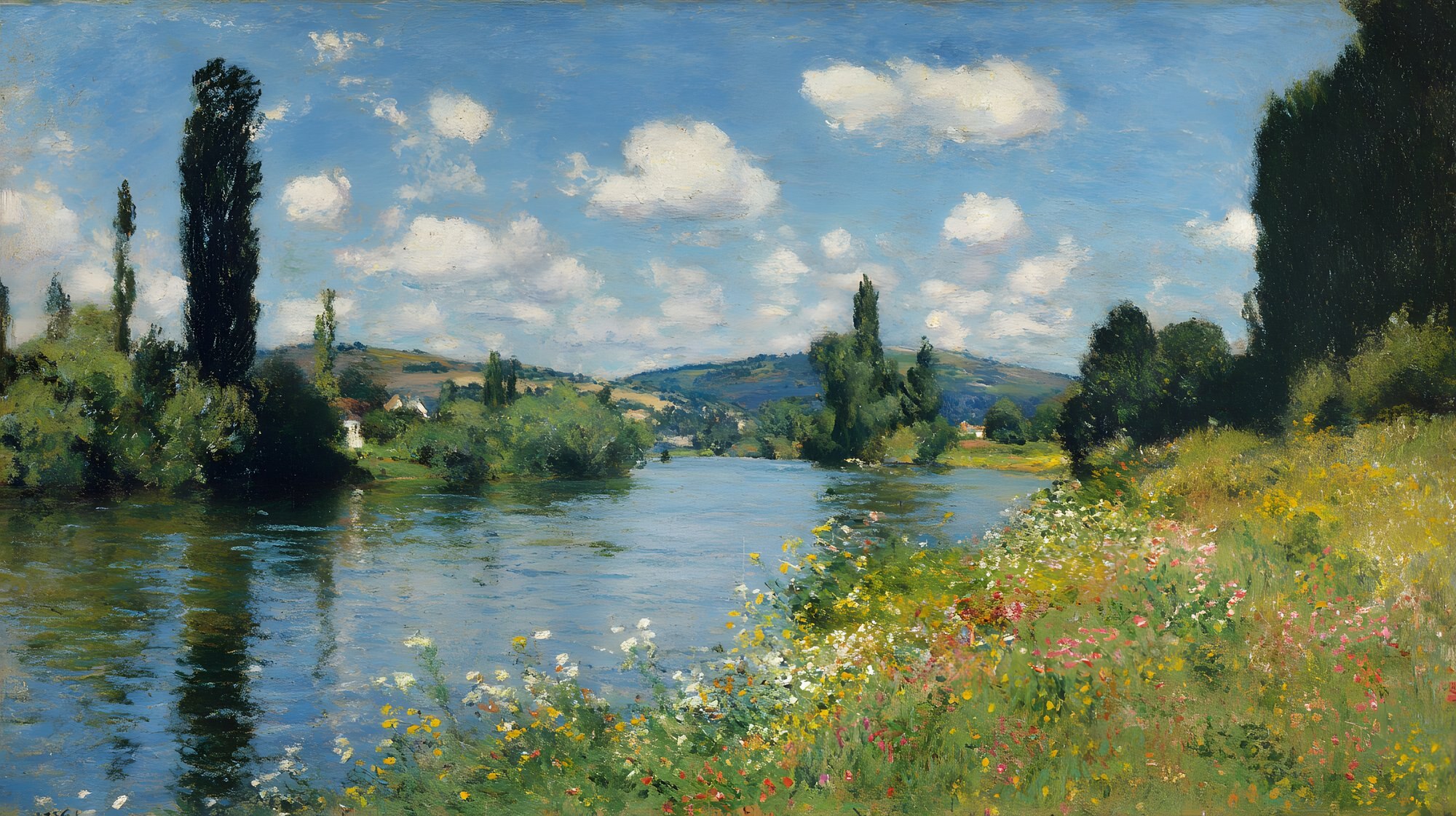
Famous Impressionist paintings capture modern life in its public pleasures and private routines, from crowded dance halls to a mother watching her sleeping child. Their subjects include industrial ports as well as sunlit rivers. These 17 works show how artists used color, framing, and brushwork differently, while distinguishing members of the Impressionist group from influential neighbors such as Édouard Manet and Georges Seurat.
In This Article
- 1. Impression, Sunrise by Claude Monet
- 2. La Grenouillère by Claude Monet
- 3. La Grenouillère by Pierre-Auguste Renoir
- 4. Dance at Le Moulin de la Galette by Pierre-Auguste Renoir
- 5. Luncheon of the Boating Party by Pierre-Auguste Renoir
- 6. The Ballet Class by Edgar Degas
- 7. The Cradle by Berthe Morisot
- 8. Paris Street, Rainy Day by Gustave Caillebotte
- 9. A Bar at the Folies-Bergère by Édouard Manet
- 10. In the Loge by Mary Cassatt
- 11. L’Absinthe by Edgar Degas
- 12. The Gare Saint-Lazare by Claude Monet
- 13. The Flood at Port-Marly by Alfred Sisley
- 14. The Boulevard Montmartre on a Spring Morning by Camille Pissarro
- 15. A Box at the Théâtre des Italiens by Eva Gonzalès
- 16. A Sunday on La Grande Jatte—1884 by Georges Seurat
- 17. Water Lilies by Claude Monet
- Key Takeaways
- Frequently Asked Questions
- Start With Two Riverside Views
1. Impression, Sunrise by Claude Monet
Claude Monet’s Impression, Sunrise (1872) shows the port of Le Havre, where cranes and smokestacks emerge through blue-gray haze. The orange sun and its reflection punctuate a harbor shaped by commerce, not untouched nature.
Shown at the first independent exhibition in Paris in 1874, it prompted Louis Leroy’s mocking review, which helped give Impressionism its name. The exhibition occupied the former studio of photographer Nadar. The painting belongs to the Musée Marmottan Monet in Paris.
2. La Grenouillère by Claude Monet
In La Grenouillère (1869), Monet paints a bathing and boating resort at Croissy-sur-Seine, outside Paris. A small circular island, nicknamed the Camembert, anchors the scene, while floating facilities and moored boats make leisure’s practical arrangements visible.
Broad, separated strokes turn the water into shifting bands of reflection. Monet gives these marks almost as much attention as the visitors, making the river’s moving surface a central subject. This version belongs to the Metropolitan Museum of Art in New York.
3. La Grenouillère by Pierre-Auguste Renoir
Pierre-Auguste Renoir’s La Grenouillère (1869), in Stockholm’s Nationalmuseum, brings the same resort’s social activity into sharper focus. People gathering around the tree on the little island appear more individually described than in Monet’s version.
Renoir’s smaller, softer touches connect clothing and foliage to the glittering water. Compare the island in both pictures: Monet emphasizes its structure within the river, while Renoir gives greater weight to the gathering itself. Their shared view makes differences in artistic attention unusually easy to see.
4. Dance at Le Moulin de la Galette by Pierre-Auguste Renoir
Renoir’s Dance at Le Moulin de la Galette (1876) presents a Sunday gathering in Montmartre. Dappled light falls across faces and clothing, joining seated conversations to the dancers beyond.
The large canvas gives popular recreation the scale once associated with more prestigious subjects. Its apparent informality also rests on deliberate organization: foreground figures draw you into the crowd without letting it dissolve into confusion. Now at the Musée d’Orsay, it makes sociability itself a substantial subject.
5. Luncheon of the Boating Party by Pierre-Auguste Renoir
Painted in 1880–81, Luncheon of the Boating Party gathers Renoir’s acquaintances on the balcony of the Maison Fournaise in Chatou. A striped awning shades the table, where bottles and leftover fruit suggest a meal giving way to conversation.
The figures include Aline Charigot, who later married Renoir, playing with a small dog. Beyond them, the river remains visible through the balcony’s open side. The painting is a centerpiece of the Phillips Collection in Washington, DC.
6. The Ballet Class by Edgar Degas
Edgar Degas’s The Ballet Class (1874) makes ballet look like disciplined work. Dancers wait, stretch, and adjust their clothing around the elderly ballet master Jules Perrot, whose staff establishes a firm vertical within the room.
The empty floor matters as much as the figures: its diagonal boards pull your eye toward the lesson. Degas turns away from the polished spectacle an audience would see. His subject is the preparation behind that spectacle, including fatigue and distracted attention.
7. The Cradle by Berthe Morisot
Berthe Morisot’s The Cradle (1872) depicts her sister Edma watching her sleeping daughter, Blanche. The mother’s bent arm echoes the baby’s raised arm, linking two figures separated by a translucent curtain.
That curtain is both a protective barrier and an opportunity to paint delicate shifts of white. Exhibited with the Impressionists in 1874, the picture gives sustained attention to domestic care. At the Musée d’Orsay, it offers a quiet counterpoint to the group’s better-known outdoor scenes.
8. Paris Street, Rainy Day by Gustave Caillebotte
Gustave Caillebotte’s Paris Street, Rainy Day (1877) shows the broad streets near the Gare Saint-Lazare. Umbrellas separate pedestrians into self-contained units, while wet paving stones reflect the pale daylight.
The sharply receding buildings record the remodeled capital’s new urban scale. Caillebotte’s relatively smooth finish also challenges the idea that every Impressionist artist used loose, conspicuous brushstrokes. At the Art Institute of Chicago, the painting’s large dimensions make the approaching couple feel almost physically present.
9. A Bar at the Folies-Bergère by Édouard Manet
Édouard Manet’s A Bar at the Folies-Bergère (1882) places a barmaid behind a counter of bottles, flowers, and oranges. A mirror expands the scene into a crowded entertainment hall, with a trapeze performer’s legs visible at the upper left.
The displaced reflection complicates your position as a viewer and possible customer. The painting belongs to the Courtauld Gallery in London. Manet influenced the Impressionists profoundly, but he never participated in their independent exhibitions.
10. In the Loge by Mary Cassatt
Mary Cassatt’s In the Loge (1878) shows a woman using opera glasses in a theater box. Across the auditorium, a man directs his own glasses toward her, making looking a social exchange rather than an innocent act.
Cassatt gives the woman purpose and concentration: she watches the performance instead of presenting herself to us. The black dress stands firmly against the warm theater interior. See the painting at the Museum of Fine Arts, Boston.
11. L’Absinthe by Edgar Degas
Degas’s L’Absinthe (1875–76), also known as In a Café, places two figures behind a succession of pale marble tabletops. Their proximity does little to relieve their apparent isolation.
The models were actress Ellen Andrée and artist Marcellin Desboutin; the picture should not be treated as documentary proof of their drinking habits. Its off-center arrangement makes the viewer feel like another café patron observing from nearby. The work belongs to the Musée d’Orsay.
12. The Gare Saint-Lazare by Claude Monet
Monet’s The Gare Saint-Lazare (1877), at the Musée d’Orsay, brings his study of changing atmosphere inside a railway terminal. Steam partially dissolves the locomotives and the iron-and-glass roof above them.
This is industrial modernity experienced through visibility: machinery appears, disappears, and reappears through vapor. Monet painted several views of the station, treating its shifting conditions as a subject worthy of sustained attention. Smoke and steam do the optical work that mist performs in his river pictures.
13. The Flood at Port-Marly by Alfred Sisley
Alfred Sisley’s The Flood at Port-Marly (1876), in the Musée d’Orsay, shows floodwater surrounding an ordinary building. A boat occupies space normally available to pedestrians, turning a familiar settlement into a temporarily altered environment.
Sisley’s restrained palette avoids making the event theatrical. Horizontal reflections steady the composition even as the water disrupts daily movement. The painting widens the meaning of modern life beyond Parisian entertainment: weather and river conditions also determined how people inhabited the capital’s surrounding towns.
14. The Boulevard Montmartre on a Spring Morning by Camille Pissarro
Camille Pissarro painted The Boulevard Montmartre on a Spring Morning in 1897 from an elevated hotel viewpoint. The broad Paris street fills with carriages and pedestrians, reduced by distance to small, distinct marks.
Unlike Caillebotte’s street-level encounter, this view makes traffic into a collective pattern. Rows of buildings contain the movement while the boulevard carries it deep into the picture. The spring canvas is in a private collection; the Metropolitan Museum of Art holds a winter view from the same window, The Boulevard Montmartre on a Winter Morning. Both belong to Pissarro’s sustained exploration of the street under different conditions.
15. A Box at the Théâtre des Italiens by Eva Gonzalès
Eva Gonzalès’s A Box at the Théâtre des Italiens (1874) pairs a seated woman in a pale evening dress with a man behind her. The dark theater setting makes the dress and bouquet especially prominent.
The composition presents a theater box as a place to be seen as well as to watch. Gonzalès studied with Manet and, like him, did not exhibit with the independent Impressionist group. Her painting belongs to the Musée d’Orsay.
16. A Sunday on La Grande Jatte—1884 by Georges Seurat
Georges Seurat developed A Sunday on La Grande Jatte—1884 between 1884 and 1886. On an island in the Seine, upright figures occupy a carefully ordered park, their stillness contrasting with the flickering surface of small color marks.
The painting appeared at the final Impressionist exhibition in 1886, but its systematic method belongs to Neo-Impressionism. It is also central to accounts of Post-Impressionism. At the Art Institute of Chicago, it offers a useful boundary case, not evidence that all these painters worked alike.
17. Water Lilies by Claude Monet
Monet’s Water Lilies (1906), at the Art Institute of Chicago, removes the horizon and concentrates on floating leaves and reflections. The pond’s surface becomes difficult to separate from the sky and trees mirrored within it.
This cultivated setting was part of the home at Giverny where Monet lived from 1883 until his death 43 years later. The painting extends his interest in unstable appearances, but the garden itself was deliberately made. Its apparent naturalness depended on sustained human care.
Key Takeaways
- Impressionist subjects include industrial labor, theaters, cafés, and private interiors—not just landscapes.
- Monet and Renoir’s riverside paintings offer a direct comparison of individual approaches.
- Broken color and changing light matter, but the selected artists do not share one uniform technique.
- Manet’s influence should not be confused with participation in the independent Impressionist exhibitions.
- Seurat’s systematic color marks a Neo-Impressionist development, while Monet’s garden continues his study of reflection.
Frequently Asked Questions
Who Are 10 Famous Impressionist Artists?
Ten famous artists associated with Impressionism are Claude Monet, Pierre-Auguste Renoir, Edgar Degas, Berthe Morisot, Camille Pissarro, Alfred Sisley, Mary Cassatt, Gustave Caillebotte, Paul Cézanne, and Armand Guillaumin. These Impressionist artists did not follow identical paths; Cézanne’s later work, especially, became important to Post-Impressionism.
Who Is Considered the Most Famous Impressionist Artist?
Claude Monet is generally considered the most famous Impressionist artist, although fame has no definitive ranking. His repeated studies of haystacks and Rouen Cathedral helped make changing light a defining concern of Impressionist art.
Why Do Monet and Renoir Both Have Paintings Titled La Grenouillère?
They painted side by side at the same resort, so their titles identify a shared location. The resulting canvases preserve separate decisions about composition and emphasis, not an attempt to produce matching pictures.
Is L’Absinthe the Same Painting as Degas’s In a Café?
Yes, both titles refer to the same work. In a Café emphasizes the setting, while L’Absinthe directs attention toward the drink before the seated woman.
Is Monet’s Water Lilies One Painting or a Series?
Water Lilies names a large series, not one canvas. It includes intimate pond views and monumental compositions, including the panels installed in the Musée de l’Orangerie’s oval rooms in Paris. Broad labels such as Impressionism should not obscure that variety within one artist’s work.
Start With Two Riverside Views
Begin with Monet and Renoir’s versions of La Grenouillère. Compare how much space each gives the visitors, then follow the brushmarks across the water. A shared subject makes individual choices easier to recognize than a definition alone can.
Carry that comparison into the other paintings. Cassatt makes watching an active subject; Degas exposes the work behind entertainment; Caillebotte gives the rebuilt city an imposing physical presence. Together, these famous impressionist paintings show why Impressionism cannot be reduced to pretty scenery or one kind of brushstroke. Keeping Manet’s independent position and Seurat’s systematic method distinct sharpens the story. What connects this selection is sustained attention to contemporary experience, even when the artists disagree about how to paint it.