
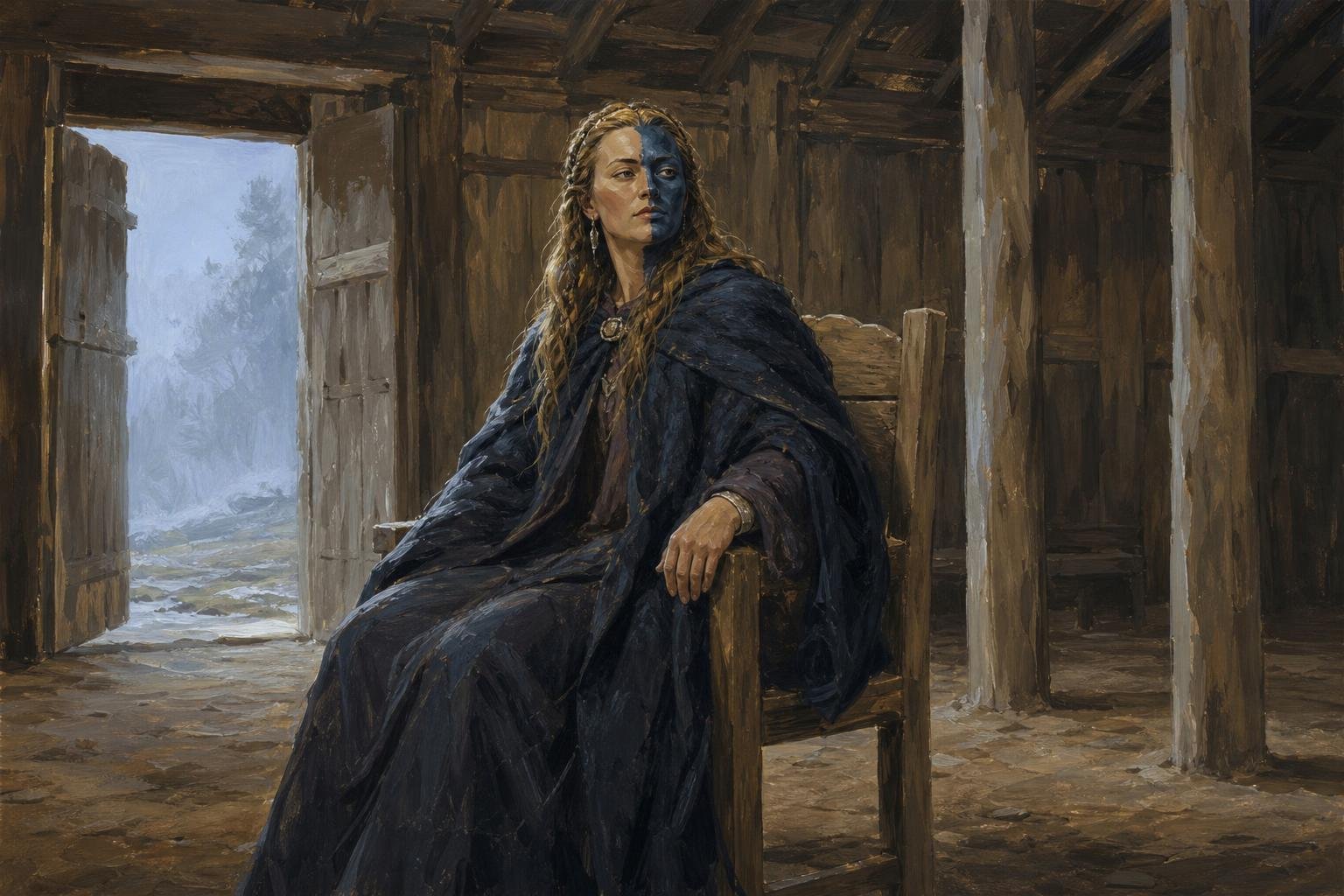
The Hel Norse mythology describes is Loki’s monstrous daughter and a female ruler of the dead. Odin casts her into Niflheim, where she receives those who die of sickness or old age; her name also names the realm of the dead.
Her most consequential encounter with the gods comes after Baldr’s death. They want him back. Getting him out means sending a rider into her domain and asking its ruler to release him.
In This Article
- What the Medieval Sources Tell Us
- Hel’s Family and Odin’s Decision
- What Hel Looks Like
- Her Realm, Hall, and Household
- The Road to Hel’s Gates
- Why Baldr Does Not Return
- Key Takeaways
- Frequently Asked Questions
What the Medieval Sources Tell Us
Hel has a speaking role in Snorri Sturluson’s Prose Edda: she hears an appeal on Baldr’s behalf and gives an answer that determines whether he can leave. Snorri also supplies the details of her household and appearance. His account provides the thread connecting her family to the journey into her realm.
The Poetic Edda preserves poems drawing on older traditions, giving a broader setting for these stories of gods and death. Snorri composed the Prose Edda in Christian Iceland in the thirteenth century. The surviving manuscripts of the Poetic Edda also belong to the Christian period. Both preserve valuable traditions through later literary frameworks, not direct transcripts of Viking Age belief. The label “Norse god Hel” refers to a female figure, though her place in storytelling is clearer than her place in religious worship.
Hel’s Family and Odin’s Decision
Hel’s mother is the giantess Angrboda; her father is Loki. Their other children are Fenrir, the enormous wolf, and Jormungandr, the serpent associated with the sea surrounding the human world. The gods learn of the children and the harm foretold through them.
Odin separates the siblings. He hurls Hel into Niflheim and gives her power over nine worlds, with places to assign to those sent to her. The feared child becomes a ruler far from the gods who feared her family.
Her dominion fills with the dead. Snorri singles out those whose lives end through sickness or old age: these are the people who arrive in her keeping.
What Hel Looks Like
Hel is half blue-black and half flesh-colored in Snorri’s description. Her expression is grim and downcast. The division runs through her bodily appearance, making death visible in the figure who rules the dead.
Translations differ over the blue-black color term, but the contrast with flesh is central to the description. One part bears the color of a human body; the other makes her immediately distinct. Her appearance gives the encounter with Hel a physical force before she ever speaks.
Her Realm, Hall, and Household
Hel’s name is generally traced to a Germanic root meaning “to hide” or “conceal.” English “hell” is a linguistic relative. That relationship helps explain the expression “Norse hell,” although Hel’s domain is not defined by punishment for moral wrongdoing.
Modern explanations often call the place Helheim. Older texts also use Hel for the destination itself, and their descriptions do not fit one consistent map. Snorri’s account of its inhabitants is one account within that broader tradition, not a rule shared by every story of death.
Within his account, the household has an unsettling precision. Hel’s hall is Eljudnir. Her dish is Hunger, her knife Famine, and her bed Sick-bed. Everyday objects carry names of deprivation: even eating and sleeping belong to the hardship of this dwelling. These details give the mythology of Hel a domestic bleakness, with suffering built into the furnishings.
The Road to Hel’s Gates
Hermod rides Odin’s horse Sleipnir to seek Baldr. For nine nights he travels through dark, deep valleys before reaching the river Gjoll. Its bridge, Gjallarbru, has a guardian named Modgud.
Modgud questions the rider because he does not look like a dead man. Baldr has already crossed, she tells him. From the bridge, the road to Hel runs down and north.
Hermod continues until the gates stand in his way. He tightens his saddle, preparing for a jump that will carry horse and rider beyond the barrier. Sleipnir clears the gates.
Why Baldr Does Not Return
Inside, Hermod finds Baldr seated in a place of honor. He tells Hel how deeply the gods mourn and asks her to let Baldr ride home with him. Hel sets a condition: everything in the world, living and dead, must weep for Baldr.
The gods send messengers to ask for those tears. Almost everything weeps. The appeal reaches a giantess named Thokk, who refuses to mourn him; Snorri reports the belief that she is Loki in disguise.
Her refusal is enough. The condition requires everyone, so all the grief already gathered cannot secure Baldr’s return. In her cave, Thokk offers only dry tears. Baldr remains with Hel.
Key Takeaways
- Hel’s family places her among the beings the gods fear before she becomes ruler of the dead.
- Her household turns ordinary domestic objects into signs of deprivation.
- Hermod reaches her hall through a journey with named crossings and a guarded bridge.
- Baldr’s release depends on universal mourning; one refusal defeats the appeal.
Frequently Asked Questions
Are Hel and Hela the same?
Hela is an alternative name for Hel in some later English-language treatments, but adaptations can change the character. In Marvel’s film Thor: Ragnarok (2017), Hela is Odin’s daughter, a different relationship from the medieval story.
Did Hel have any children?
The medieval sources give Hel no securely attested children. Family trees that supply her with offspring add relationships absent from the Eddas.
What did Odin do to Hel?
Odin cast Hel into Niflheim and gave her authority over a domain of the dead. He acted because of the danger associated with Loki and Angrboda’s children, not because Hel had rebelled against him.
Does Hel decide when people die?
Hel receives the dead; the stories do not give her the task of deciding everyone’s lifespan. “Norse god of death” is therefore a loose label for her role, whose clearest expression is her control over release from her realm.
Is there evidence that Vikings worshipped Hel?
There is no secure evidence for a widespread, organized cult of Hel comparable to the evidence for worship of Thor or Odin. The familiar “Hel goddess” label describes her mythic standing without establishing ritual worship, though the evidence cannot rule out individual acts of devotion.