
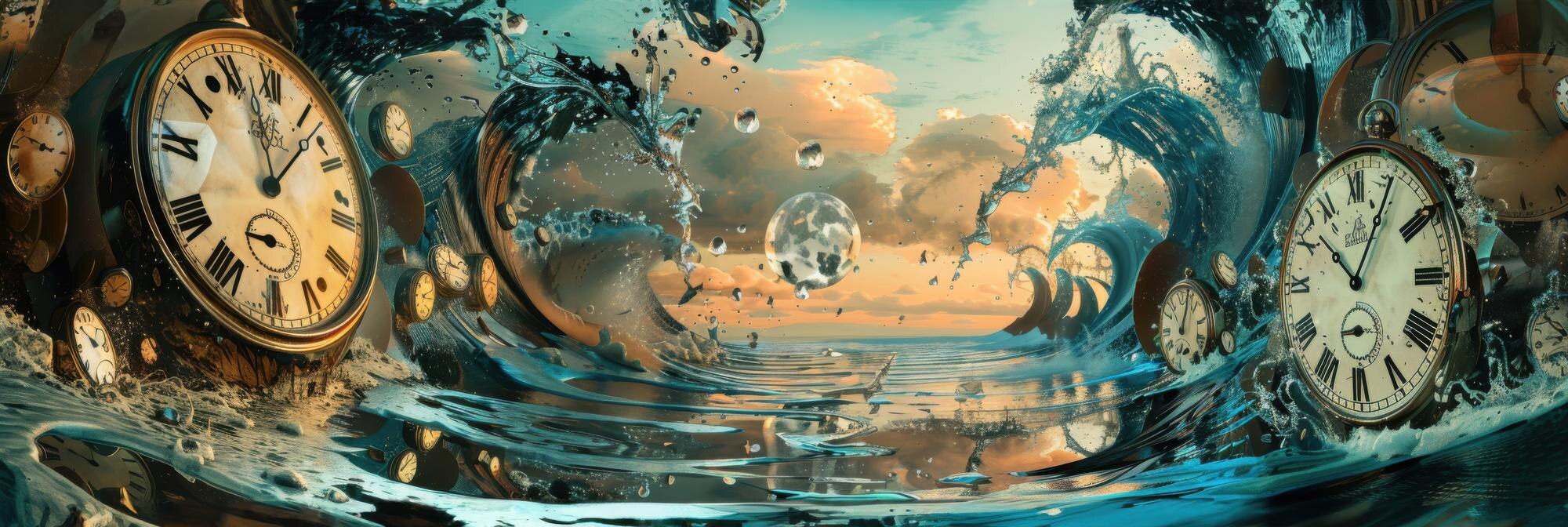
Famous Surrealist paintings include Salvador Dalí’s melting watches in The Persistence of Memory and René Magritte’s apple-obscured portrait, The Son of Man. They make familiar things behave impossibly, turning an ordinary object into the source of a picture’s strangeness.
These ten works show how famous Surrealist artists gave that strangeness different forms. Each offers a point of entry through its most arresting details, from Magritte’s blocked kiss to Remedios Varo’s meal for the moon.
In This Article
- 1. The Persistence of Memory
- 2. The Son of Man
- 3. The Lovers
- 4. The Treachery of Images
- 5. The Harlequin’s Carnival
- 6. Eine kleine Nachtmusik
- 7. Self-Portrait
- 8. Tomorrow Is Never
- 9. Celestial Pablum
- 10. The Song of Love
- Key Takeaways
- Frequently Asked Questions
- Look for the Unexpected Connection
1. The Persistence of Memory
Salvador Dalí’s The Persistence of Memory (1931), at the Museum of Modern Art in New York, places limp watches across a barren setting. One hangs from a branch; another drapes over a pale, eyelash-bearing form.
Dalí paints each impossible sag with the care you might expect in a portrait. Time feels unstable because its instruments have lost their stiffness. The closed watch in the foreground escapes the melting, only to become a gathering place for ants.
2. The Son of Man
A green apple blocks almost all the face in René Magritte’s The Son of Man (1964), in a private collection. The bowler-hatted man stands before a low wall, with water and sky behind him; part of one eye remains visible. That glimpse makes the obstruction more frustrating than a completely hidden face. Unlike Dalí’s watches, the apple needs no distortion. The fruit looks ordinary; its position is outrageous.
3. The Lovers
In the version of The Lovers (1928) held by New York’s Museum of Modern Art, two people kiss through white cloth wrapped around their heads. Their bodies draw together, but the fabric prevents direct contact.
Magritte gives an intimate gesture the discomfort of a barrier you can almost feel. The folds press between the faces where skin should meet. Desire and separation occupy the same small space: these lovers can reach each other without getting past what covers them.
4. The Treachery of Images
Magritte’s The Treachery of Images (1929), at the Los Angeles County Museum of Art, pairs a carefully rendered pipe with a sentence beneath it. This Surrealist painting needs neither monsters nor distorted bodies: its friction lies between a recognizable object and the words that deny it. The presentation is calm, almost instructional. Then comes “Ceci n’est pas une pipe”: “This is not a pipe.”
5. The Harlequin’s Carnival
Joan Miró painted The Harlequin’s Carnival in 1924–25; it belongs to the Buffalo AKG Art Museum. Wiry creatures and floating shapes crowd a room with forms resembling musical instruments.
A ladder rises at the left, while a window opens onto a contrasting space. Those architectural anchors make the surrounding activity stranger: the room has boundaries, but its inhabitants refuse ordinary weight or anatomy. Thin lines give the creatures spindly bodies; patches of color keep the eye moving through the commotion.
6. Eine kleine Nachtmusik
Dorothea Tanning’s Eine kleine Nachtmusik (1943), in the Tate collection, borrows the German name associated with Mozart’s serenade, usually translated as “A Little Night Music.” The title’s promise of light entertainment meets a hotel-like corridor occupied by two girls and a huge sunflower.
The flower’s scale turns a familiar interior into a place of confrontation. Its damage makes the encounter feel physical: one girl’s hair stands upward, and torn petals lie scattered across the floor.
7. Self-Portrait
Leonora Carrington’s Self-Portrait, also known as The Inn of the Dawn Horse (c. 1937–38), belongs to the Metropolitan Museum of Art in New York. A white rocking horse hangs behind Carrington, while another white horse runs outside the window, linking the enclosed room to the world beyond it.
Carrington herself sits beside a hyena. That partnership shifts the force of the self-portrait: the painter shares her space with an animal presence instead of posing alone for our inspection.
8. Tomorrow Is Never
Kay Sage’s Tomorrow Is Never (1955), also at the Metropolitan Museum of Art, replaces lively creatures with towering skeletal structures. Draped forms occupy their frameworks beneath a subdued gray atmosphere.
The open scaffolding suggests construction, yet offers no clear purpose or shelter. Cloth gives the structures a strangely inhabited look without supplying recognizable occupants. Against the empty spaces, each framework feels isolated. The title makes that suspended condition harsher: whatever these structures await, tomorrow will not bring it.
9. Celestial Pablum
Remedios Varo’s Celestial Pablum (1958), also called Celestial Feeding, belongs to the FEMSA Collection in Monterrey, Mexico. A woman works inside a narrow architectural enclosure, operating a grinding apparatus and spoon-feeding a crescent moon confined in a cage.
The moon has become small enough to need a caregiver, while feeding it requires elaborate machinery. Domestic labor takes on cosmic proportions: the machine grinds stars into food for a caged crescent moon.
10. The Song of Love
Giorgio de Chirico’s The Song of Love (1914), at the Museum of Modern Art in New York, sets a classical sculpted head beside a large rubber glove. A green ball sits below them; a train appears beyond the wall.
The cold solidity of the head meets the glove’s limp, hollow shape. Their mismatched materials make the pairing feel wrong before any explanation begins. De Chirico painted this metaphysical work ten years before André Breton’s 1924 Surrealist Manifesto, anticipating the movement’s unsettling combinations.
Key Takeaways
- Familiar objects become strange when their relationships stop making everyday sense.
- Dalí’s precise realism and Miró’s wiry creatures offer different routes into dream imagery.
- A Surrealist artwork can unsettle through language as effectively as through impossible forms.
- Tanning, Carrington, Sage, and Varo give the movement a range far beyond melting watches.
Frequently Asked Questions
What is Surrealism art?
Surrealism is an artistic and literary movement formally launched by André Breton’s manifesto in 1924. A Surrealism painting can draw on dreams or unexpected associations, as Miró’s crowded room does. Surrealism artwork also includes sculpture, photography, and other media.
What are some of Salvador Dalí’s most famous paintings that display Surrealism?
Dalí’s famous examples include The Persistence of Memory, Dream Caused by the Flight of a Bee (1944), and Metamorphosis of Narcissus (1937). Dream Caused by the Flight of a Bee, at Madrid’s Museo Nacional Thyssen-Bornemisza, sends tigers toward a sleeping woman; Metamorphosis of Narcissus belongs to Tate.
What are the 7 characteristics of Surrealist art?
Seven recurring characteristics are dream imagery, unexpected juxtapositions, distorted forms, altered scale, symbolic objects, ambiguous spaces, and associations drawn from the unconscious. Dalí’s watches demonstrate distortion, while Tanning’s sunflower shows altered scale. Individual Surrealist paintings use different combinations of these features.
Why is The Song of Love included if it predates the Surrealist movement?
The Song of Love provides a precedent for Surrealism’s puzzling combinations of familiar objects. De Chirico’s pairing of a sculpted head and rubber glove exemplifies the metaphysical paintings that influenced artists later associated with Surrealism.
Are Celestial Pablum and Celestial Feeding the same painting?
Yes, both English titles refer to Varo’s Papilla estelar. “Pablum” means a soft food here, connecting the title to the woman spoon-feeding the moon.
Look for the Unexpected Connection
Surrealism’s force comes from relationships that ordinary life would rule out. Magritte keeps his apple recognizable and changes where it belongs; Varo changes the moon’s scale until it needs feeding. Those choices matter more than finding a single hidden message behind every object.
For a first comparison, put Magritte’s pipe beside Miró’s crowded room. The pipe makes its challenge with a sentence, while Miró fills a bounded interior with restless forms. If one leaves you cold, the other may offer a way in. The movement has room for both restraint and abundance. What connects these paintings is their ability to make familiar things resist the explanations we usually give them.