
These six Japanese mythical creatures introduce different sides of the supernatural: the kitsune (fox spirit), the tanuki (raccoon dog), the kappa (river imp), the oni (horned ogre), the yūrei (ghost of the dead), and the tsukumogami (object spirit). Yōkai is a broad term encompassing beings as different as shapeshifting foxes and animated umbrellas. Yūrei are specifically human ghosts, sometimes distinguished from yōkai but also included in broader uses of the term.
In This Article
- 1. Kitsune, the Fox Spirit
- 2. Tanuki, the Shapeshifting Raccoon Dog
- 3. Kappa, the River Imp
- 4. Oni, the Horned Ogre
- 5. Yūrei, the Ghost of the Dead
- 6. Tsukumogami, the Object Spirits
- Key Takeaways
- Frequently Asked Questions
- How Japanese Supernatural Traditions Took Shape
1. Kitsune, the Fox Spirit
Kitsune are foxes whose intelligence and magical power grow with age. One tradition says a fox gains a new tail every 100 years. Tenko is the Japanese name for a heavenly fox. Along the way, foxes in these stories possess people, a condition called kitsunetsuki, and take human shape, very often as beautiful women.
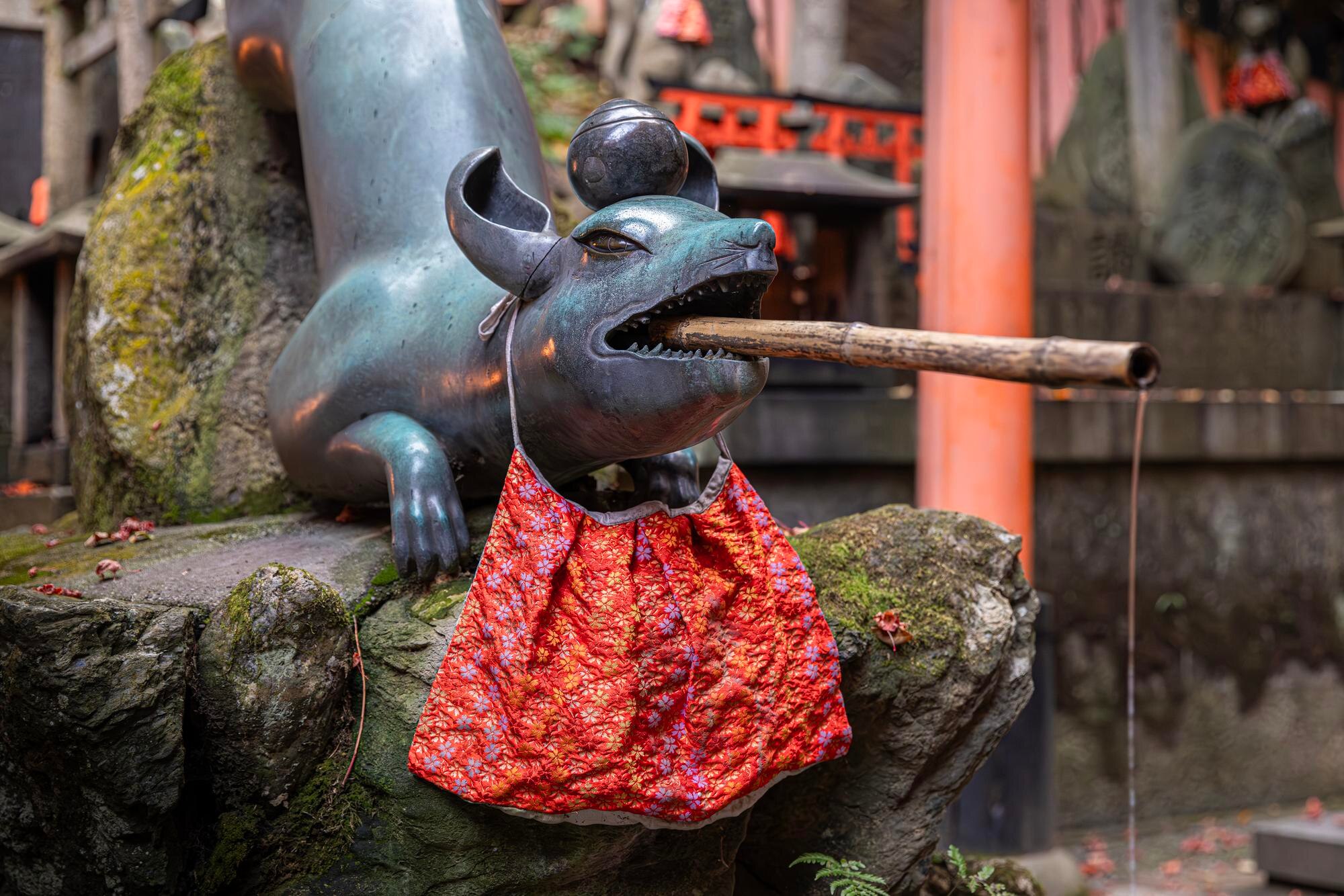
The fox also has a respectable side. Foxes serve as messengers of Inari, the kami of rice and prosperity. They are not Inari, though visitors often take them for the deity. At Fushimi Inari Taisha in Kyoto, fox statues guard the gates and paths, many holding a key or a jewel in their mouths.
The fox women are a different matter. The most famous of them is Tamamo-no-Mae, a courtesan at the court of Emperor Toba in the 12th century. Her beauty and learning won the emperor's favor until he fell mysteriously ill, and a court diviner exposed her as a nine-tailed fox. She fled to Nasu, in present-day Tochigi Prefecture, where warriors hunted her down. Her spirit lodged in a boulder called the Sesshō-seki, or Killing Stone, said to kill anything that touched it.
The stone split in two in March 2022. The news traveled across Japan, because people still remembered what was supposed to be inside it.
2. Tanuki, the Shapeshifting Raccoon Dog
The tanuki is a real animal, the raccoon dog, still common in Japanese woods and suburbs. It shares the fox's gift for transformation, which makes the two the best-known Japanese folklore animals. Its tricks lean comic, though. A tanuki turns leaves into coins or drums on its round belly under a full moon. A kitsune story can end in ruin; a tanuki story usually ends in a laugh at someone's expense, sometimes the tanuki's own.
Most people now picture the tanuki as it looks in Shigaraki, a pottery town in Shiga Prefecture. Shigaraki's ceramic tanuki stand outside restaurants and shops across Japan, wearing a straw hat and carrying a sake flask and a ledger of unpaid bills. They stand for easy luck in business.
The tale Japanese children know best is Bunbuku Chagama, the transforming teakettle. A tanuki takes the form of an iron kettle. Set over a fire, it sprouts a head, a tail, and legs. In the best-known version, a poor man who acquires the kettle puts it on show, the tanuki walks a tightrope for paying crowds, and the man grows rich.
Morin-ji, a temple in Tatebayashi, Gunma Prefecture, preserves a different kettle legend. In the temple's own account, Shukaku brings a kettle whose hot water never runs out, then later reveals his animal identity. That is not the same narrative as the tightrope-performing tanuki.
3. Kappa, the River Imp
The kappa is a child-sized river creature with a beak, a turtle's shell, webbed hands, and a water-filled hollow on top of its head. That water is its strength. If it spills, the kappa weakens, so the old advice is to bow politely: a kappa will bow back and empty its own head. Kappa love cucumbers, which is why cucumber sushi rolls are called kappamaki, and they challenge passersby to sumō matches.
Few Japanese creatures have as clear a printed history. Toriyama Sekien's illustrated Gazu Hyakki Yagyō (1776) gave the kappa a page in a catalogue of yōkai that helped settle how later artists drew it. In 1910, Yanagita Kunio's Tōno Monogatari recorded kappa tales from Tōno in Iwate Prefecture, where a pool behind Jōken-ji temple, Kappa-buchi, is still known as the kappa's home.
Those records do not make the kappa cute. In folk accounts, kappa drag children and horses into rivers and drown them, so the creature worked as a practical warning about deep water. The cucumbers and the sumō sit on top of that older fear.
Some stories turn the fear around. A kappa caught and released, or one whose severed arm is handed back, repays the favor by teaching the family how to set broken bones.
4. Oni, the Horned Ogre
Oni have red or blue skin and horns, carry iron clubs, and wear tiger-skin loincloths. The costume has a source. The northeast was the unlucky direction through which evil entered, and it was named for the ox and the tiger in the zodiac, which gave the oni an ox's horns and a tiger's hide. Of all the creatures here, the oni comes closest to a stock Japanese monster.
That makes it the one families throw things at. Oni are driven out every year at Setsubun, around February 3. People toss roasted soybeans out the door or at a relative wearing an oni mask, shouting "Oni wa soto, fuku wa uchi" ("Oni out, good fortune in"), then eat one bean for each year of their age.
Not every horned figure is an oni. The Namahage of the Oga Peninsula in Akita Prefecture look like oni and outsiders often call them that, but locally they are visiting deities. On New Year's Eve, men in masks and straw capes go house to house and ask whether the children have been lazy. UNESCO added the custom to its list of intangible cultural heritage in 2018, as part of the Raiho-shin visiting-deity rituals.
The real oni of legend is Shuten-dōji, the oni king of Mount Ōe, northwest of the capital at Kyoto, who raided the city for young women. Minamoto no Yorimitsu and his four retainers climbed the mountain disguised as wandering mountain priests. They shared drugged sake with the oni, then beheaded Shuten-dōji while he slept. In many tellings, the severed head flew up and bit at Yorimitsu's helmet before it died.
5. Yūrei, the Ghost of the Dead
Oiwa is the most famous ghost in Japan. In Tsuruya Nanboku IV's kabuki play Tōkaidō Yotsuya Kaidan (1825), she is poisoned, and her husband Iemon wants to leave her to marry into a richer family. The poison disfigures her face, and her hair comes out in clumps as she combs it. She dies and returns to haunt him, in one scene emerging from a paper lantern.
Oiwa is a yūrei: the spirit of a dead person held in this world by strong emotion, whether rage, jealousy, love, or a funeral left undone. Humans can become yōkai, and yūrei were always once human. Stage yūrei like Oiwa fixed the look: white burial clothing, loose black hair, hands hanging limp from the wrists, and no visible feet. The footless ghost is often credited to the 18th-century painter Maruyama Ōkyo, and kabuki stagecraft spread it widely.
Most Japanese spirits of the dead never haunt anyone. During Obon in midsummer, families welcome ancestral spirits home with lanterns and offerings, and those ancestors are honored guests, not yūrei.
Oiwa still gets careful treatment. Casts staging the play traditionally visit Oiwa's shrine in Yotsuya, Tokyo, to pay their respects first, a custom kept out of caution as much as piety.
6. Tsukumogami, the Object Spirits
Tsukumogami are household objects that come alive, traditionally at 100 years of age. The Tsukumogami-ki, a Muromachi-period picture scroll, tells of old tools thrown out during year-end cleaning just short of that age. Resentful at being discarded, they become yōkai and take revenge on the humans who used them, and in the end they turn to Buddhism. The best-known forms are the kasa-obake, a one-eyed paper umbrella that hops on a single leg, and the chōchin-obake, a lantern whose torn paper splits into a mouth.
The same objects march in the Hyakki Yagyō, or Night Parade of One Hundred Demons, a picture-scroll tradition in which yōkai process through the streets after dark. The version held at the Shinju-an subtemple of Daitoku-ji in Kyoto fills its procession with walking pots, instruments, and kitchen tools.
Ittan-momen, from Kagoshima Prefecture, shows where the category ends. It is a strip of cotton cloth that flies through the night sky and wraps around people's faces and necks. It is sometimes filed with the tsukumogami, but the hundred-year rule plays no part in its story. Mizuki Shigeru made it nationally famous in his manga GeGeGe no Kitarō, and it stands in bronze on Mizuki Shigeru Road in Sakaiminato, Tottori Prefecture.
The scroll's lesson about worn-out objects survives in practice. At Hari-kuyō, held on February 8 or December 8 depending on the region, people retire broken sewing needles by pushing them into soft tofu or konnyaku.
Key Takeaways
- Yōkai is a broad category that includes tricksters, lucky charms, and household oddities, not only evil monsters.
- Kitsune and tanuki both shapeshift, but fox stories tend toward danger and tanuki stories toward comedy.
- Yūrei were once human; humans can also become yōkai.
- Rivers, mountains, households, and ordinary objects each produce their own kind of supernatural being.
- Appearance can mislead: the oni-like Namahage are received as visiting deities in Oga.
Frequently Asked Questions
What are the four mythical beasts in Japan?
They are the Four Symbols, guardians of the compass directions that Japan adopted from China. Seiryū is the Azure Dragon of the east, Byakko the White Tiger of the west, Suzaku the Vermilion Bird of the south, and Genbu the Black Tortoise of the north. All four appear in wall paintings at the Kitora tomb in Nara Prefecture, painted around 1,300 years ago. The Takamatsuzuka tomb, also in Nara Prefecture, preserves three; its Vermilion Bird painting was lost through grave robbing.
What is the most powerful mythical creature in Japan?
No single answer exists, because power depends on the story. Yamata no Orochi, the eight-headed serpent slain by the storm god Susanoo in the Kojiki (712), is the great monster of early Japanese mythology. Among yōkai, the nine-tailed fox and the oni king Shuten-dōji are the usual candidates.
What are the 13 types of kitsune?
Traditional folklore has no fixed list of 13 kitsune. Older sources separate zenko, the benevolent foxes linked to Inari, from yako, the wild field foxes that trick and possess people, and rank the oldest as tenko, heavenly foxes. Lists of 13 elemental or named types come from modern books and games.
Are all kitsune female?
No, male foxes appear in folklore too. The best-known stories feature fox women, though, such as Tamamo-no-Mae or Kuzunoha, the fox wife said to be the mother of the diviner Abe no Seimei. Those famous tales create the impression that kitsune are always female.
Are all yōkai dangerous to humans?
No, many are helpful or harmless. Amabie, a scaled creature reported off Higo Province in 1846, predicted harvests and disease and told people to copy its appearance and show others, according to Kyoto University Library's transcription. The account does not explicitly promise protection from illness. Amabie returned to popularity in 2020. Zashiki-warashi, child spirits from Iwate Prefecture, bring prosperity to the houses they live in.
How Japanese Supernatural Traditions Took Shape
Japanese supernatural traditions reach us through local accounts, religious practices, plays, and illustrated books, not a single shared origin. Artists did more than preserve existing stories: Toriyama Sekien also created beings for his collections. Widely circulated images helped shape familiar appearances without making every telling identical.