
In siren mythology, the Sirens are female singers from Greek myth whose voices lured sailors to their deaths. In the oldest Greek art they appear as birds with women's heads, not as fish-tailed mermaids. Homer gives the earliest surviving account. Later poets, mythographers and vase painters then added parents, names, a death and a backstory that Homer never mentions.
Homer never says what his Sirens look like. He gives only their voices, which leaves room for a gap that runs through every story below. The painters gave the Sirens feathers, later writers gave them reasons, but changes to their stories did not always mean changes to their bodies.
In This Article
- Who the Sirens Were and Why Accounts Disagree
- What Homer's Sirens Sing to Odysseus
- Orpheus, Butes, and the Argonauts
- Persephone, Demeter, and the Contest With the Muses
- Where Ancient Writers Put the Sirens' Island
- How Ancient Art Shows the Sirens and When Mermaids Arrived
- Key Takeaways
- Frequently Asked Questions
- Read the Sirens Through Their Sources
Who the Sirens Were and Why Accounts Disagree
What are sirens? In Greek myth they are a small group of female singers who live on an island and kill the sailors their song draws ashore. In Homer, their song draws sailors toward them; no pursuit is described. In later accounts they throw themselves into the sea, while another tradition gives them wings to search for Persephone.
Circe's warning in Book 12 of the Odyssey supplies the terrible setting. The Sirens sit in a meadow surrounded by human bones, with skin shriveling around them. Their clear song enchants those who approach, and Circe says the listener will never return to a waiting wife and children. Homer does not explain precisely how the victims die, whether they are physically restrained, or how their bodies come to lie around the singers.
The deadly song defines their encounters with sailors in Homer and Apollonius. Many other details change from writer to writer. Their parents are the river god Achelous and the Muse Terpsichore in Apollonius of Rhodes, Achelous and the Muse Melpomene in the Bibliotheca attributed to Apollodorus, and Earth in Euripides' Helen, where they are "winged maidens, daughters of Earth."
Their number shifts too. Homer uses the Greek dual form for them, which implies exactly two. Later sources usually give three. The Epitome of the Bibliotheca names them Pisinoe, Aglaope and Thelxiepeia. Their musical roles were divided among a lyre player, a singer and a flute player. A tradition from southern Italy calls them Parthenope, Leucosia and Ligeia.
Greek myth had no official version. Poets reshaped stories for their own works, and towns kept their own. The Sirens Greek mythology remembers best are still Homer's unnamed pair, two voices in a field of bones.
What Homer's Sirens Sing to Odysseus
The meadow of bones comes from Circe. Before Odysseus leaves her island, she warns him that whoever hears the Sirens never returns to his wife and children. Then she tells him how to get past.
He does exactly what she says. He softens beeswax and presses it into his crew's ears. He has himself tied upright to the mast and orders the men to bind him tighter if he begs to be let go. When the song reaches him, he begs, and two of the crew add more rope. The ship rows on.
The song is the point of the scene. The Sirens call Odysseus by name. They say they know everything the Greeks and Trojans suffered at Troy, and everything that happens on the earth. They offer him knowledge. They promise that listening will make him wiser.
Homer leaves out wings, feathers and tails. He also leaves out the Sirens' fate. The Epitome of the Bibliotheca 7.19 says they were fated to die when a ship passed them and died after Odysseus sailed by, but does not say how. Hyginus's Fabulae 141 says they threw themselves into the sea after he passed.
Orpheus, Butes, and the Argonauts
Apollonius of Rhodes, writing in the third century BC, sends a second ship past the Sirens in Book 4 of the Argonautica. Jason's crew is sailing home with the Golden Fleece when they reach the island he calls Anthemoessa. His Sirens are partly birds and partly maidens. This is the first great poem to give them the body vase painters had been drawing for centuries.
There is no wax this time, and no rope. Orpheus is aboard. As the Sirens begin, he takes up his lyre and strikes a fast, loud tune that drowns them out. Odysseus fought the song by binding his body. Orpheus fights it with louder music.
One Argonaut, Butes, hears the Sirens' voices and leaps overboard to swim for their shore. Aphrodite took pity on him, snatched him out of the waves and set him down at the Lilybaean headland in Sicily. He lived, but the Argo sailed on without him.
The timing of Butes's leap needs care. In his Dickinson College commentary on Argonautica 4.913, Peter Hulse reads Butes as having already jumped after hearing the Sirens before Orpheus began playing. On that reading, his leap does not show Orpheus's music failing.
Persephone, Demeter, and the Contest With the Muses
Before the sea, some traditions say, the Sirens were companions of Persephone, Demeter's daughter. Apollonius mentions that they attended her before Hades carried her down to the underworld.
Ovid builds a whole origin on that loss in Book 5 of the Metamorphoses. When Persephone vanished, her companions wanted to search the seas for her. They asked the gods for wings, and they kept their girls' faces and voices so their song would not be lost. In Ovid the bird body is a gift they asked for.
The Roman mythographer Hyginus turns the same change into a sentence passed on them. In his account Demeter, called Ceres in Latin, made them birds because they failed to help her daughter. The feathers are identical. The judgment is opposite.
Pausanias, the travel writer, records a stranger episode. Hera persuaded the Sirens to challenge the Muses to a singing contest. The Muses won, plucked out the Sirens' feathers and wore them as crowns. A Muse is often named as the Sirens' mother, so the losers were stripped by their own family.
Where Ancient Writers Put the Sirens' Island
Homer sets the island on Odysseus's route between Circe's home and the strait of Scylla and Charybdis, with no name and no directions. Apollonius names it Anthemoessa, "flowery," an echo of Homer's meadow.
Greeks living in Italy took the island off the edge of the map and put it on their own coast. The Sirenussae, small islands named for the Sirens, were placed near Sorrento, and today they are identified with the Li Galli archipelago off Positano. The poet Lycophron and other Greek writers tell what happened after the Sirens drowned themselves: their bodies washed up at separate points along the southern Italian shore.
Each body got a grave. Leucosia and Ligeia were tied to sites farther south. Parthenope came ashore at Naples, a city that was itself called Parthenope in antiquity, and the geographer Strabo records that her tomb was still shown there in his day.
How Ancient Art Shows the Sirens and When Mermaids Arrived
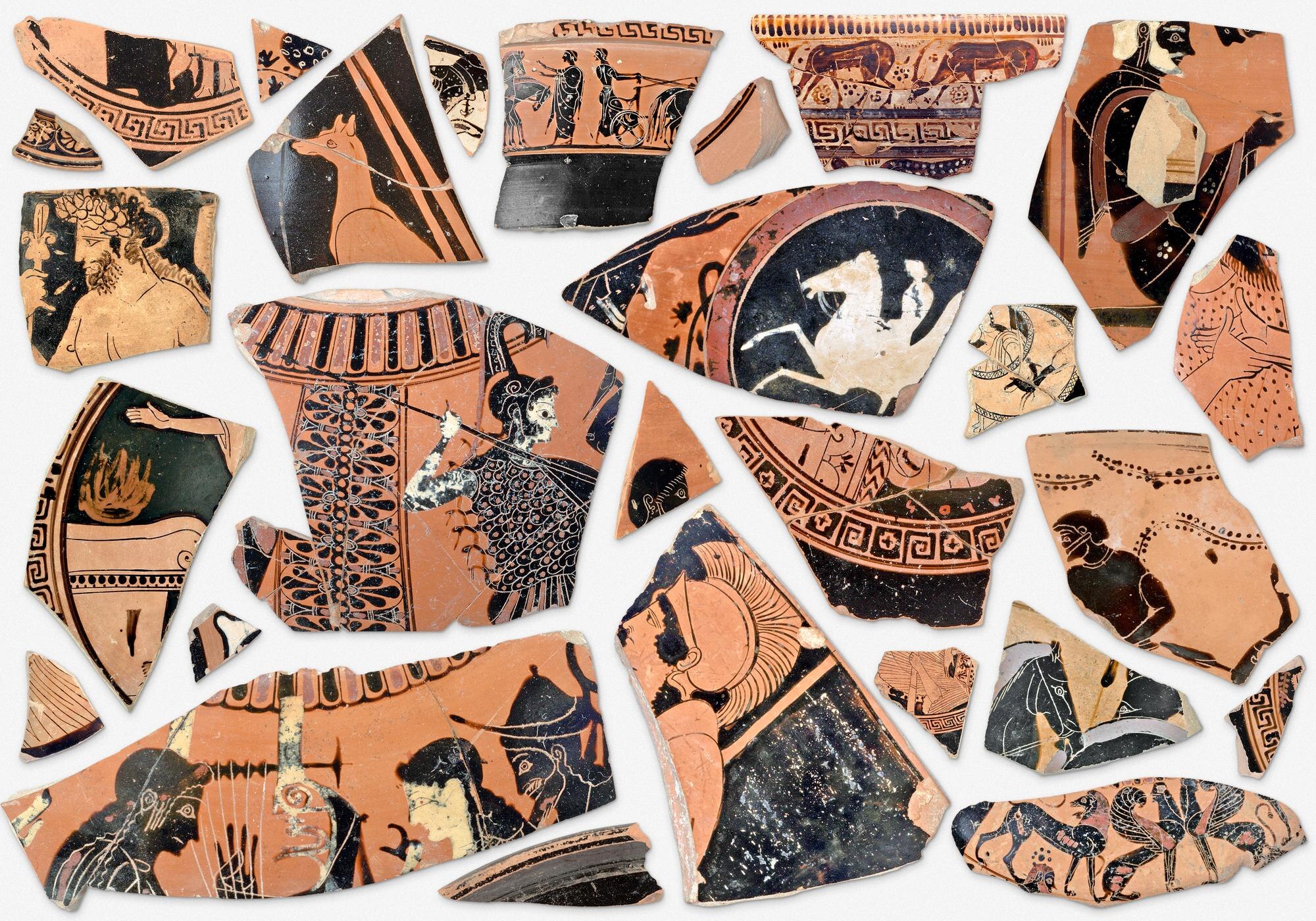
Surviving artworks show the bodies that Homer leaves out. From at least the seventh century BC, Greek painters and sculptors made the Sirens birds with human heads. Some have human arms holding lyres or pipes, and a few early ones are bearded men. This is the siren bird of Greek pottery, and it stayed the standard image throughout antiquity.
A red-figure stamnos, a storage jar, in the British Museum shows it in action. It was made around 480–470 BC by the artist scholars call the Siren Painter. Odysseus stands bound to the mast while bird-bodied Sirens perch on the cliffs around the ship, and one plunges toward the water with her eyes closed.
Art also gave the Sirens a job the epics never mention. On Greek grave monuments, especially Attic funerary sculpture of the fourth century BC, they tear their hair or play instruments over the dead. On a tomb a Siren is a mourner, not a killer.
The fish-tailed Siren became established in medieval texts and imagery. The Liber Monstrorum, an early medieval Latin text, provides an early surviving written description: maidens from the head to the navel with scaly fish tails. Bestiaries then drew both forms side by side as medieval writers retold myths about the Sirens for Christian readers, and the tail slowly won. The Greek Siren has clawed feet gripping a rock and wings folded behind a woman's face. Her medieval successor has a woman's arms and a scaled tail, sometimes split in two and held up in each hand.
Siren mythology in art: bird-women and fish-tailed figures compared
| Siren depiction | Head and upper body | Lower body | Wings and limbs | Visual identification cues |
|---|---|---|---|---|
| Archaic Greek bird-Siren | Human head, usually female; bird-shaped torso | Feathered bird body | Feathered wings; clawed bird feet | Human face on a bird silhouette; no fish tail |
| Classical Greek bird-woman | Woman’s head and increasingly human torso | Bird body beneath the human waist | Wings and bird legs; human arms in many examples | Human-bird hybrid, sometimes holding a musical instrument |
| Medieval single-tailed Siren | Woman’s head and human torso | One long fish tail, often scaled | Human arms; tail fin rather than bird feet | Mermaid-like outline; mirror or comb in some images |
| Medieval double-tailed Siren | Woman’s head and human torso | Two fish tails spreading to either side | Human arms; two finned tail ends | Often shown front-facing, holding one tail in each hand |
Imagery in siren mythology ranges from Greek human-headed birds and winged bird-women to medieval women with one or two fish tails, distinguished by their torsos, wings, feet and tail shapes.
The language kept the medieval version. French sirène, Italian sirena and Spanish sirena all mean "mermaid." Modern films and logos show siren creatures as tailed beauties of the sea, unlike the bird-bodied Sirens familiar from Greek vase painting.
Key Takeaways
- The oldest Greek Sirens are human-headed birds; the fish-tailed form became established in medieval texts and imagery.
- Homer links their song to sailors' deaths but leaves the precise manner of death unexplained.
- Homer's Sirens offer Odysseus knowledge of Troy and of everything on earth.
- Odysseus and his crew survive with wax and rope; Orpheus protects the Argonauts with music, while Aphrodite rescues Butes after his leap overboard.
- Ovid makes their wings a gift, Hyginus a punishment, and Pausanias has the Muses pluck them as trophies.
- Greeks in Italy gave the Sirens tombs, with Parthenope's at Naples.
Frequently Asked Questions
Why were mermaids called Sirens?
Medieval texts and images increasingly represented Sirens with fish tails, bringing them together with the mermaid figure. The Liber Monstrorum is an early written example.
What are some examples of siren characters in media?
The film O Brother, Where Art Thou? (2000), loosely based on the Odyssey, turns the Sirens into three women singing by a river. The television series Siren (2018–2020) uses the name for dangerous mermaids. The Starbucks logo is a two-tailed siren, a medieval design rather than a Greek one.
Are Sirens evil or good?
Ancient sources make them neither simply evil nor simply good. They kill sailors in Homer and Apollonius, yet Ovid makes them Persephone's loyal searchers and Greek tombs show them grieving. The same figure is a killer at sea and a mourner at a grave.
What is the significance of the Sirens in the Odyssey?
The Sirens test how much Odysseus wants to know. He alone aboard his ship listens while his crew's ears are stopped with wax; Circe's advice and their ropes prevent him from acting on what he hears. The scene shows his curiosity held in check by planning and by the men he trusts.
Are sirens only female?
In ancient literature the Sirens are always female. The bearded bird-sirens of early Greek art are the exception, and they faded as the female form became standard.
What do sirens do to their victims?
Homer describes their enchanting song and the victims' remains but leaves the manner of death unexplained. Other ancient accounts include physical violence: in Natural History 10.70, Pliny reports Dinon's claim that Sirens in India sing people to sleep and tear them apart. Pliny himself rejects the story.
Read the Sirens Through Their Sources
In Homer and Apollonius, the danger begins with listening. Apollonius gives the Argonauts a musical defense; Butes leaps overboard at the Sirens' song and survives through Aphrodite's intervention. The body changed most of all, from the human-headed birds on the Siren Painter's stamnos to the medieval fish tail. If you want the myth in the ancient words, read the Odyssey's Sirens episode first. Then read Book 4 of the Argonautica and Book 5 of Ovid's Metamorphoses to see how later poets answered it.