
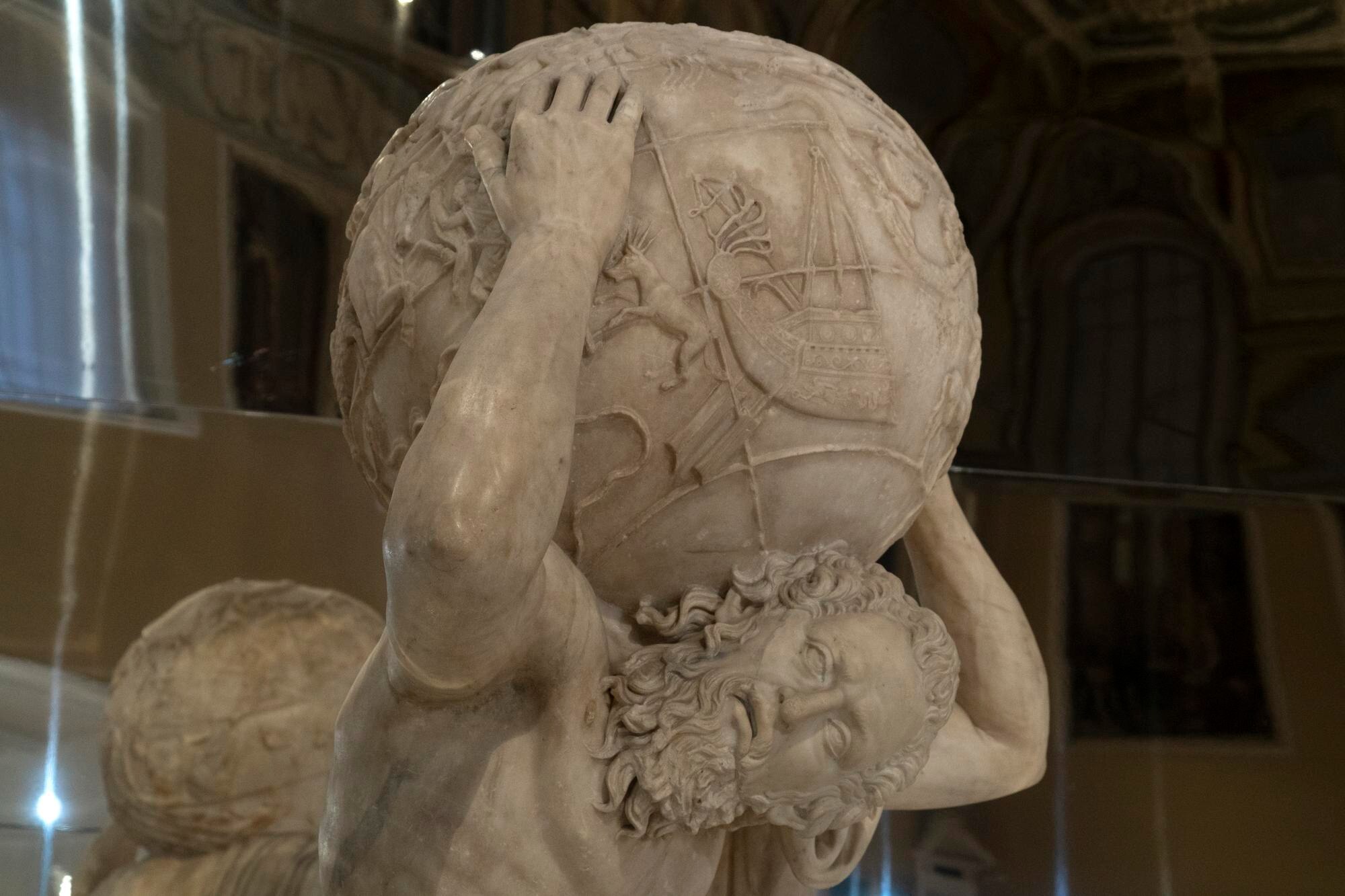
In Greek mythology, Atlas is the Titan who holds up the sky. After Zeus defeated the Titans, he sentenced Atlas to stand at the western edge of the world and carry the heavens on his head and hands. Hesiod's Theogony describes him there, bearing that weight under hard necessity as the lot Zeus gave him.
Accounts differ on parts of his story, including his parentage and how he came to bear the sky. In the stories of Atlas, Greek mythology returns again and again to the sky: in his punishment, his meetings with Heracles and Perseus, his daughters in the stars, and the statue behind a modern mix-up.
In This Article
- Atlas's Parents and Brothers
- Why Zeus Punished Atlas
- Where Atlas Holds Up the Sky
- Heracles and the Golden Apples
- Perseus Turns Atlas Into a Mountain
- Atlas's Daughters in the Stars
- Sky, Not Earth: The Farnese Atlas and the Globe Mix-Up
- Key Takeaways
- Frequently Asked Questions
- Atlas's Burden Is the Sky
Atlas's Parents and Brothers
Hesiod's Theogony, usually dated to around 700 BCE, gives the family tree. Atlas is the son of Iapetus, one of the original Titans, and Clymene, a daughter of Oceanus. Pseudo-Apollodorus's Library 1.2.3 instead names his mother as Asia, another daughter of Oceanus, and gives him the same father and brothers. That parentage makes Atlas a Titan by descent: he belongs to the second generation of the old gods whom Zeus later overthrew.
Hesiod gives him three brothers, Prometheus, Epimetheus and Menoetius, and presents all four sons as a set of warnings. Menoetius was arrogant, so Zeus struck him with a thunderbolt and sent him down to Erebus. Prometheus tricked Zeus over the division of a sacrifice and stole fire for humans. Zeus had him bound in chains while an eagle ate his liver by day, and the liver grew back each night.
Epimetheus, whose name means "afterthought," accepted Pandora, the first woman. In Hesiod's Works and Days, he accepts her as Zeus's gift despite Prometheus's warning not to take gifts from Zeus. Pandora then opens the jar that releases evils among humankind. Epimetheus's mistake brings suffering to humans; Hesiod does not describe a separate sentence for him comparable to Atlas's burden.
Why Zeus Punished Atlas
Atlas fought against Zeus. The war between the Titans and the Olympians lasted ten years, according to Hesiod, and Zeus won it with the thunder and lightning the Cyclopes made for him and the boulders thrown by the Hundred-Handed giants. In the Latin mythographer Hyginus's account, Atlas led the Titan side.
Most of the defeated Titans were locked in Tartarus, a prison as far beneath the earth as the sky is above it. Atlas was given a different sentence. Zeus kept him at the far edge of the world and made him support the heavens.
Where Atlas Holds Up the Sky
Hesiod gives that punishment an exact address. Atlas stands at the ends of the earth, before the clear-voiced Hesperides, holding up the wide heavens with his head and tireless hands. The Greeks put the Hesperides and their garden in the far west, near the river Ocean that circled the world. Nearby, Hesiod says, Night and Day meet and greet each other as they cross a great threshold of bronze.
In the Odyssey, Atlas is the father of the nymph Calypso and knows the depths of every sea. He keeps the tall pillars that support the heavens and hold earth and sky apart.
Heracles and the Golden Apples
The best-known story of Atlas comes from the labors of Heracles. In Apollodorus's account, the eleventh labor requires Heracles to bring King Eurystheus the golden apples of the Hesperides. Prometheus advises him not to fetch the apples himself but to send Atlas, so Heracles takes the sky onto his own shoulders while Atlas goes to the garden.
Atlas comes back carrying three apples and has a plan of his own. For the first time since the war he has nothing on his shoulders, and he means to keep it that way. He offers to take the apples to Eurystheus himself and leave Heracles holding the heavens.
Heracles pretends to agree. He asks for one favor: would Atlas take the sky back for a moment while he puts a pad on his head to ease the weight? Atlas sets the apples down and takes the weight again. Heracles picks up the apples and walks away.
Perseus Turns Atlas Into a Mountain
Ovid's Metamorphoses, completed around 8 CE, tells an Atlas myth with no Heracles in it. In Book 4, Atlas is a giant king at the western edge of the world. He owns huge flocks and herds and a grove of trees with golden leaves and golden fruit. The goddess Themis once warned him that a son of Jupiter would come to rob him of his gold.
Perseus, flying home with the head of Medusa, lands in Atlas's kingdom at nightfall and asks for shelter. He mentions that Jupiter is his father. Atlas remembers the prophecy, refuses him, and tries to throw him out by force.
Perseus is no match for the giant's strength, so he turns away and holds up Medusa's head. Atlas becomes stone. His beard and hair turn into forests, his shoulders and hands become ridges, his head becomes the summit, and his bones turn to rock. The gods then make him grow until the sky and all its stars rest on him. The range across northwest Africa still carries his name: the Atlas Mountains.
Atlas's Daughters in the Stars
Atlas's family made it into the sky he holds. His best-known daughters are the seven Pleiades, whose mother is usually the Oceanid Pleione. One of them, Maia, became the mother of Hermes by Zeus.
The hunter Orion saw the sisters and chased them, and the pursuit went on for years. Zeus ended it by lifting the Pleiades into the heavens as stars. Orion later joined them there as a constellation of his own, and the chase never stopped.
On winter nights the Pleiades, a small, tight cluster in Taurus, cross the sky from east to west, and Orion rises behind them and follows them all night. Their sisters the Hyades, another cluster in Taurus that the ancients linked with rain, sit close by. Through his daughters, the Titan who holds up the stars also supplied some of them.
Sky, Not Earth: The Farnese Atlas and the Globe Mix-Up
The most famous ancient statue of Atlas shows what he was carrying. The Farnese Atlas, a second-century CE Roman sculpture in Naples's National Archaeological Museum, shows Atlas kneeling under a huge sphere. The sphere is a celestial globe, carved with the constellations, including the creatures and heroes the Greeks saw in the night sky.
Older Greek art says the same. A metope from the fifth-century BCE Temple of Zeus at Olympia shows the moment before the trick: Heracles holds up the sky with help from Athena, while Atlas stands in front of him holding the golden apples. What rests on Heracles's shoulders there is heaven.
The globe's carved constellations identify it as a representation of the heavens. In the sky-bearing myths, the Earth is what Atlas stands on, not what he carries.
Key Takeaways
- Atlas is a son of the Titan Iapetus and a brother of Prometheus, Epimetheus and Menoetius.
- He fought against Zeus in the war with the Titans, and Zeus sentenced him to hold up the sky.
- Hesiod places him at the western edge of the world near the Hesperides. Homer has him keeping the pillars between earth and sky.
- Atlas tries to leave Heracles holding the sky, but Heracles tricks him into taking it back.
- In Ovid, Perseus turns him to stone with Medusa's head, and the Atlas Mountains take his name.
- The globe in the Farnese Atlas is the heavens, carved with constellations, not the Earth.
Frequently Asked Questions
Who is stronger, Atlas or Hercules?
The answer depends on the account. In the golden-apples story, Heracles holds the sky temporarily and wins by cunning, not a strength contest. Philostratus the Elder's Imagines 2.20 describes Heracles privately believing he could support the heavens better than Atlas, but concealing that ambition and offering to share the burden out of apparent sympathy. The passage gives no decisive outcome. In Seneca's Hercules Furens, Juno says the heavens rested better on Hercules's shoulders.
Why does Zeus punish Atlas?
Zeus punishes Atlas for fighting against him in the war between the Titans and the Olympians. His sentence is to support the heavens. Ovid's Metamorphoses tells a different story: Perseus turns Atlas into a mountain after Atlas refuses him shelter and tries to drive him away. That transformation is not a sentence imposed by Zeus.
Who did Atlas marry?
Atlas's best-known partner is Pleione, a daughter of Oceanus and the mother of the Pleiades. Some later versions give him Hesperis as the mother of the Hesperides. Hesiod names no wife for him.
Is Atlas good or evil?
Atlas is neither hero nor villain in the ancient stories. He fought on the losing side against Zeus, tried to leave Heracles stuck under the sky, and in Ovid he drives Perseus away. What people remember him for is the endurance of carrying the heavens, not cruelty.
Who was Atlas?
Atlas was a Titan, the son of Iapetus and Clymene, who held up the heavens at the western edge of the world. Modern summaries sometimes call Atlas god of astronomy or of endurance. The early poets describe his task and location; later writers such as Diodorus Siculus credit him with knowledge of the stars.
Atlas's Burden Is the Sky
The accounts differ most clearly over how Atlas comes to bear the sky. Hesiod gives him a burden assigned by Zeus; Ovid turns a king into a mountain after his clash with Perseus. These are different tellings, not successive stages of one story.