
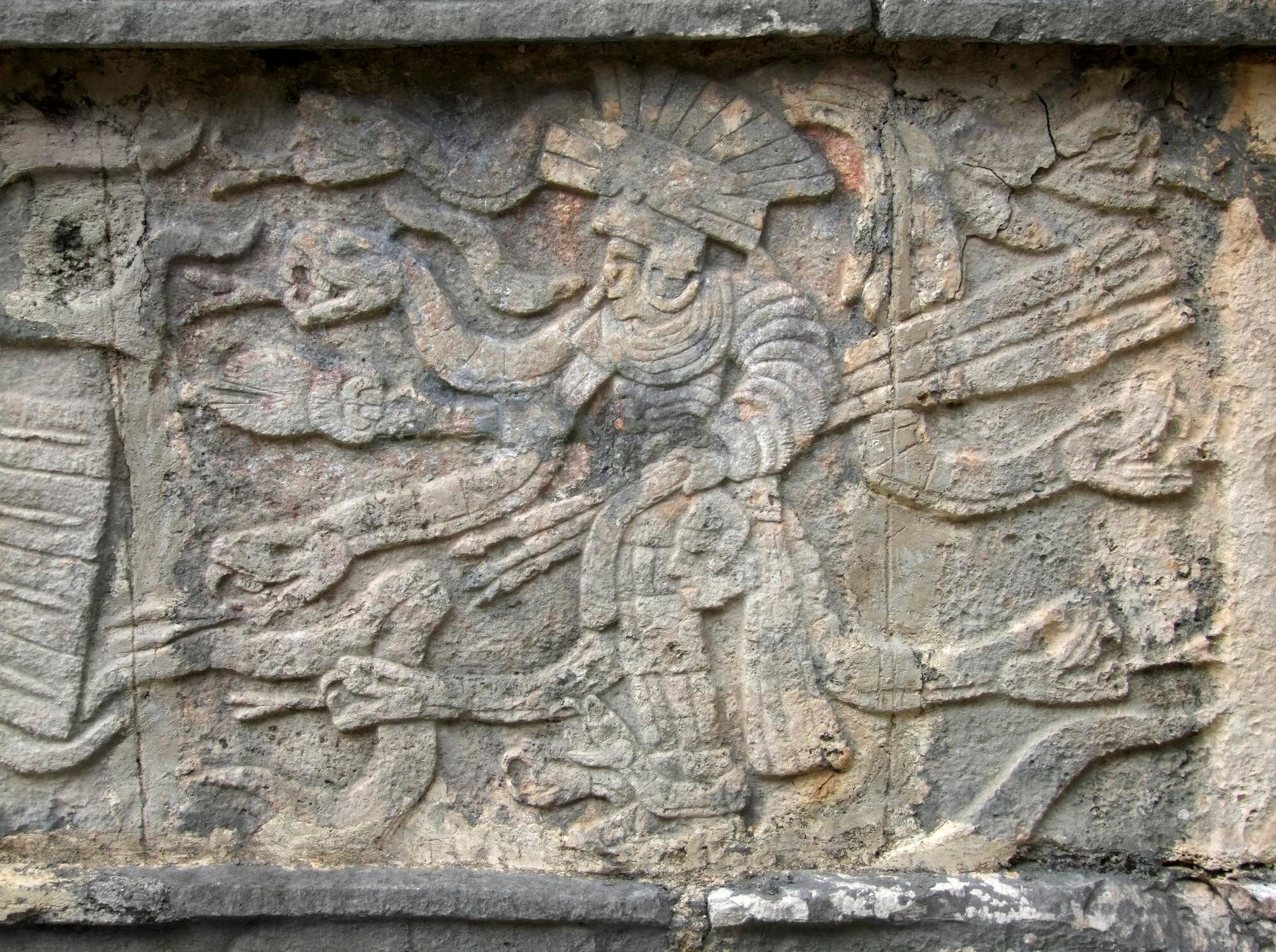
Mayan gods were the powers the ancient Maya held responsible for rain, maize, the sun, childbirth and death, and no single one ruled everywhere. Their names and ranks changed between cities, languages and centuries. Their roles also overlapped and varied with context; one deity could have several functions. A farmer burning copal for rain and a king drawing his own blood dealt with Maya gods on the same terms: offerings went up, and rain, harvests and the right to rule came back. Each section below takes one god or group by its job, then shows the image or story through which the Maya knew it.
| Name | Schellhas letter | Domain | Key image or source |
|---|---|---|---|
| Kukulkán | Not securely identified | Wind, rulership | Feathered serpent |
| Chaac | B | Rain | Curling nose, axe |
| Ixchel | Uncertain; not securely I or O | Childbirth, medicine | Colonial accounts |
| Ah Puch | A labels the skeletal figure; name uncertain | Death | Bare ribs, fleshless jaw |
| Maize god | E | Maize, renewal | Corn-shaped head |
| Yum Kaax | Not applicable | Forest, hunt | Yucatec tradition |
| Itzamna | D | Creation, writing | Aged lord |
| K'inich Ajaw | G | Sun | T-shaped teeth |
| K'awiil | K | Lightning, dynasty | Serpent foot |
The letters classify codex figures, not every deity named in Maya traditions.
In This Article
- Where Our Knowledge of the Gods Comes From
- Kukulkán, the Feathered Serpent
- Chaac, the Rain God
- Ixchel, Goddess of Childbirth and Medicine
- Ah Puch and the Hero Twins in the Underworld
- Yum Kaax and the Maize God
- Itzamna, K'inich Ajaw, and K'awiil
- How the Maya Worshipped Their Gods
- Key Takeaways
- Frequently Asked Questions
- Understanding the Pantheon Through Its Roles
Where Our Knowledge of the Gods Comes From
The Dresden Codex is a folding book of bark paper coated in white lime plaster and painted mostly in red and black. Its pages pair columns of bar-and-dot numbers with small painted gods: a long-nosed figure seated in rain, a death god with bare ribs, an old woman emptying a jar of water over the world.
In 1897, the German scholar Paul Schellhas gave the figures letter labels because many names and identifications remained uncertain. The long-nosed rain figure became God B, the skeleton God A, the aged lord God D. The letters stuck because they commit to nothing. Scholars can discuss God B without first agreeing that he is Chaac, and Mayan deities whose glyph names are still uncertain keep their letters today.
The codices are only one source. Classic inscriptions and painted ceramics from roughly 250 to 900 CE record the religion of kings and courts. The sixteenth-century K'iche' Popol Vuh preserves highland myths written down after the Spanish conquest.
Kukulkán, the Feathered Serpent
Kukulkán joined wind with rulership. Related feathered serpents appear elsewhere: Q'uq'umatz shapes the world alongside Tepeu in the Popol Vuh, and central Mexico knew the god as Quetzalcoatl.
At Chichén Itzá, the pyramid called El Castillo rises in nine stepped terraces. On late afternoons around the March and September equinoxes, their edges cast triangles of light down the side of the north stairway. The triangles line up into a rippling body that seems to slide toward the ground. At the bottom waits a carved stone serpent head.
Chaac, the Rain God
Codices show Chaac with a curling nose and an axe that strikes thunder and releases rain. Long-nosed masks cover the Codz Poop's facade at Kabah. Traditionally identified with Chaac, they are described in a 2024 bulletin from Mexico's National Institute of Anthropology and History (INAH) about the restoration award as Witz, the sacred mountain deity. The Puuc hills around these cities have no rivers, and people stored rainfall in underground cisterns called chultuns. A dry year there could empty them.
That dependence has outlasted the cities. Yucatec farmers still hold Ch'a Chaak ceremonies to call the rain, and in some villages boys tied to the altar's legs croak like frogs, the animals that announce a storm.
Ixchel, Goddess of Childbirth and Medicine
Colonial accounts link Ixchel to childbirth and medicine. Her familiar identification as a moon goddess owes much to later scholarship: archaeologist Traci Ardren traces the influential merging of lunar, weaving and healing figures to J. Eric S. Thompson's reconstruction. Her most famous shrine stood on the island of Cozumel. Pilgrims crossed from the mainland to visit it, and women came to ask for safe births and fertile marriages.
Older images make her harder to pin down. On page 74 of the Dresden Codex, an aged goddess with jaguar claws and a serpent in her hair pours a flood from a jar. Scholars call her Goddess O, and her name in the Postclassic codices reads Chak Chel. Classic art also shows a young woman seated in a crescent moon, holding a rabbit, close to the codices' young Goddess I. These images do not establish that Ixchel, Chak Chel and Goddess I were a single deity.
Ah Puch and the Hero Twins in the Underworld
Ah Puch appears as a skeleton or a bloated corpse: bare ribs, a fleshless jaw, black spots of decay. The Popol Vuh gives the underworld different rulers, One Death and Seven Death, lords of Xibalba. These underworld lords are undone by their own vanity.
They summon the twins Hunahpu and Xbalanque and put them through a series of houses meant to kill them. In the Dark House the twins get a torch and two cigars and must return them unburned by morning. They tie red macaw feathers to the torch and fireflies to the cigars, so both glow all night and stay whole.
The final trick is the boldest. The twins jump into an oven, let the lords grind their bones and throw them into a river, and return days later as wandering performers. They sacrifice each other and come back to life. One Death and Seven Death ask to be sacrificed too. The twins kill them and leave them dead, then rise into the sky as the sun and moon.
Yum Kaax and the Maize God
The maize god, God E, has a long sloping head shaped like an ear of corn, often topped with leafy hair. Classic vases show him dying and returning, sometimes rising out of a cracked turtle shell, as the crop does each planting season.
Kings took on that role in public. On stelae and in ritual, a ruler appeared in the god's costume: a skirt of netted jade beads, a spondylus shell at the waist, and a towering frame of quetzal feathers behind his shoulders. Dressed that way, the king carried the same promise of renewal as his people's fields.
Yum Kaax, "lord of the forest," governs something else: wild plants, animals and the hunt. The milpa belonged to the maize god, and the forest around it to Yum Kaax.
Itzamna, K'inich Ajaw, and K'awiil
On Classic stelae a king often stands holding a small god by one foot. The foot is a serpent. The figure is K'awiil, God K, with a smoking axe or torch through his forehead, and in the king's hand he becomes a scepter. Holding him, the ruler held lightning and the power of his dynasty.
K'inich Ajaw, God G, is the sun, recognizable by square eyes and filed, T-shaped front teeth. Rulers built his title into their names, as with K'inich Janaab Pakal of Palenque.
Itzamna, God D, is an aged lord linked to creation. Scholar Bruce Love notes that his prominence in colonial accounts may reflect their emphasis on Izamal, where he was a principal deity, rather than a hierarchy shared throughout the Maya world. Colonial sources credit him with inventing writing.
How the Maya Worshipped Their Gods
Everyday offerings included copal incense, maize and cacao. In the Popol Vuh, the first ancestors burn copal toward the rising sun. Royal bloodletting tied authority to debt owed the gods. Lintel 24 at Yaxchilán shows Lady K'abal Xook pulling a thorny rope through her tongue while the king holds a torch.
Chichén Itzá's Sacred Cenote received richer gifts. Between 1904 and 1910 Edward Thompson dredged it and pulled up jade, gold, copal and human remains. Cenotes were sacred access points to the watery underworld, associated with rain deities such as Chaac.
The ballgame also staged struggles between life and death. Maya art shows kings dressed as gods reenacting mythological games. A relief at Chichén Itzá depicts a decapitated ballplayer, but the Metropolitan Museum of Art cautions that who was sacrificed, when, and how sacrifice related to play remain unclear.
Key Takeaways
- Which god ranked highest depended on the city and the century.
- Many familiar names are modern labels: Schellhas's letters, or spellings that passed through Spanish.
- Kings borrowed the gods' authority by taking their names and wearing their costumes.
- In the Popol Vuh the death lords can be beaten, and the Hero Twins beat them with wit.
Frequently Asked Questions
Who is the main god of the Maya?
No single god ruled the whole Maya world. Itzamna was prominent in colonial accounts, especially those connected with Izamal. Kukulkán held special prominence at Chichén Itzá, while Chaac was central to rain ceremonies among Yucatec farmers.
Are Mayan and Aztec gods the same?
No, they were separate traditions that shared some features. Kukulkán and Quetzalcoatl are both feathered serpents, and Tlaloc's rain role resembles Chaac's.
Who was the most feared Mayan god?
The surviving evidence does not establish one god as the most feared. Ah Puch's imagery emphasizes death and decay; the Popol Vuh portrays One Death and Seven Death as dangerous underworld rulers.
Why do Maya deities have different spellings in English?
The variants come from different Mayan languages, Spanish transcription and modern alphabets, which is why you see both Chac and Chaac. Scholars generally use "Maya" for the people and culture and "Mayan" for the languages.
How many gods did the Maya worship?
Nobody can give an exact number. Local traditions and gods with overlapping forms make any total unreliable. Schellhas's letters identify the figures in the codices, not the whole pantheon.
Understanding the Pantheon Through Its Roles
A god's role is a starting point, not a permanent identity. Names, images and stories must be read in their regional and historical setting: the rain rites of Yucatán, the royal imagery of Classic cities and the highland Popol Vuh do not describe a single, unchanging pantheon.