
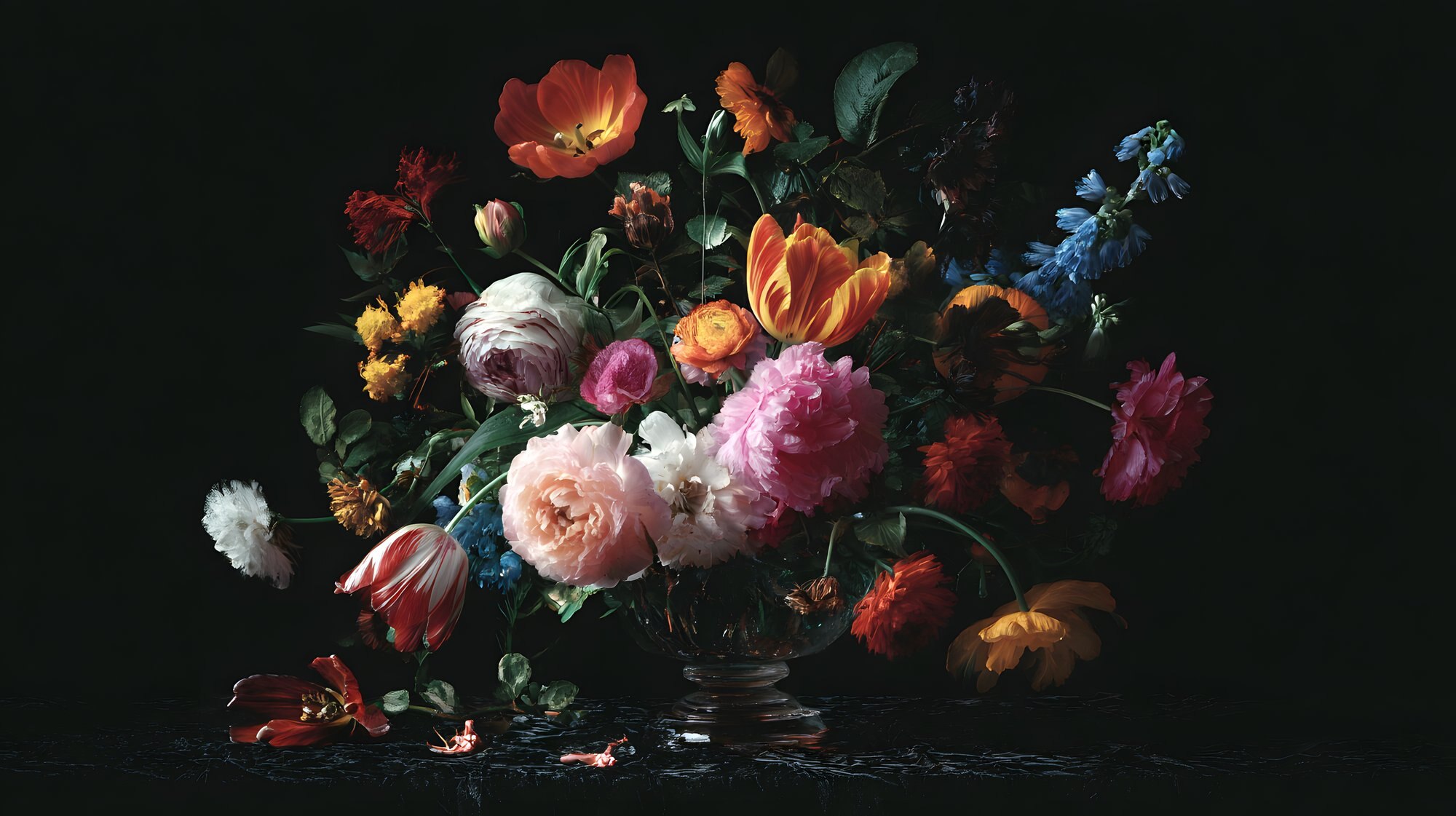
In the famous flower paintings of Dutch and Flemish artists, blossoms from different seasons share a single vase: an impossible bouquet, painted flower by convincing flower. Rachel Ruysch’s Flowers in a Vase is one celebrated example; later flower paintings include Van Gogh’s Sunflowers, Monet’s Water Lilies, and Georgia O’Keeffe’s immense blossoms. Their subjects have roots in common, but their ambitions pull apart: a flower can be a specimen to examine or something large enough to swallow your attention.
That change is the thread running through this history. The vase gradually loses its authority, until the garden spreads across the walls and a single blossom takes over the canvas.
In This Article
- How Dutch and Flemish Bouquets Were Built
- Rachel Ruysch and the Living Bouquet
- Manet and Renoir Bring Flowers Closer
- Van Gogh Makes Color the Subject
- Monet Moves From Vase to Pond
- Gauguin and Redon Reimagine the Bouquet
- Georgia O’Keeffe Enlarges the Flower
- Key Takeaways
- Frequently Asked Questions
- From Botanical Detail to Expressive Color
How Dutch and Flemish Bouquets Were Built
A seventeenth-century bouquet could be accurate in every petal and impossible as a whole. Artists combined flowers that bloomed in different seasons, using individual studies to build arrangements no gardener could gather at once. A blossom faces forward; another turns sideways; a third slips into shadow. Each gets room to declare its shape. These famous paintings of flowers offer abundance without surrendering control.
Control also made the bouquet a display of possession. Imported plants and expensive varieties could suggest the resources needed to acquire them. A damaged leaf introduced a different reckoning: money could obtain the flower, but it could not keep it fresh. Maria van Oosterwijck gave petals and insects concentrated attention, while Jan Brueghel the Younger continued the Flemish tradition of elaborate flower pieces. Against dark backgrounds, pale blossoms become sharply available to the eye.
Jan van Huysum’s later bouquets bring brighter settings and densely layered flowers to this constructed abundance. Jan Davidsz de Heem gives it a more theatrical footing. His arrangements reach across stone ledges, their containers unable to hold the whole display within a tidy outline. At the edge, the grandeur gets untidy: curling stems stretch over the stone, with small creatures crawling among them.
Rachel Ruysch and the Living Bouquet
Ruysch’s Flowers in a Vase (about 1685), in the National Gallery, London, puts that apparent disorder to work. Light petals draw the eye upward and outward from the dark. Leaves and stems carry it between the bright patches, so the bouquet feels active without becoming shapeless. No single blossom can explain the movement. It happens in the gaps and overlaps.
There was a more literal collection of nature behind Ruysch’s knowledge. Her father, Frederik Ruysch, was an anatomist and botanist whose collections included preserved anatomical specimens. Set those preserved bodies beside Rachel’s painted flowers in your mind: both depend on close inspection, but her bouquet makes stillness look temporary. A turned stem seems capable of continuing its turn.
That is where her botanical precision becomes more than identification. Delicate petals and tougher foliage have different substances, different ways of taking light. The arrangement needs those differences. Without the resistance of a leaf or the weight of a shaded flower, the illuminated blossoms would have nothing to push against.
Manet and Renoir Bring Flowers Closer
Édouard Manet’s Flowers in a Crystal Vase (about 1882) brings the encounter down to the scale of a small floral work made near the end of his life. The glass gives the stems a second appearance below the flowers: they cross inside the vessel, altered by water and broken by reflections. The container is transparent, yet looking through it is complicated.
Manet handles that complication with economical marks. A pale stroke catches a petal; a darker passage gives the bouquet weight. You can see how little paint an effect requires. Beside the labor of a Dutch arrangement, this economy feels almost abrupt. The cut flowers have arrived close at hand, without the ceremony of an elaborate setting.
Pierre-Auguste Renoir’s Chrysanthemums (1881–82), in the Art Institute of Chicago, crowds the vase again. Soft, irregular flower heads press together, their edges less insistent than their collective mass. Warm and cool touches keep that mass moving. Among famous floral paintings, this is a generous example of how loose brushwork can make a bouquet feel substantial: the flowers need no hard outlines to occupy space.
Renoir keeps that abundance inside a familiar vessel. Monet will make the vessel itself expendable.
Van Gogh Makes Color the Subject
In Arles in 1888, while preparing for Paul Gauguin’s arrival, Van Gogh developed his best-known vase compositions of sunflowers. Sunflowers names a group of paintings, not one unique canvas. In the National Gallery, London’s version, the yellow flowers stand against a yellow background. There is almost nowhere for yellow to escape itself.
Stand close to that painted surface and the petals seem to scrape against the surrounding color. Thick paint catches the light; strokes twist with the petals, then thicken into the heavier centers. Some heads spread open, while others droop or expose their seeds. The bouquet has heft. Its uneven condition prevents the repeated flowers from settling into an agreeable pattern.
The pressure comes from small differences within the restricted palette. Background and blossom share a color family, yet they must remain distinct enough for each head to carry its own direction and weight. Yellow has to build the room around the bouquet as well as the bouquet itself.
Irises changes the terms. Painted in 1889 at Saint-Rémy and now in the J. Paul Getty Museum, it brings you close to a bed of growing plants. Blue-violet flowers rise above long green leaves, interrupted by a white iris. The white flower breaks the company of its neighbors without leaving it. Van Gogh also painted vase arrangements of irises; rooted growth and cut stems gave him quite different structures to work with.
Monet Moves From Vase to Pond
Monet’s Water Lilies paintings make the flower inseparable from its surroundings. At Giverny, he developed the water garden whose pond became a sustained subject. Lily pads and flowers occupy the water’s surface, while reflections bring another space into it. Blue can belong to the sky overhead even though you meet it beneath the floating plants.
The difficulty is pleasurable, then disorienting. A mark that seems to describe a leaf gives way to a streak of paint; a reflection appears to open depth where the pads insist on a surface. The flowers no longer supply a stable center. Your attention travels between things that occupy the same painted patch but cannot occupy the same physical space.
At the Musée de l’Orangerie in Paris, the large Water Lilies decorations extend across surrounding walls. A portable still life offers a compact arrangement; these paintings make viewers turn and move to take in successive passages. The body becomes involved in looking.
In passages without a bank or horizon, that movement has no dependable shore to return to. You look for the edge that would tell you where you stand. It is gone. The water remains in front of you, but your footing feels less certain.
Gauguin and Redon Reimagine the Bouquet
Gauguin’s A Vase of Flowers (1896) carries concerns from his Tahitian work into still life. The vessel and setting have their own force, supporting a bouquet held together by strong outlines and broad color relationships. Where Monet lets reflected forms slip, Gauguin contains them. His flowers inhabit a painted world whose structure stays firm.
Odilon Redon gives the bouquet another freedom. Flowers became increasingly important within his expanding work in color. Recognizable blossoms mingle with forms that resist naming. Identification ceases to be the price of admission: the unfamiliar shapes can exert as much pull as the flowers you know.
His pastel portrait Violette Heymann (1910), in the Cleveland Museum of Art, makes that freedom visible beside a human face. The sitter appears in profile, with flowers gathered beside her head in a floating field. They do not sit obediently in a vase on a table. Their colored forms occupy the space next to her as though a bouquet had escaped its support.
The face gives you someone definite to look at. Beside it, Redon allows growth without an ordinary room to contain it.
Georgia O’Keeffe Enlarges the Flower
Georgia O’Keeffe is a central modern flower artist because she changes the distance between viewer and blossom so radically. In Black Iris (1926), at the Metropolitan Museum of Art, folded petals fill the composition. There is little room to stand back from the flower within the picture. Its interior becomes the place you have entered.
Pale outer folds lead toward dark, compressed passages. Looking inward feels like stepping into an architectural cavern, except that the walls bend and open with the softness of petals. An edge that first seems decorative becomes a boundary between light and depth. The flower is recognizable, but recognition does not make its space easy to grasp.
Jimson Weed/White Flower No. 1 (1932), in the Crystal Bridges Museum of American Art, sends that enlargement outward. Broad white blossoms spread against green foliage, their trumpetlike forms assertive and architectural. Where Black Iris gathers attention into its folds, this painting opens across the canvas.
Scale changes the encounter. An easily overlooked blossom now commands the viewer’s field of vision, and the small adjustments of ordinary flower-looking no longer suffice. You have to give it space.
Key Takeaways
- The impossible seasonal bouquet establishes a lasting tension: an individual flower can be observed faithfully while the whole arrangement is invented.
- Ruysch and Manet offer different kinds of intimacy, one built through sustained detail and the other through economical marks.
- Following the vase’s disappearance helps connect Monet’s pond with O’Keeffe’s close-ups: both unsettle the viewer’s distance from flowers.
- Redon’s floating blooms show why botanical accuracy is only one possible ambition for floral art.
Frequently Asked Questions
Which artist is famous for painting flowers?
Van Gogh is especially famous for painting flowers, particularly his Sunflowers. In the London version, yellow meets yellow while the drooping heads refuse to become a uniform display.
What is Van Gogh’s flower painting called?
Sunflowers is the title most often associated with Van Gogh’s flower paintings, though he also painted irises, roses, and other blossoms. Another famous flower painting by him, the Getty’s Irises, breaks its blue-violet company with a white flower.
Why do some painted bouquets combine flowers that bloom in different seasons?
Artists combined studies made at different times to assemble bouquets that could not bloom together naturally. The Dutch and Flemish arrangements discussed above give each specimen a convincing presence, even when the gathering itself is impossible.
What can insects or wilting petals symbolize in a floral still life?
Wilting petals can suggest mortality and beauty’s short life, while insects can evoke decay, transformation, or close observation of nature. In de Heem’s arrangements, small creatures interrupt the grand display at the stone ledge; a butterfly can also carry associations with resurrection in a religious context.
How can readers distinguish different paintings with the same floral title?
The artist, date, collection, and visible arrangement distinguish paintings that share a floral title. A work loosely described as a famous flower painting becomes unmistakably the Getty’s Irises when its growing bed and contrasting white bloom enter the description, unlike Van Gogh’s vase arrangements.
From Botanical Detail to Expressive Color
Floral painting comes down to how much freedom an artist takes with something closely observed. The Dutch bouquet joins flowers that nature keeps apart; Monet removes the boundaries that make a garden easy to read. Neither choice abandons the flower. Each asks it to do more than resemble itself.
For a first encounter, Ruysch suits the pleasure of exact detail, while Manet suits an interest in how little paint can establish a presence. O’Keeffe offers the strongest break with the scale of an ordinary bouquet. Her Black Iris turns a blossom’s folded interior into the main event. Across these differences, the subject remains familiar; what changes is the kind of attention it demands.