
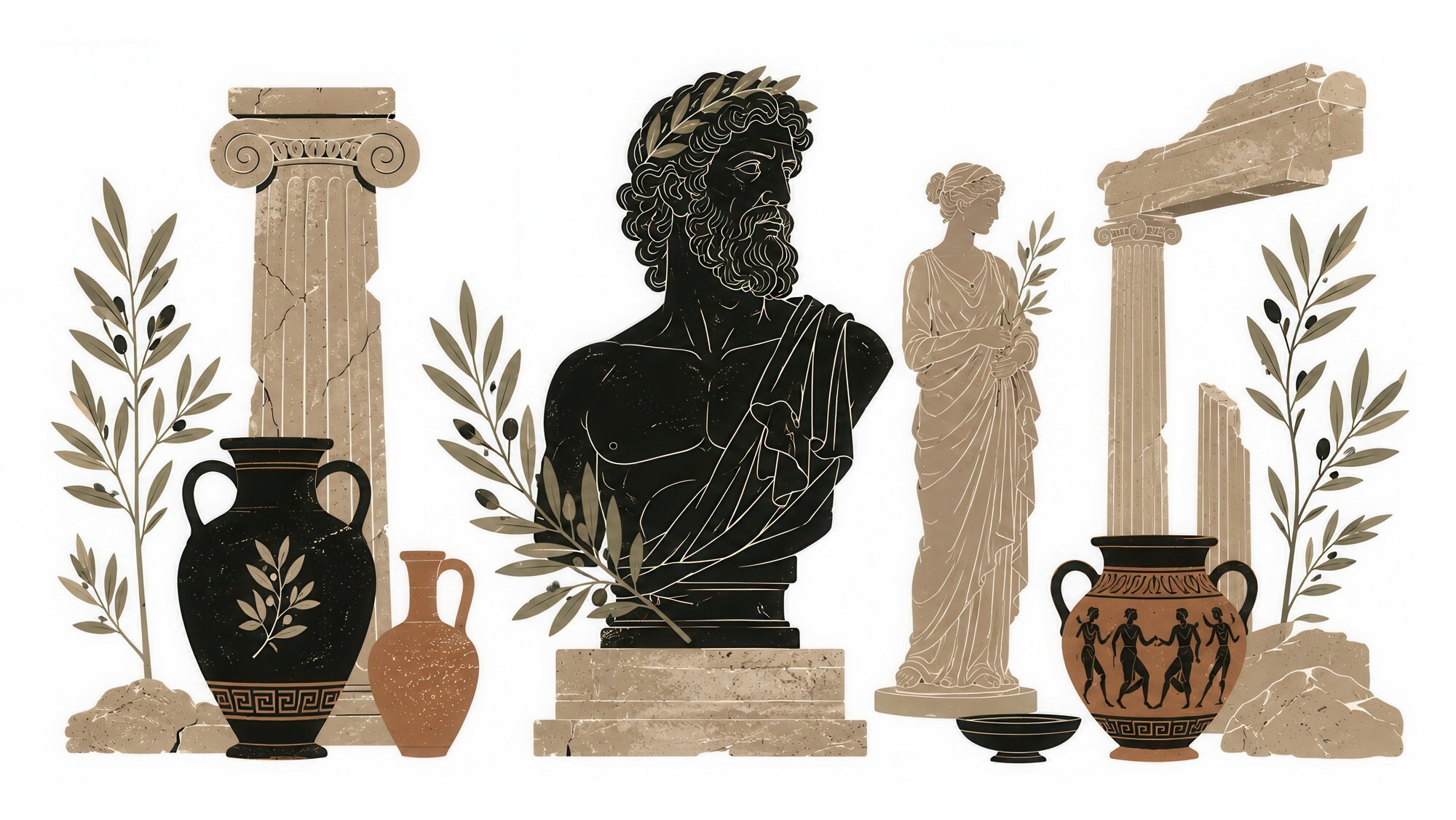
In Greek mythology, Hestia is the goddess of the household and civic hearth, associated with the altar flame and the shared meal that followed a sacrifice. She was the eldest child of Cronus and Rhea and an older sister of Zeus. For Hestia, Greek mythology supplies almost no stories, yet whenever Greeks sacrificed to any god, she received the first share.
The surviving sources preserve few stories about Hestia but describe substantial honors. Her name, her family, her vow and her worship show how a goddess with little surviving narrative could still hold an important place in Greek religion.
In This Article
- What Her Name Means
- Firstborn Among the Children of Cronus: Her Family
- The Vow That Kept Her Unmarried
- Her Seat Among the Olympians
- Worship at the Household and City Hearth
- What the Hymns Say
- How Hestia Differs From Roman Vesta
- Key Takeaways
- Frequently Asked Questions
- The Hearth at Religion's Center
What Her Name Means
In Greek, hestia is the ordinary word for a hearth, and the goddess carries that word as her name. Because one word named both, context matters when distinguishing the physical hearth from the goddess. The shared name closely connects Hestia with the hearth, but Greek poetry and art also present her as a person.
That fire cooked the food and warmed the room, and it received small offerings. The shared word did not make every mention of a hearth a reference to the goddess.
Hestia also appears in human form in ancient art. In Athenian vase painting, she is shown as a veiled woman, sometimes holding a flowering branch; a kettle also appears as an attribute in sculpture. These are occasional attributes, not a fixed set present in every depiction. The François Vase, a painted Athenian vessel from the sixth century BC, shows the gods arriving at the wedding of Peleus and Thetis, and a figure labeled Hestia walks in that procession. She shares a large mantle with Demeter and Chariclo. Here she is represented as a woman among other deities.
Firstborn Among the Children of Cronus: Her Family
The fullest account of her birth comes from Hesiod's Theogony. It names her first among the children of Cronus and Rhea, followed by Demeter, Hera, Hades, Poseidon and Zeus. Cronus had been warned that a son would overthrow him, so he swallowed each child as it was born.
Rhea saved the youngest. She handed Cronus a stone wrapped in swaddling clothes, and he swallowed it in place of Zeus. When Zeus grew up, he overcame his father and the swallowed children were released. Hesiod says the stone emerged first because Cronus had swallowed it last, but does not specify the children's order of release.
The Homeric Hymn to Aphrodite calls Hestia both the firstborn and the youngest child of Cronus without explaining the paradox. In his note to the hymn, translator H. G. Evelyn-White explains it as Hestia being swallowed first and released last. Her family also made her sister to Zeus, Poseidon and Hades, and aunt to Apollo and Hermes.
The Vow That Kept Her Unmarried
The Homeric Hymn to Aphrodite tells the only early story about a choice Hestia made. Two gods wanted to marry her: Poseidon, her own brother, and Apollo, her nephew. She refused them both, and the hymn says she refused firmly.
What she received in place of a husband is listed in detail. Zeus gave her a seat in the middle of the house, where she takes the richest portion. She is honored in the temples of all the gods. Among mortals she ranks as the eldest of goddesses. The hymn also names her as one of three goddesses whom Aphrodite cannot sway, alongside Athena and Artemis.
Those honors answered an oath. Having turned away the sea god and the god of Delphi, Hestia reached out, touched the head of Zeus and swore to remain a maiden for all her days.
Her Seat Among the Olympians
Greek writers agreed that there were twelve chief gods but never fixed who they were, and Hestia appears on some lists and not others. The most memorable ancient picture of her place among them sits outside any list.
It comes from Plato's Phaedrus. Socrates describes the gods riding out across the heavens. Zeus leads the way in a winged chariot, and the other gods follow in eleven companies, each to its own place. Almost the whole household of heaven goes out on that journey.
Hestia alone stays behind in the house of the gods.
The scene can be read as an image of the hearth as the household's fixed center: the others travel while Hestia remains. Elsewhere, the François Vase shows her walking in the wedding procession with the other gods.
Worship at the Household and City Hearth
Ritual is where a goddess with so few stories held so much honor. The hearth was important in Greek household religion, but many households used portable braziers for cooking and heating. A few days after a birth, the household carried the newborn around the hearth in a rite called the Amphidromia. The circuit brought the child into the family in front of the goddess at its center.
The same order governed sacrifice. Greeks offered Hestia the first portion, and the saying "to begin from Hestia" came to mean starting at the proper beginning. Even when the sacrifice was for Zeus or Apollo, she ate first.
Cities kept a common hearth as well, usually in a building called the prytaneion. In at least some cities, that fire was kept continuously burning. There the city fed its magistrates, honored citizens and visiting envoys, so the community ate at one shared fire the way a family did at home.
That civic fire also traveled. Greek colonists carried sacred fire from their mother city's hearth and used it to light the hearth of the new settlement. A colony founded hundreds of miles away still burned the flame of the city that sent it.
What the Hymns Say
Two short Homeric hymns speak to her directly, Hymns 24 and 29. The Hymn to Aphrodite told how she earned her honors; these two poems show her holding them.
Hymn 24 runs only a few lines. It finds Hestia at Pytho, the sanctuary of Delphi, tending the holy house of Apollo, with oil always dripping from her hair. The poem does not explain the oil or identify it as fuel. Instead, it turns from that description to an invitation: Hestia is asked to enter the speaker's house and favor the song. Apollo, whose house she tends here, is also one of the suitors she refuses in the Hymn to Aphrodite.
Hymn 29 pairs her with Hermes. It says that mortals hold no feast without pouring honey-sweet wine to Hestia first and last. It then asks Hermes, the messenger god, to join her in favoring the household. Readers often see a balance in that pairing, with the fixed center of the house matched to the god of doorways and roads.
Pindar's eleventh Nemean ode gives her a civic voice. It opens by calling on Hestia as the guardian of the prytaneion, the goddess of the city's council hearth.
How Hestia Differs From Roman Vesta
Rome's hearth goddess, Vesta, filled a similar role, and the two are often merged. The Roman cult was organized differently. Vesta had a round temple in the Roman Forum, a priesthood of Vestal Virgins kept the state fire burning inside it, and her festival, the Vestalia, fell in June.
The best literary source for that festival is Ovid's Fasti, a Roman poem on the calendar. Ovid writes that Vesta's temple held no statue, because she was nothing other than living flame. The Greek word hestia means hearth, but that shared name does not mean Greek artists and poets represented the goddess only as fire.
The Fasti also contains a story in which this goddess faces sexual violence. During a festival, Priapus approached Vesta as she slept, intending to assault her. A donkey's braying woke her, and the attempt failed. Ovid tells this of Vesta, not Hestia, and it should not be read back into Greek myth as an early Greek tradition.
The structure differs most. Hestia was honored at every hearth and rarely had temples of her own, while Vesta stood at the center of a state cult with a dedicated priesthood.
Key Takeaways
- Hestia presided over the hearth, home, altar flame and sacrificial feast.
- She was the eldest child of Cronus and Rhea and a sister of Zeus; the Homeric Hymn to Aphrodite also calls her the youngest.
- Her vow of maidenhood, sworn on the head of Zeus, left her without husband or children.
- She received the first portion of sacrifices to every god, an honor out of proportion to her handful of myths.
- Roman Vesta is a useful comparison, but the Greek and Roman cults were built differently.
Frequently Asked Questions
What is Hestia the goddess of?
Hestia is the goddess of the hearth, the fire at the center of the home. She also oversaw the altar flame and the shared meal after sacrifice. Through the city's common hearth in the prytaneion, she watched over the community as well as the household.
Was Hestia married to Zeus?
No, Hestia never married Zeus or anyone else. She was his older sister. The Homeric Hymn to Aphrodite says she swore by Zeus's head to remain a maiden and received honors from him.
Who was Hestia in love with?
No surviving ancient myth gives Hestia a romantic partner. Homeric Hymn 29 invites Hestia and Hermes to dwell together in friendship, not as romantic partners. Poseidon and Apollo both sought to marry her. She turned them both down and took her vow of maidenhood.
Was Hestia Athena's girlfriend?
No, no ancient text describes a romantic bond between Hestia and Athena. The Homeric Hymn to Aphrodite groups them with Artemis as the three goddesses Aphrodite cannot sway, because all three stayed unmarried.
The Hearth at Religion's Center
Hestia's importance is clearest in the practices described by her sources: honoring her at a feast, welcoming a child at the household hearth and maintaining the city's common fire. Her surviving stories are few, but they still give her a place in the divine family and a choice of her own in refusing marriage. Read together, the myths, hymns and ritual evidence show both a goddess represented as a person and the sacred hearth whose name she shares.