
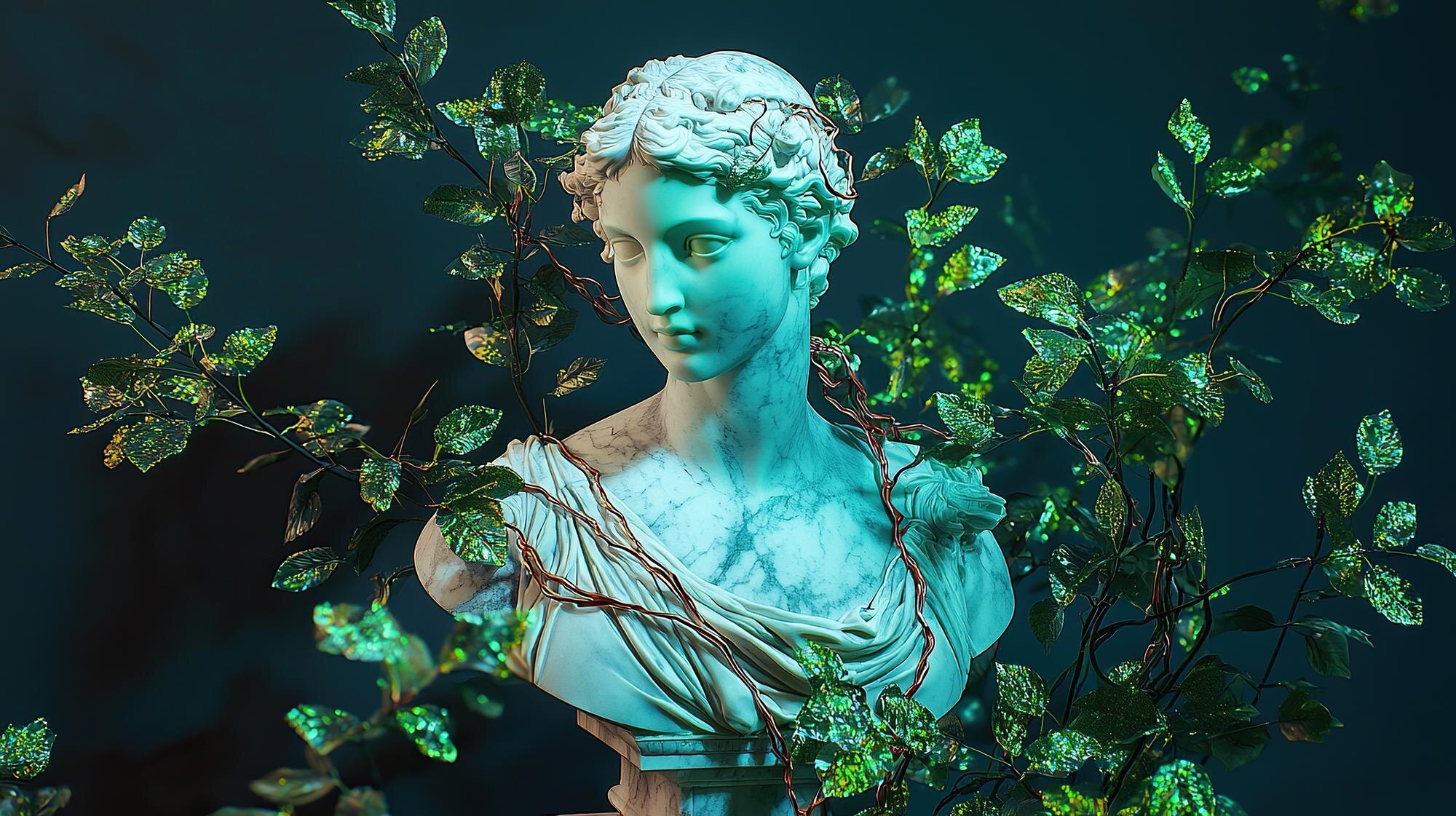
Gaia is the Greek goddess of the earth. More precisely, she is Earth itself, imagined as a living mother. She is a primordial deity, one of the first beings to exist, and the grandmother of Zeus, but she is no Olympian. Her relationship with divine rulers varies between sources. In Hesiod, she made the sickle used against her husband and hid her grandson from his own father; in Apollodorus, she later bore monsters to challenge that grandson's rule.
The stories come mostly from Hesiod's Theogony, with later additions from Apollodorus's Library, Aeschylus's Eumenides and the Homeric Hymn to Earth. Those sources do not always agree.
In This Article
- Who Gaia Is in Greek Myth
- What She Created Without a Partner
- Her Children by Three Partners
- How She Helped Topple Uranus and Cronus
- Why She Turned Against Zeus
- Worship and Gaia's Oracle at Delphi
- How Ancient Artists Showed Her
- Key Takeaways
- Frequently Asked Questions
- Earth at the Root of Divine Power
Who Gaia Is in Greek Myth
Hesiod's Theogony, composed around 700 BCE, gives the oldest connected account of her origin. First came Chaos, a yawning gap. After it came broad-breasted Gaia, the secure seat of all things, along with misty Tartarus in the depths of the earth, and Eros. No one gives birth to Gaia. She simply comes into being. In Hesiod's genealogy, she is the mother of the twelve Titans and the grandmother of Zeus. Gaia is the ancestor of many major divine families: sky, sea, Titans and, in the end, the Olympians all trace back to her. But not every deity does: Hesiod makes Erebus and Night children of Chaos, and Aether and Day their offspring.
Her name is the ordinary Greek word for land or earth, so the same figure appears as Gaia, Gaea or Ge. Ge is the usual form in Athenian Greek. Gaea is a Latinized spelling that still turns up in older English books. All three name one goddess.
The word does double duty. A Greek audience hearing it could picture the dark soil, the solid floor beneath the sky, or a mother who speaks and schemes. In the poems, Gaia is all three at once.
Gaia personifies Earth itself. Demeter, by contrast, governs grain and harvest.
What She Created Without a Partner
Her first acts of creation she performs alone. She bore starry Uranus, the Sky, equal to herself, to cover her on every side and give the gods a secure home. She bore the long Mountains, haunts of the nymphs. She bore Pontus, the barren sea with its swelling waves. Hesiod stresses that she did all this without any union of love.
So sky, mountains and sea are the offspring of earth. They come second, and they come from her.
Then the sky she made became her husband. Uranus is both Gaia's son and her first mate, and Pontus, the sea she bore, becomes her second. The Greek gods begin with a mother who gives birth to her own partners.
Her Children by Three Partners
Hesiod names three partners for Gaia, and each union produces a different kind of power. The table sets them out side by side.
Gaia in Greek mythology: children by Uranus, Pontus and Tartarus
| Gaia’s partner | Offspring group | Number of children | Named children | Role in Greek mythology |
|---|---|---|---|---|
| Uranus (Sky) | Titans | 12 | Oceanus, Coeus, Crius, Hyperion, Iapetus, Theia, Rhea, Themis, Mnemosyne, Phoebe, Tethys and Cronus | Cronus overthrows Uranus; Cronus and Rhea become parents of the first Olympian generation. |
| Uranus (Sky) | Cyclopes | 3 | Brontes, Steropes and Arges | Give Zeus thunder and forge his thunderbolt. |
| Uranus (Sky) | Hundred-Handers (Hecatoncheires) | 3 | Cottus, Briareus and Gyes | Each has 100 hands and 50 heads; they help Zeus defeat the Titans. |
| Pontus (Sea) | Sea deities and Eurybia | 5 | Nereus, Thaumas, Phorcys, Ceto and Eurybia | Ancestors of the Nereids, Harpies, Graeae and Gorgons; Eurybia mothers Astraeus, Pallas and Perses. |
| Tartarus (the abyss) | Typhon (Typhoeus) | 1 | Typhon | A monster with 100 serpent heads who challenges Zeus and is defeated by his thunderbolt. |
In Hesiod’s account, Gaia bears twelve Titans, three Cyclopes and three Hundred-Handers with Uranus, five children with Pontus, and Typhon with Tartarus.
Cronus, the youngest of the Titans, matters most to what follows. The sea line matters too. Nereus, the truthful old man of the sea, later fathered the fifty Nereids, and Phorcys and Ceto became the parents of several monsters. Through Pontus, Gaia's family reaches down into the waves.
Her strangest children came from no marriage at all. When Uranus was cut, drops of his blood fell on the ground, and Gaia took them in like seed in a field. As the year went round, she bore from them the Erinyes, or Furies, who hunt down crimes against kin. She bore the Giants too, born already in gleaming armor with long spears in their hands, and the ash-tree nymphs called Meliai. A wound in the sky became a crop in the soil.
How She Helped Topple Uranus and Cronus
Uranus hated his children and pushed them back inside Gaia's body as each was born. She groaned under the strain, made a great sickle of gray adamant, and asked her sons to punish their father. Only Cronus agreed. When Uranus came to lie with her, Cronus ambushed him and cut off his genitals. The severed parts fell into the sea, where Aphrodite formed from the foam.
Cronus then took power and married his sister Rhea. Gaia and Uranus had warned him that a son would overthrow him, so he swallowed each child Rhea bore. Rhea turned to her parents for help, and they sent her to Lyctus on Crete to give birth to Zeus. Gaia took the infant to raise in secret. Cronus was handed a stone wrapped in swaddling clothes, and he swallowed it in place of his son.
Her help did not end with the birth. In Hesiod's Theogony, Gaia's counsel deceived Cronus into bringing his swallowed children back up, beginning with the stone. Zeus and his siblings then fought the Titans, winning with the help of the Hundred-Handers, whom Gaia advised them to free. Later in the poem, after Typhon's defeat, the gods urged Zeus to become king on her counsel. She and Uranus also warned Zeus about his first wife, Metis, which led him to swallow her.
Why She Turned Against Zeus
Apollodorus's Library, a handbook usually dated to the first or second century CE, gives Gaia a reason to oppose Zeus: anger over the Titans' defeat. Its account also differs from Hesiod's story of the Giants growing from Uranus's spilled blood. Apollodorus says Earth, vexed on account of the Titans, bore the Giants to Uranus.
Then came a race. An oracle declared that the gods could not kill the Giants without a mortal's help. Gaia went looking for a drug that would keep her sons from dying even then. Zeus moved first. He forbade Dawn, the Moon and the Sun to shine, and in the darkness he cut the plant himself before she could reach it. Heracles took the field beside the gods, and the Giants fell.
In Apollodorus's account, Gaia grew angrier after the Giants' defeat and bore Typhon to Tartarus. This enormous, part-human, part-serpent monster temporarily disabled Zeus by severing his sinews. Hermes and Aegipan restored them, and Zeus resumed the fight, eventually crushing Typhon beneath Mount Etna in Sicily.
Hesiod tells a different version: Typhon has a hundred serpent heads, and Zeus defeats him with thunderbolts and hurls him into Tartarus. Hesiod does not explicitly say Gaia bore him for revenge.
Worship and Gaia's Oracle at Delphi
Gaia was worshiped as well as storied, and as the earth that witnesses everything, she was called on in oaths. In the Iliad, Agamemnon swears by Zeus, the Sun, the rivers and Earth before the duel of Paris and Menelaus. At Athens, Ge had her own cult, including worship under the title Kourotrophos, "nurturer of the young."
That nurturing side fills the Homeric Hymn to Earth. It calls her mother of all and eldest of all beings. She feeds every creature on land and in the sea, and she grants rich harvests and herds to those she favors. The hymn's mother Gaia is generous and steady, with none of the plotting found in Hesiod.
Her strongest claim to religious authority comes from Delphi. Aeschylus's Eumenides, staged in 458 BCE, opens with the Pythia, Apollo's priestess, praying in order of seniority. She names Earth as the first prophet of the shrine. Themis held the seat after her, then the Titaness Phoebe, who passed it to Apollo. In Aeschylus's version, Apollo inherits the oracle through Themis and Phoebe from Gaia, the goddess Earth and its first prophet.
How Ancient Artists Showed Her
How do you paint a goddess who is the ground? Greek artists usually answered by showing Gaia only from the waist up, rising out of the earth.
The pose is clearest in the story of Erichthonius, an early king of Athens. Apollodorus tells how Hephaestus tried to force himself on Athena and his seed fell on the ground. Earth bore the child, and Athena raised him. Athenian vase painters show Ge half emerged from the soil, handing the infant up to Athena, so the earth itself becomes mother of the Athenians' ancestor. Roman artists later gave her counterpart, Terra or Tellus, a full body, seated with children and abundant fruit.
The same half-risen pose turns tragic on the Pergamon Altar, carved in the second century BCE. In its Gigantomachy frieze, Athena drags the Giant Alcyoneus by his hair. Below them Ge rises from the ground, reaching up and pleading for the son she bore against the gods, and she cannot save him.
Key Takeaways
- Gaia is Earth personified and a primordial deity, not an Olympian.
- In Hesiod, Gaia produces Sky, Mountains and Sea without a partner, then takes Sky and Sea as mates.
- Her descendants include Titans, Cyclopes, sea gods, Furies, Giants and Typhon.
- She helps overthrow Uranus and Cronus. Apollodorus presents her as opposing Zeus over the Titans; Hesiod also has her support Zeus's kingship.
- Cult and art show her gentler side: oath-witness, nurturer, first prophet at Delphi and grieving mother.
Frequently Asked Questions
Who is Gaia to Zeus?
Gaia is Zeus's grandmother on both sides. His father, Cronus, and his mother, Rhea, are both her children with Uranus. In Hesiod, she hid the infant Zeus on Crete and later supported his kingship. In Apollodorus, she opposed him through the Giants and Typhon.
Did Gaia marry her son?
Yes, Gaia took her son Uranus as her mate. In Hesiod's Theogony she bore him without a partner, and their union produced the Titans, Cyclopes and Hundred-Handers.
Who did Gaia have children with?
Hesiod names three partners for Gaia: Uranus, the Sky; Pontus, the Sea; and Tartarus, the abyss below the earth. She also bore children without a partner, including Uranus himself, and she bore the Furies and Giants from Uranus's spilled blood. In the Athenian story, she gave birth to Erichthonius from Hephaestus's seed.
Who is Gaia?
Gaia is the Greek personification of Earth and one of the first beings to exist after Chaos.
What is Gaia's Roman name?
The Romans called her Terra or Tellus, often with the title Mater, "Mother." Terra Mater and Tellus Mater were honored as the earth that nourishes crops and living things.
Earth at the Root of Divine Power
Gaia's power reaches beyond her place at the beginning of the divine family tree. She arms Cronus against Uranus, shelters Zeus and mourns the children the gods defeat. Worshipers also knew her as a nurturer and witness to oaths. The Earth that gives the gods their home remains a mother with children to protect, even against the rulers she helped establish.