
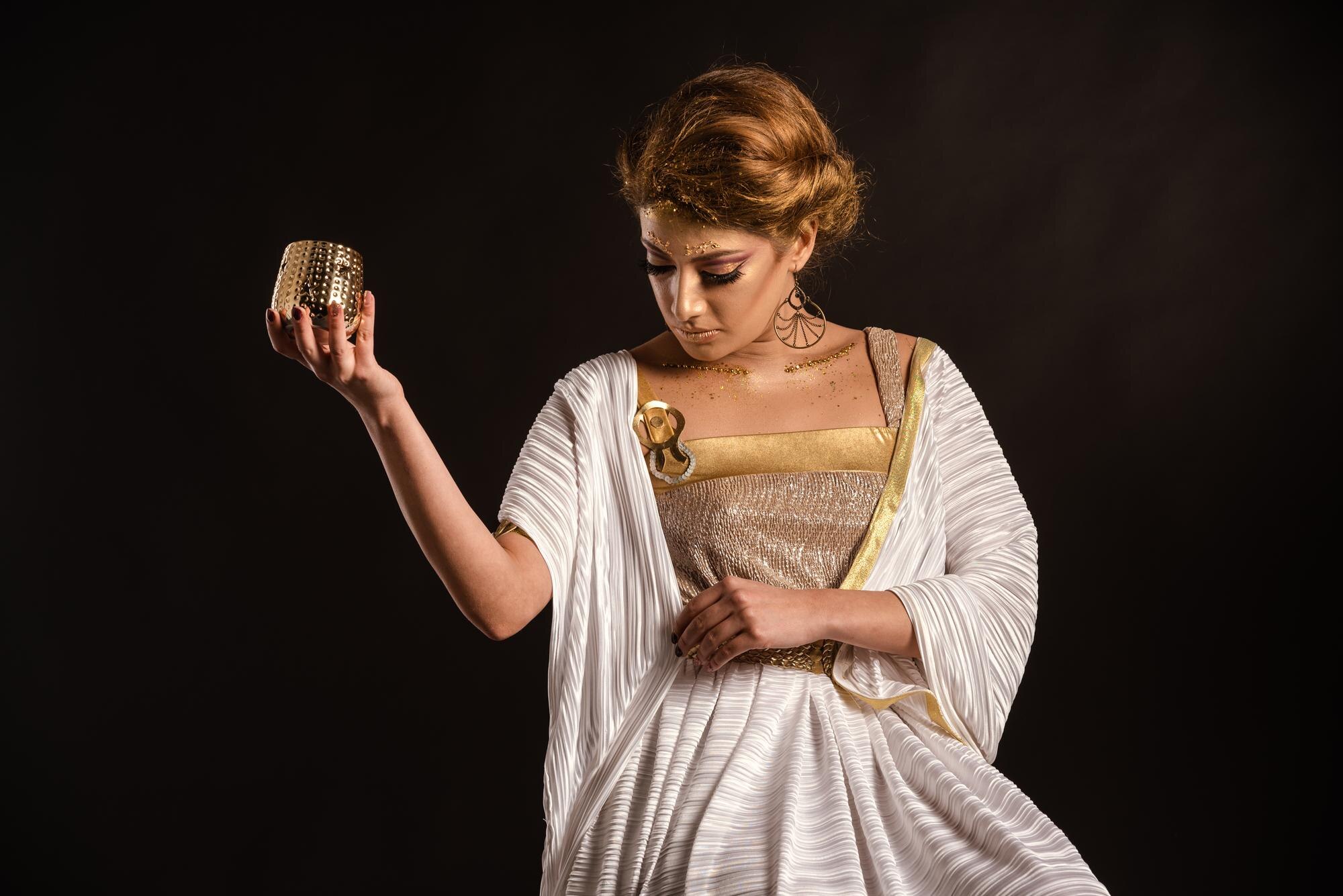
Pandora is the first woman in Hesiod’s account of human origins, fashioned by the gods as part of Zeus’s retaliation against Prometheus. Her story explains why suffering accompanies human life, but its earliest surviving form differs from the familiar tale of a curious woman opening a forbidden box.
Understanding Pandora means separating Hesiod’s account from the details added by later storytellers. The original vessel is a large jar, her motives receive little explanation, and the hope left inside creates a problem that the poem never fully resolves. This article follows the story from Zeus’s quarrel with Prometheus through Pandora’s creation and the jar’s opening, then considers its later retellings and her family. Throughout, the distinction is between what an ancient source says and what readers have made of it.
In This Article
- Why Zeus Sent Pandora
- How the Gods Made the First Woman
- What Hesiod Says About the Jar
- Why Hope Stays Inside
- How the Jar Became a Box
- Pandora’s Family and Her Place in Greek Religion
- Key Takeaways
- Frequently Asked Questions
- Reading Pandora Beyond the Box
Why Zeus Sent Pandora
Pandora’s story begins with a dispute over what humans may receive from the gods. Hesiod tells related versions in the Theogony and Works and Days, poems usually dated to around 700 BCE. They share a connection between the first woman and Zeus’s anger, but they do not present identical narratives. Reading them as separate treatments prevents details from one poem from being mistaken for statements made in the other.
In the Theogony, Prometheus first challenges Zeus through the division of a sacrificial ox at Mecone. He arranges the portions so that edible meat is concealed beneath an unappealing covering, while bones appear attractive under a layer of fat. Zeus takes the portion containing the bones. Hesiod also says that Zeus recognizes the deception, making this more complicated than a simple story about an unsuspecting god being fooled.
The dispute over sacrifice leads to a dispute over fire. Zeus withholds fire from humanity, and Prometheus steals it in a hollow fennel stalk. Fire gives humans a resource Zeus has denied them, so its theft challenges his authority. Zeus answers by arranging a punishment that looks desirable: the beautiful woman who stands at the beginning of the female human race in the poem.
That woman is not named Pandora in the Theogony. The name appears in Works and Days, where Zeus announces that humans will receive an evil in exchange for fire, something they will embrace with pleasure. This framing matters because the punishment works through attraction and acceptance. Pandora does not independently decide to begin a conflict with humanity; Zeus has already determined the purpose her arrival will serve.
Acceptance falls to Epimetheus, whose name suggests “afterthought,” in contrast to the foresight associated with his brother Prometheus. Prometheus warns him never to accept a gift from Zeus but to send it back. Epimetheus nevertheless receives Pandora and understands the harm only afterward. The warning concerns Zeus’s gift, not an instruction to Pandora about a container.
The contrast between the brothers gives the episode a recognizable human problem: understanding a danger after the decisive choice has already been made. Yet divine power governs the outcome. Zeus designs the response to Prometheus, and humans bear its consequences. Any interpretation centered entirely on Pandora’s curiosity leaves that larger conflict out of view.
How the Gods Made the First Woman
Zeus supplies the plan, but several gods contribute to Pandora’s making. In Works and Days, he orders Hephaestus to mix earth with water and give the resulting figure human speech and strength, with the appearance of a beautiful maiden. Pandora is therefore a fashioned human being, not a daughter born through an ordinary divine genealogy.
Her fashioned body receives abilities and qualities from other gods. Athena teaches her skilled work, especially weaving. Aphrodite contributes grace and painful desire, while Hermes supplies a shameless mind and a deceptive disposition. Hesiod’s account combines attractions with qualities his poem treats as dangerous. It does not describe a straightforward collection of blessings bestowed on a fortunate recipient.
Adornment makes those qualities visible. Athena dresses Pandora, while the Graces and Persuasion place gold necklaces around her. The Hours, also understood as the Seasons, crown her with spring flowers. These details make the gift outwardly appealing before Epimetheus accepts it. Clothing and jewelry have a narrative purpose: they help conceal the harm Zeus intends beneath a desirable appearance.
Hermes also gives her speech and names her Pandora. Hesiod explains the name through the gifts contributed by the Olympian gods, commonly rendered in English as “all-gifted.” That explanation belongs to this particular telling. The name has also invited discussion of “all-giving” meanings and possible connections with the earth, but those discussions should not replace what Works and Days explicitly says about her creation.
The divine contributions also explain why it is misleading to treat her as a solitary maker of disaster. Her appearance, capabilities, and disposition all belong to a design ordered by Zeus. Pandora acts within that design, but Hesiod gives readers very little access to her thoughts. He develops the gods’ intentions much more fully than hers.
That imbalance reflects the poem’s view of women. In the Theogony, the first woman introduces a discussion that presents women as a burden on men, while also acknowledging the difficulties of remaining unmarried. This is evidence for Hesiod’s gender ideology, not a neutral description of women or a statement that every Greek person held exactly the same beliefs.
Nor does divine manufacture automatically make Pandora a goddess. Making Pandora goddess of curiosity would assign her a divine office that Hesiod never gives her. In his narrative, she belongs to the explanation of mortal human life. Her creation involves gods, but she does not receive their sovereignty or become the ruler of an abstract quality.
What Hesiod Says About the Jar
The object Pandora opens in Works and Days is a pithos, a large storage jar. Ancient Greek households used such vessels for provisions including grain, wine, and oil. Some were large enough to stand on the floor or sit partly buried in the ground. This is a materially different object from the small, portable box familiar in illustrations.
The story of Pandora, Greek mythology’s first woman in Hesiod’s account, therefore involves an ordinary kind of storage vessel rather than a box. That domestic setting matters: an object associated with keeping household resources becomes the point through which affliction reaches the world. The poem does not need an elaborate magical chest to make the event consequential. Removing the lid is enough.
Before the opening, Hesiod says, humans lived apart from evils, exhausting toil, and painful diseases. Pandora lifts the jar’s lid and scatters its contents, bringing grievous troubles to humanity. Diseases subsequently move among people without speaking, because Zeus has deprived them of a voice. Their silent movement makes suffering unpredictable: people cannot rely on a warning before it arrives.
Hesiod does not supply a canonical inventory of seven evils. Modern lists sometimes name qualities such as greed or envy, but those lists should not be attributed to his poem. His account emphasizes the broad conditions of mortal suffering, including sickness and labor, without organizing everything released into a fixed numbered scheme. A neat list can make a retelling easier to remember while changing the evidence.
The evidence also does not support every familiar detail about the container. Hesiod does not explicitly narrate Zeus handing Pandora the jar as a wedding present, nor does he give her a direct command never to open it. He reports the opening without developing a psychological explanation for her action. Curiosity may make sense to a later storyteller, but it is not an expressly stated motive here.
That silence leaves an important limit on interpretation. We can say what Pandora does, and we can place the action within Zeus’s announced punishment. We cannot reconstruct a detailed scene of temptation or defiance and call it Hesiod’s account. Even the jar’s precise ownership and its route into the household remain unexplained.
One thing does remain inside: Elpis, generally translated as “Hope.” Pandora replaces the lid before Elpis can escape, and Hesiod connects the outcome with Zeus’s will. The contrast between the troubles outside and Elpis inside gives the jar episode its unresolved ending. What remains withheld may matter as much as what has been released.
Why Hope Stays Inside
The meaning of Elpis depends partly on the Greek word itself. Although “Hope” is the familiar English translation, elpis can refer more broadly to expectation, including an expectation about something unwelcome. That range does not make “Hope” wrong. It does mean that a modern reader should be cautious about assuming the word carries only a reassuring, positive meaning.
A positive reading treats the jar as a place of preservation. On this interpretation, hope remains available as a resource against the suffering that has entered human life. The contrast has emotional force: disease and hardship spread widely, yet something sustaining survives. Many later retellings make this the comforting lesson of the episode.
The difficulty is access. If confinement preserves hope, how do people benefit from something shut inside? Hesiod does not explicitly say that Pandora releases it later or distributes it among suffering humans. A reading that makes hope a readily available consolation must therefore explain a connection the narrative leaves unstated. Preservation is possible, but it is not a complete answer by itself.
A darker reading treats the jar as a prison. Hope stays confined while troubles circulate freely, leaving humans without a benefit they might otherwise possess. Under this interpretation, Zeus’s punishment includes deprivation as well as affliction. The same physical detail supports the opposite moral because containment can mean either safekeeping or exclusion.
The broader sense of expectation creates another possibility. Confinement might protect people from a damaging kind of anticipation, such as an oppressive foreknowledge of suffering. Alternatively, hope itself might prolong human effort under conditions that offer no guarantee of success. These interpretations ask whether expectation helps mortals endure their situation or keeps them bound to it.
Hesiod’s wider poem does not settle the issue neatly. Elsewhere in Works and Days, hope can accompany an idle person who lacks the means of life, so it is not automatically a dependable good. That passage complicates an exclusively cheerful reading without proving that Elpis in the jar must be harmful.
The safest conclusion is therefore limited but useful: the poem makes hope’s confinement significant without assigning it an unmistakable moral value. Readers can compare the competing interpretations and ask which details each explains best. They need not pretend that the ancient text supplies a single final answer.
How the Jar Became a Box
The move from jar to box belongs to the story’s later transmission, not to a second container described by Hesiod. A major point in that change is the Renaissance scholar Erasmus. In the 1508 edition of his Adages, his treatment of the story used the Latin word pyxis, meaning a small box or casket, in place of the large jar indicated by Greek pithos.
Erasmus’s wording helped establish the box in later European retellings. The change was small at the level of vocabulary but substantial at the level of the scene readers pictured. A storage vessel became something easy to hold, hide, or carry. Illustrators and storytellers could present the act of opening as a more intimate encounter with a mysterious possession.
The reasons for Erasmus’s substitution are less secure than its influence. It is sometimes connected with the story of Psyche, who opens a container she has been forbidden to open in Apuleius’s Metamorphoses, also known as The Golden Ass. That comparison is useful because it shows how distinct stories can share memorable features. It should not be presented as a proven account of what Erasmus was thinking.
The familiar prohibition against opening Pandora’s container also fits later moral storytelling especially well. Once the narrative supplies a clear command, the opening can become an act of disobedience, and curiosity can become its obvious motive. Those additions create a tidy lesson about personal conduct. Hesiod’s version is less tidy because Zeus’s intention, the gift’s deceptive appearance, and Epimetheus’s acceptance remain central.
Modern usage simplifies the story further. To “open Pandora’s box” means to begin something that releases serious, often unforeseen difficulties. That expression needs neither the whole divine conflict nor a settled interpretation of hope to work. It preserves the idea of consequences escaping control.
Understanding the expression does not require rejecting it as incorrect English. “Pandora’s box” has its own established history. The useful distinction is between explaining a modern idiom and describing an ancient source: the box belongs to the former’s development, while the jar belongs to Hesiod’s surviving text.
Pandora’s Family and Her Place in Greek Religion
Pandora’s story does not end with the jar in every ancient source. Later mythographic tradition identifies her as the mother of Pyrrha by Epimetheus. The Library attributed to Apollodorus gives this parentage, connecting Pandora with the family that survives a great flood. This material extends her place in human origins beyond the explanation of suffering found in Hesiod.
Pyrrha marries Deucalion, the son of Prometheus. Their marriage brings together the children of the two brothers whose contrasting judgment shapes the earlier story. In the flood tradition, Deucalion and Pyrrha survive the catastrophe and participate in restoring humankind. Pandora therefore becomes an ancestor within a larger account of human survival, although the later family narrative should not be read back into every detail of Works and Days.
The best-known restoration episode involves stones. In Ovid’s Metamorphoses, Deucalion and Pyrrha receive an obscure instruction to throw the bones of their great mother behind them. They understand the mother as Earth and the bones as stones; the stones they cast become human beings. This is a Roman poetic treatment of their story, distinct from Hesiod’s account of Pandora’s creation.
That Roman treatment raises a common question: does Pandora have a separate Roman name? No standard Roman counterpart replaces her in the way that Jupiter corresponds to Zeus or Minerva to Athena. Roman writers could retain Greek mythological names, and Pandora remains Pandora. Calling her a Greek figure does not prevent her family’s stories from appearing in Latin literature.
Her presence in art likewise needs to be distinguished from a divine office. Pausanias, in his Description of Greece, reports a representation of Pandora’s birth on the base of the Athena Parthenos statue in Athens. This shows her place in a major visual setting associated with the gods. It does not, by itself, establish that she was worshipped as the goddess of curiosity or of the jar.
Pandora mythology thus involves several kinds of evidence, each answering a different question. Hesiod supplies the central early literary accounts; later authors develop the genealogy; an ancient description records an artistic representation. Keeping those sources separate produces a fuller understanding without inventing one continuous, universally accepted biography.
Key Takeaways
- Zeus commissions Pandora as retaliation after Prometheus gives fire to humanity.
- Hephaestus shapes Pandora, while other gods contribute her attributes.
- Hesiod’s vessel is a jar, not the familiar modern box.
- The ancient account does not identify a canonical set of seven evils.
- Hope’s confinement allows competing interpretations, not one definitive moral.
Frequently Asked Questions
Who is Pandora?
In Works and Days, she opens a jar that releases troubles into human life while Elpis, usually translated as Hope, remains inside. Her role connects human suffering with Zeus’s response to Prometheus.
Is Pandora evil or good?
Hesiod presents Pandora as part of a harmful gift designed by Zeus, but he gives little account of her own intentions. Calling her simply evil ignores the gods’ control over her creation and purpose. Calling her wholly benevolent also goes beyond the poem, which emphasizes the suffering associated with her arrival.
Why was Pandora cursed?
Hesiod does not describe Pandora receiving a curse as punishment for an earlier wrongdoing of her own. Instead, Zeus has her created as part of his punishment of humanity after Prometheus’s theft of fire. The idea that she was personally cursed can obscure the difference between being punished and serving a divine plan.
Why did Zeus create Pandora?
Zeus orders Pandora’s creation in retaliation for Prometheus giving stolen fire to humans. He intends her as an attractive gift that will bring harm to those who accept it. The story concerns his authority over humanity as well as his conflict with Prometheus.
Who created Pandora?
Hephaestus fashions Pandora from earth and water on Zeus’s instructions in Works and Days. Other gods contribute to her abilities and appearance, with Athena teaching skilled work and Hermes supplying speech and a deceptive disposition. Her creation is a collective divine project directed by Zeus.
Did Pandora and Epimetheus have children?
Yes, later ancient tradition identifies Pyrrha as their daughter. Pyrrha marries Deucalion, Prometheus’s son, and the couple survives the great flood in their story. This genealogy appears in sources such as the Library attributed to Apollodorus, rather than being developed in Hesiod’s jar episode.
Reading Pandora Beyond the Box
Pandora’s story comes down to more than a warning against curiosity. In Hesiod, her creation belongs to Zeus’s conflict with Prometheus, and the jar’s opening explains why suffering accompanies human life. The poem leaves her motives largely unstated, making the gods’ intentions easier to identify than her own.
The clearest way to read the myth is to keep its layers separate. Begin with the pithos in Works and Days, then distinguish the later box and the added emphasis on a forbidden act. Treat hope’s confinement as a question the text leaves open. Those distinctions preserve what makes Pandora difficult: she is both an acting figure and a being fashioned to carry out a punishment she did not design.