
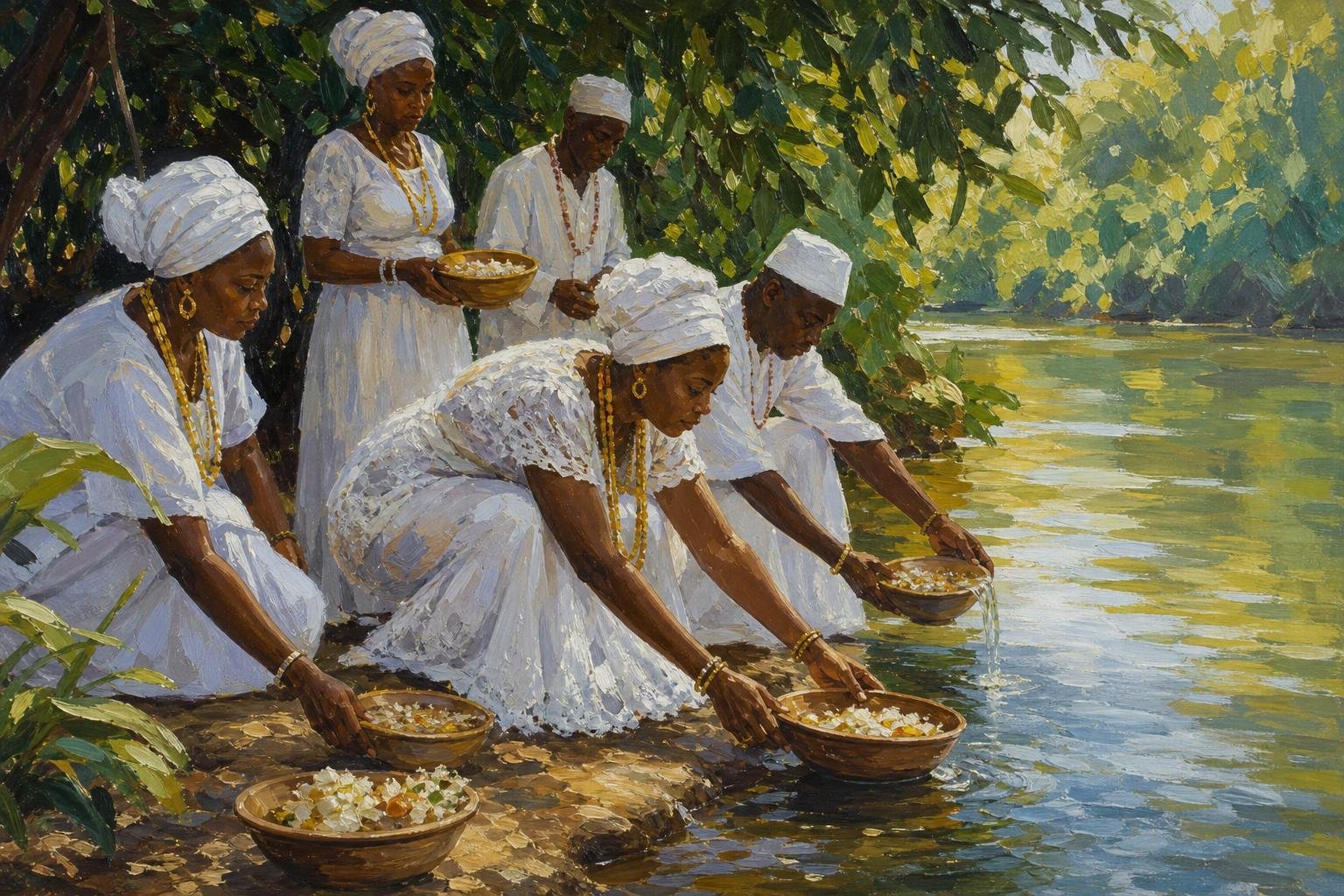
African gods are the deities of many separate religions, not one continental pantheon. The Yoruba of Nigeria worship orishas, the Fon of Benin serve vodun, and Idoma traditions venerate ancestral spirits known as Alekwu. This West African selection covers deities and ancestral powers, naming the communities that honor them, the stories that define them and living worship practices.
Eight of the ten come from the Yoruba world, and Olokun is shared with the Edo. The orishas serve Olodumare, the supreme deity and source of ashe, the power that makes things happen. Enslaved Yoruba people carried orisha worship across the Atlantic. It became part of Brazilian Candomblé and Cuban Lucumí, where several orishas are known by different names.
In This Article
- 1. Obatala, Shaper of Human Bodies
- 2. Ogun, Orisha of Iron
- 3. Shango, Thunder King of Oyo
- 4. Oya, Wind and the Niger
- 5. Oshun, River Goddess of Osogbo
- 6. Oba, Shango's First Wife
- 7. Eshu, Messenger at the Crossroads
- 8. Olokun, Owner of the Deep Sea
- 9. Mawu-Lisa, Fon Creator Pair
- 10. Alekwu, Idoma Ancestral Authority
- Key Takeaways
- Frequently Asked Questions
- Start With the Tradition Behind Each Name
1. Obatala, Shaper of Human Bodies
An Ile-Ife creation account splits the making of people between two figures. Obatala shaped human bodies from clay, and Olodumare breathed life into them. Then Obatala drank palm wine while he worked, and some of the bodies came out misshapen.
He took responsibility for that mistake. He became the protector of people born with disabilities, and his devotees traditionally refuse palm wine. White is his color, so his shrines and priests are dressed in white cloth. In Candomblé he is Oxalá.
2. Ogun, Orisha of Iron
When the orishas first came down to earth, the story goes, a forest too thick to cross stood in their way. None of their tools could cut it. Ogun could, because he held the secret of iron, and he hacked a road through with his blade while the others followed.
That same blade shows his temper. In the story of Ogun at Ire, he came back to the town he ruled and found nobody would greet him. He did not know they were keeping a festival of silence. He killed people before he learned the reason. Ashamed, he drove his sword into the ground and sank out of sight.
Blacksmiths and drivers count him as their patron. Oaths sworn on iron call on him, and Ile-Ife honors him every year at the Olojo festival.
3. Shango, Thunder King of Oyo
Shango began as a man. Yoruba tradition remembers him as an early Alaafin, or king, of Oyo who became the orisha of thunder. When stories spread that he had hanged himself, his followers answered with a phrase still used in his worship: "Oba ko so," "the king did not hang." His emblem is the double-headed axe. Brazil knows him as Xangô.
4. Oya, Wind and the Niger
Oya is Shango's wife and rules wind and storms. In Candomblé she is called Iansã, and she guards the gates of cemeteries. The Niger River's Yoruba name, Odo Oya, means Oya's river. Her shrines hold buffalo horns, a reminder of the stories in which she takes the form of a buffalo.
5. Oshun, River Goddess of Osogbo
Oshun governs sweet water and fertility. One story says the male orishas once left her out of their work, and the world dried up until they went back and asked her to return.
Her home is a real place. The Osun-Osogbo Sacred Grove became a UNESCO World Heritage Site in 2005, and its annual festival ends with a procession to the river. Abroad, she is Oxum in Candomblé and Ochún in Lucumí.
6. Oba, Shango's First Wife
In one version of the story, Oba wanted Shango's attention, and Oshun told her how to get it: put part of herself in his food. Oba cut off her ear and served it in his soup. Shango was disgusted and rejected her, and she became the Oba River. Where it meets the Osun, the water runs rough, as if the rivalry never ended. Lucumí devotees know her as Obba and link her to marriage and cemeteries.
In Brazilian Candomblé, offerings to Obá include acarajé, a ritual food documented by Brazil's heritage institute, IPHAN.
7. Eshu, Messenger at the Crossroads
Eshu carries offerings between people and the orishas, so he receives the first salute in any ritual. His best-known story is a trick. He walked between two friends wearing a hat that was one color on one side and another color on the other. Each friend saw only his own side, and they fought over what color it was.
Missionary translations identified Eshu with the Christian devil, an identification devotees reject. In Candomblé he is Exu.
8. Olokun, Owner of the Deep Sea
Among the Edo of the Benin Kingdom, Olokun is male and rules a palace under the sea that mirrors the Oba's palace on land. He grants wealth and children. Edo devotees keep his altars white with chalk and set out pots of water for him.
Yoruba stories make the deep more dangerous. In one of them, Olokun tried to flood the land, and Obatala chained the sea's owner to the ocean floor. These accounts often describe a female or fluid-gender figure living in the depths. Lucumí worship ties Olokun closely to Yemayá.
9. Mawu-Lisa, Fon Creator Pair
Mawu-Lisa belongs to Fon Vodun in Benin. Mawu is the moon and the night, and Lisa is the sun and the day. Some accounts describe twins, and others describe one being with two natures. Both were born of Nana Buluku.
Creation in this tradition is a journey. Mawu traveled over the world carried in the mouth of the great serpent Aido-Hwedo, and mountains rose wherever they stopped. The finished earth was heavy, so the serpent coiled beneath it to hold it up.
Vodu priest and anthropologist Basile Goudabla Kligueh describes priests invoking Mawu Ségbo Lisa during prayer, after the other deities and ancestors.
10. Alekwu, Idoma Ancestral Authority
At some traditional Idoma funeral and installation ceremonies for chiefs, ancestral masks represent the dead. Alekwu refers to ancestral spirits in these Nigerian communities, not a single god. It also acts as a judge. People settle disputes and accusations by swearing oaths at Alekwu shrines, and Idoma belief holds that anyone who swears falsely there will die.
Key Takeaways
- Three of the Yoruba figures are rivers you can stand beside: the Niger for Oya, the Osun for Oshun and the Oba for Oba.
- Several orishas started out as people, or behave like them, with Shango's kingship, Ogun's remorse and Obatala's drinking.
- Diaspora names mark the routes worship traveled: Oxalá, Xangô and Exu in Brazil, and Ochún and Obba in Cuba.
- Outside the orishas, power can belong to a pair, as with Mawu-Lisa, or to ancestors, as with Alekwu.
Frequently Asked Questions
Who is the strongest god in Africa?
There is no single most powerful god across African traditions. Some African cosmologies recognize a supreme being; others do not. Yoruba religion places Olodumare highest, and the Akan honor Nyame. Even Nyame's power has a well-known story attached. The spider Anansi bought the sky god's stories by capturing a python, a leopard, hornets and a fairy, and every story has belonged to Anansi since.
Who is the goddess of Africa?
No African goddess stands for the whole continent. Isis was worshiped well beyond ancient Egypt in the ancient world. Today Oshun is honored in living traditions that link Nigeria to Brazil and Cuba.
What is an orisha?
An orisha is a deity who carries out a particular role within Yoruba religion under Olodumare. Worship includes offerings, songs and spirit possession. Ifa divination guides religious practice. Many of the African deities best known outside Africa are orishas, because the diaspora carried them abroad.
Are Oba and Oshun the same figure?
No. They are distinct orishas and wives of Shango, associated with separate rivers and devotees. The ear-cutting story has several versions; it does not define their identities.
Why do some traditions describe Olokun differently?
Olokun's forms differ because Yoruba and Edo communities pass down oral traditions through towns, priests and lineages, with no central scripture. Each place kept its own version. Worship then crossed the Atlantic and changed again in Cuba.
Start With the Tradition Behind Each Name
Each of these names comes down to a place and the people who keep its rites. Oshun belongs to the Osogbo grove, Ogun to Ile-Ife's Olojo festival and Alekwu to Idoma oath shrines. "Thunder god" tells you what Shango controls. The Oyo kingship tells you why his followers still insist the king did not hang.