
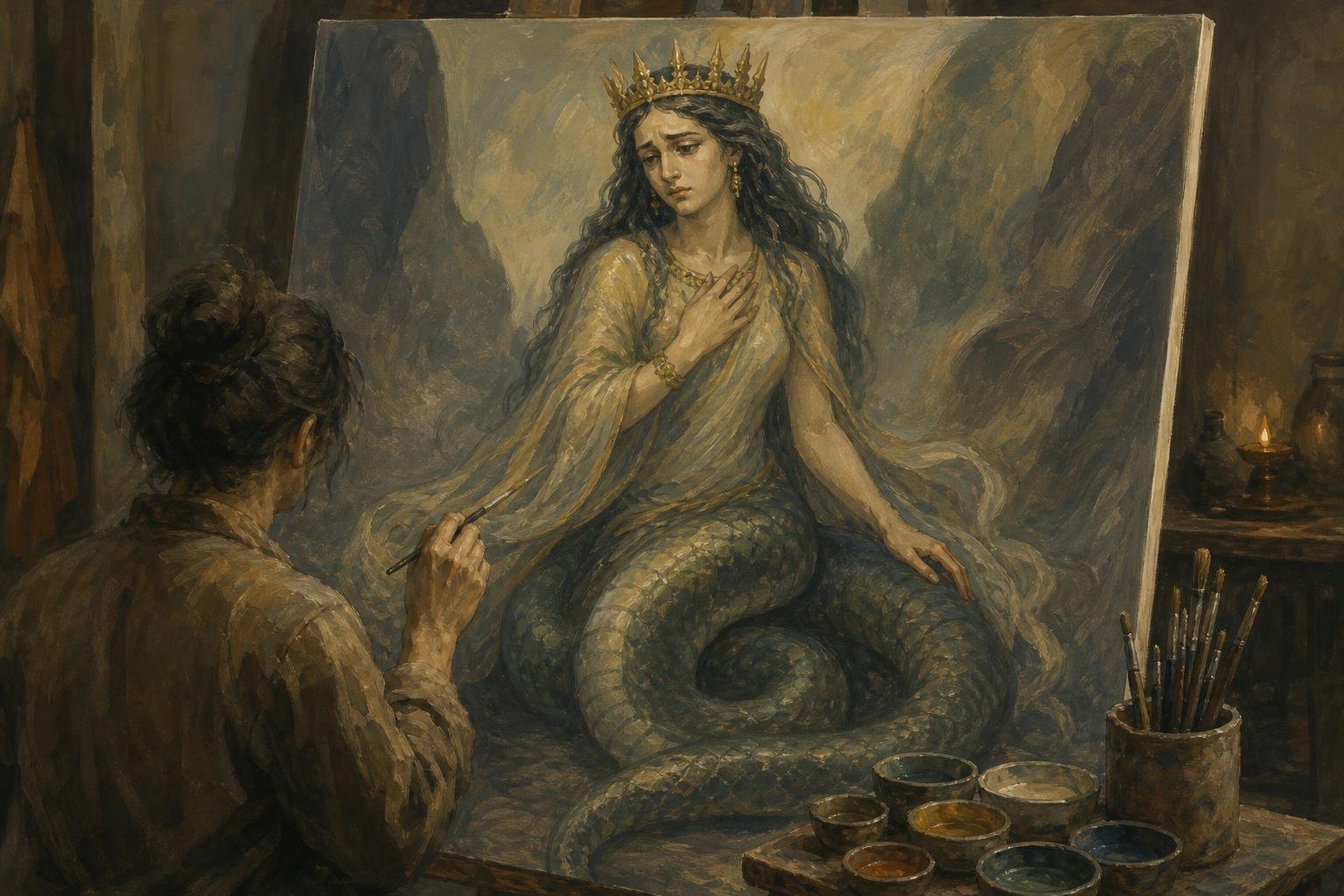
In Greek mythology, Lamia was a Libyan queen whom Zeus loved and Hera punished. Hera took her children, and Lamia's grief turned her into a monster who crept into other people's homes and devoured their babies. The name also refers to a whole class of female night-spirits who hunted the young, sometimes by stealing them and sometimes by seducing them.
Lamia is best known as a child-eater, but the stories do not share one origin or motive. The bereaved queen and the seductive creature at Corinth belong to different accounts.
In This Article
- A Libyan Queen With Disputed Parents
- Zeus, Hera, and the Lost Children
- Sleepless Nights and Removable Eyes
- A Name to Frighten Children
- The Supernatural Bride at Corinth
- Snakes, Seduction, and Keats
- Key Takeaways
- Frequently Asked Questions
- One Name, Several Ancient Traditions
A Libyan Queen With Disputed Parents
Before the monster there was a woman, and she was beautiful. Diodorus Siculus, writing in the first century BC, describes a cave in Libya where Lamia was said to have been born. In his Library of History 20.41, she is a beautiful queen whose face becomes bestial through her savagery. After all her children die, she envies other mothers and orders their newborn babies seized and killed. He does not say here that she eats them.
Diodorus also gives the removable eyes a rational explanation. When Lamia drank heavily, she stopped watching what others did. People described that drunken inattention as blindness, and the story became one in which she put her eyes into a flask. His account explains the monster through cruelty and drink, without bringing Zeus or Hera into the story.
Even her bloodline needs care. One tradition makes the queen a daughter of Belus, a king linked with Libya and Egypt. Pausanias, in Description of Greece 10.12.1, names a Lamia who is Poseidon's daughter and the mother, by Zeus, of the Libyan Sibyl. He does not tell the child-eating queen's story in that passage. The shared name should not be treated as proof that every genealogy describes the same figure.
Zeus, Hera, and the Lost Children
Zeus fell in love with Lamia, and Hera, jealous as in so many of her husband's affairs, struck at the one thing the queen could not survive losing. In the Suda On Line translation, Hera killed Lamia's children, and grief made Lamia monstrous.
The loss of her children explains her attacks on others. Her envy of living mothers hardened into appetite. She began stealing infants and eating them, repeating against every family the injury done to hers.
That is why Lamia frightens in a different way from a dragon or a Cyclops. She was a victim first. One stray tradition even names her as the mother of Scylla, the sea monster who snatched sailors from passing ships, as if monstrousness were something she could pass down.
Sleepless Nights and Removable Eyes
The removable eyes have more than one explanation. In Plutarch's On Curiosity 2, Lamia puts her eyes aside when she goes to bed and replaces them when she goes out. He uses the image to describe people who scrutinize everyone else's faults but remain blind to their own.
Another telling connects the eyes with Hera's punishment: deprived of sleep, Lamia receives from Zeus the ability to remove and replace them, allowing her to rest. That is a different explanation from Diodorus's account of drunken inattention, not another episode supplied by him.
Lamia can set aside a part of her own body and later restore it. Depending on the account, that image explains sleep, blindness to one's own faults, or the loss of watchfulness through drink.
A Name to Frighten Children
The child-eating queen came home in a simpler form. Greek parents and nurses used her name as a threat: behave, or Lamia will come for you.
In that use the lamia monster has almost no story at all.
Diodorus explicitly says that Lamia's name still terrified children in his own day. That gives the nursery threat an ancient witness, without telling us what every family knew of the queen's story. Her name could frighten a child without an explanation of her parentage or her lost children.
The Supernatural Bride at Corinth
The most famous seduction story comes from Philostratus, who wrote his Life of Apollonius of Tyana in the early third century AD. In Book 4 a young philosophy student named Menippus meets a beautiful, wealthy woman near Corinth. She invites him home. He falls for her, and agrees to marry her.
Apollonius comes to the wedding and sees what she is; Menippus is a pupil of the philosopher Demetrius. In Philostratus's Life of Apollonius of Tyana 4.25, Apollonius exposes her true nature. The gold goblets and silver vanish, along with the wine-bearers, cooks, and other servants, under Apollonius's rebukes. Cornered, she confesses. She had been fattening Menippus up to devour him, because she preferred young, beautiful bodies whose blood was pure.
Philostratus calls her an empusa, and adds that many people call such beings lamias. The name also covers a kind of creature, and this lamia demon does not creep into nurseries. She waits at the edge of town, rich and lovely, for a young man to say yes.
Snakes, Seduction, and Keats
Snake imagery appears in ancient accounts, but the connections need care. In his Fifth Discourse, Dio Chrysostom describes Libyan creatures with women's upper bodies and serpentine lower parts. He does not name them Lamias, so they are parallels rather than a documented stage in her transformation. Philostratus also has Apollonius warn Menippus that he is embracing a serpent, although the bride appears as a woman.
John Keats makes the serpent form explicit in a later literary adaptation. His poem Lamia, published in 1820, takes the Corinth story, which he found in Robert Burton's Anatomy of Melancholy, and turns it inside out. His Lamia begins as a dazzling serpent, banded and spotted with colour. She strikes a bargain with the god Hermes, who turns her into a woman. She finds the young Corinthian Lycius on the road and wins him, and they live hidden in her enchanted palace.
Lycius wants the world to see his bride, so he insists on a public wedding feast. Apollonius comes uninvited and fixes his eyes on her. Lycius begs him to stop staring, but the old philosopher keeps looking until he names her: "A Serpent!" With a frightful scream she vanishes, and Lycius dies at the table.
In Keats the monster is the one you pity.
Key Takeaways
- Lamia appears as a Libyan queen, a child-devouring monster, and a night-haunting spirit.
- Her transformation story connects Zeus's affection, Hera's jealousy, and the loss of children.
- Belus is named as the queen's father; Pausanias names Poseidon as father of the Lamia who bore the Libyan Sibyl.
- Snake imagery and seductive behavior belong to particular versions of her, not to every account.
Frequently Asked Questions
Are Lamia and Lilith the same?
No, Lamia and Lilith are separate figures. Lamia comes from Greek tradition and Lilith from Jewish tradition. They became linked because Jerome's Latin Bible translated the Hebrew word lilith in Isaiah 34:14 as lamia, and later readers sometimes merged the two night-haunting, child-threatening figures.
Are lamias only female?
Usually they are depicted as female, but ancient descriptions are not entirely consistent. Aristophanes' Peace 758 gives Lamia testicles in a comic image; the Suda discusses that description while explicitly calling the creature female. This is not evidence for a separate class of male lamias.
Why did Hera punish Lamia?
Hera punished Lamia because Zeus had fallen in love with her. Accounts differ on the form the punishment took. The Suda On Line translation says Hera killed Lamia's children; in one tradition she also took away Lamia's sleep.
What powers do lamias have?
Their powers depend on the version of the story. In Plutarch's On Curiosity, Lamia removes her eyes at home and replaces them when she goes out. The lamia of Philostratus creates illusions of wealth and seduces young men in order to eat them, while the nursery bogey simply steals and devours children.
What is a lamia?
A lamia is a female monster from Greek myth who preys on the young. The name refers both to a Libyan queen turned child-eater and to female spirits who seduce or hunt young people, especially at night. Which use came first is uncertain.
One Name, Several Ancient Traditions
Lamia names both an individual queen and a kind of predatory spirit, but those uses do not amount to one continuous biography. Diodorus's queen orders newborns killed after losing her own children. Philostratus's bride targets a young man for food, without a story of bereavement. Keats gives his serpent-woman a different fate again: exposure destroys her and the man who loves her. Grief explains the queen's violence in some accounts; it is not the motive of every creature called a lamia.