
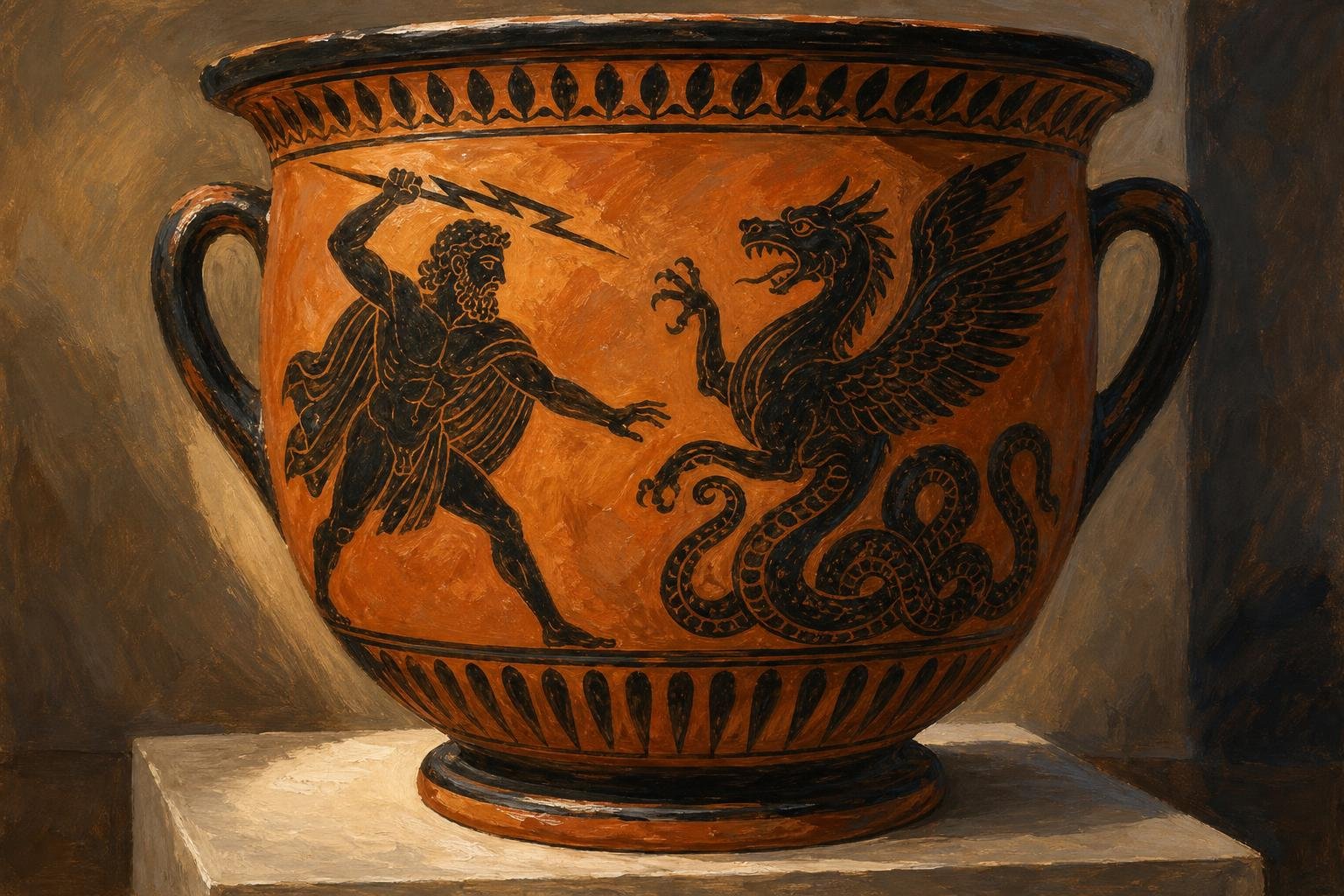
Typhon, also called Typhoeus, is the monster who challenges Zeus after the Titans’ defeat in Hesiod’s Theogony. In Hesiod's Theogony, the oldest full account, he has a hundred serpent heads and attacks the new king of heaven. The battle shakes earth and sea, and it ends with Typhon burned by thunderbolts and thrown into Tartarus. Hesiod and Apollodorus provide two detailed accounts of Typhon's challenge, sharing his parents and defeat but differing in his appearance and the battle's course. Other sources offer different births, settings and aftermaths. The sections below identify which writer supplies each version.
In This Article
- Typhon, Typhoeus, and the Other Names
- Who His Parents Were
- What Typhon Looks Like
- The Battle With Zeus
- Storm Winds, Tartarus, and Mount Etna
- Typhon and Echidna's Children
- Why Greeks Linked Typhon With Set
- Key Takeaways
- Frequently Asked Questions
- Typhon's Defeat and Zeus's Rule
Typhon, Typhoeus, and the Other Names
The spellings all mean the same figure. Hesiod, writing around 700 BCE, uses Typhaon for Echidna's mate and Typhoeus for Zeus's opponent. Homer's Iliad has Typhoeus, the Homeric Hymn to Apollo has Typhaon, and Pindar, Prometheus Bound (traditionally attributed to Aeschylus, though its authorship is disputed), and the mythographer Apollodorus use Typhon. Typhoeus appears in early epic, while Typhon appears in classical poetry.
The name itself was weather. The Greek noun typhon could mean a whirlwind, and the name probably connects with Greek words for smoke and whirling wind. Aristotle, in his Meteorology, uses typhon for a violent whirlwind that drops out of a cloud. That was a real thing a Greek sailor could see: a spinning column that came down from a dark sky, tore at the water and passed on before anyone could react.
Storm winds and volcanic fire are two recurring connections in Typhon's story, but they belong to different accounts. Hesiod makes him the source of destructive winds. Pindar, Prometheus Bound and Apollodorus place him beneath Etna; Apollodorus attributes the mountain's fiery blasts to Zeus's thunderbolts.
Who His Parents Were
Hesiod gives the parentage most retellings follow. Typhoeus is the youngest child of Gaia, the Earth, and Tartarus, the dark pit beneath the world. He is born after Zeus has driven the Titans out of heaven. Hesiod does not say she bears Typhoeus to overthrow Zeus.
Apollodorus, in the Bibliotheca (usually dated to the first or second century CE), keeps Gaia and Tartarus as his parents and places his birth in Cilicia, in southern Asia Minor. In Apollodorus's Bibliotheca 1.6.3, Gaia bears Typhon in anger after the gods defeat the Giants. Pindar, in Pythian 1.15–17, says a Cilician cave reared him, but does not explicitly name his birthplace.
The Homeric Hymn to Apollo starts with a wife's fury. Zeus has produced Athena from his own head, while Hera's son Hephaestus was born lame. Hera strikes the ground with her hand and prays to Earth, Heaven and the Titans for a son stronger than Zeus. For a year she stays away from Zeus's bed. Then she gives birth to Typhaon alone and hands the infant to the she-dragon at Delphi to raise, the same dragon Apollo later kills.
An ancient commentary on the Iliad tells a darker version. Gaia, angry over the Giants, turns Hera against Zeus. Hera goes to Cronus, the father Zeus overthrew. He gives her two eggs and tells her to bury them, because from them will rise a power that can drive Zeus from heaven. Hera buries them in Cilicia. By the time Typhon hatches, she has made peace with her husband, and she tells Zeus what is coming.
What Typhon Looks Like
What Typhon looks like depends on whom you read. Hesiod mentions his powerful hands and tireless feet, then concentrates on his heads. A hundred snake heads grow there, with dark flickering tongues, and fire blazes from the eyes under their brows. The heads make every kind of sound. Sometimes they speak in a way the gods understand. At other times they bellow like a bull, roar like a lion, yelp like puppies or hiss until the mountains echo.
Apollodorus builds a full body, and it is far larger. Typhon is human down to the thighs and taller than any mountain. His head brushes the stars. One hand reaches west and the other east, and a hundred dragon heads spring from them. Below the thighs he is huge coils of vipers. He has wings, matted hair streaming from his head and cheeks, and fire flashing from his eyes.
Ancient art offers another form to set beside these literary descriptions. A sixth-century BCE Chalcidian black-figure hydria, now in Munich, shows Zeus aiming a thunderbolt at a winged Typhon with a bearded human upper body and serpent coils for legs. This painter gives him a single human head rather than Hesiod's hundred serpent heads.
The Battle With Zeus
Hesiod's battle is short and cosmic. He says Typhoeus would have become king of gods and mortals if Zeus had not noticed him in time. Zeus thunders, and earth, sky, sea and the underworld shake. The ground boils under the fire of both fighters. Zeus leaps from Olympus and burns all hundred heads. Typhoeus collapses, and the earth beneath him melts like tin in a smith's crucible. Zeus throws him into Tartarus.
Apollodorus turns those few lines into a long campaign that Zeus nearly loses. When Typhon storms heaven, the other gods flee to Egypt. Zeus fights alone. He hurls thunderbolts from a distance, then closes in with an adamantine sickle. The fight reaches Mount Casius in Syria. There Typhon wraps Zeus in his coils, takes the sickle and cuts the sinews from Zeus's hands and feet.
The king of the gods is now a limp body. Typhon carries him to the Corycian cave in Cilicia, hides the sinews in a bearskin and sets the she-dragon Delphyne to guard them. Hermes and Aegipan steal the sinews back and refit them. Zeus returns in a chariot drawn by winged horses and chases Typhon to Mount Nysa. There the Fates trick the monster into eating fruits that weaken him.
The chase goes on into Thrace, where Typhon throws whole mountains. At Mount Haemus, Zeus's thunderbolt sends a stream of blood down the slopes, and Apollodorus says the mountain is named for it (haima is Greek for blood). Typhon flees across the sea to Sicily, and Zeus throws Mount Etna on top of him. Both accounts end with Zeus in charge. Hesiod makes his quick response decisive; Apollodorus makes his recovery depend on help from Hermes and Aegipan.
Storm Winds, Tartarus, and Mount Etna
Hesiod gives the beaten monster a lasting job. From Typhoeus come the winds that blow without warning. They fall on the misty sea, scatter ships and drown sailors, and on land they ruin the fields people have worked. Hesiod sets them apart from Notus, Boreas and Zephyrus, the south, north and west winds. Those have divine ancestry and help mortals. The killing gusts belong to Typhoeus.
This is the whirlwind from the first section, now given a cause. After his defeat, Typhon remains the source of destructive winds. The steady seasonal winds sailors relied on came from the gods. The squall that capsized them came from the monster under the earth.
His prison moves from source to source as much as his body changes. Hesiod puts him in Tartarus. The Iliad says his bed lies "among the Arimoi," and ancient readers already argued over where that was, with Cilicia among the candidates. Pindar's first Pythian ode, written around 470 BCE for Hieron of Syracuse, pins him beneath Etna and the land near Cumae. Prometheus Bound also places him under Etna.
For Greeks in Sicily, Etna was the obvious place. Thucydides records a lava flow in 425 BCE and says it was the third eruption since Greeks settled the island. A buried giant explained it. Pindar describes the mountain sending up pure fire from its depths, rivers of smoke by day and red flame by night that rolls rocks down into the sea. Prometheus Bound says the rivers of fire will one day devour the fields of Sicily. To the people farming its slopes, the volcano was Typhon still breathing.
Typhon and Echidna's Children
Hesiod calls Typhaon "terrible and lawless" and says he mated with Echidna, the half-woman, half-serpent monster. Their offspring include Orthus, the hound of Geryon, then Cerberus, the guard dog of Hades, and the Lernaean Hydra. For the fuller family account, see “Echidna Mythology: The Family Behind the Mother of Monsters.”
Why Greeks Linked Typhon With Set
Greek writers gave Typhon's name to the Egyptian god Set, and the habit is old. Herodotus, in the fifth century BCE, already calls Set "Typhon" when he tells Egyptian stories using Greek divine names. In Histories 2.156, Leto hides the young Apollo, identified as the Egyptian Horus, son of Isis and Osiris, from Typhon on Chemmis. The island was not floating before this episode; the Egyptians said it became a floating island because of it. Plutarch, writing around 100 CE in On Isis and Osiris, uses Typhon throughout for the god who murders his brother Osiris. Set killed a rightful king, fought Horus for the throne and belonged to the desert and its storms. To a Greek, that was Typhon.
Egypt also appears in the story of Typhon's attack on heaven. When Typhon storms heaven in Apollodorus, the Olympians run to Egypt and turn themselves into animals to hide. The rulers of the world, who had just beaten the Titans, are reduced to a frightened herd. The story also gave Greeks a reason why Egyptian gods had animal shapes: they were Greek gods still in disguise.
Ovid plays the panic for laughs in Book 5 of the Metamorphoses. He puts the story in the mouths of the Pierides, mortal sisters who challenge the Muses to a singing contest and choose a song that mocks the gods. Jupiter becomes the leader of a flock, a ram, which is why Libyan Ammon has curling horns. Apollo hides as a raven, Bacchus as a goat, Diana as a cat. Juno becomes a white cow, Venus a fish, Mercury an ibis. The Muses win the contest, and the sisters are turned into magpies.
Key Takeaways
- Typhon, also called Typhoeus, is the last great challenger to Zeus's rule, born after the Titans fell.
- Hesiod names Gaia and Tartarus as his parents. The Homeric Hymn makes him Hera's child alone, and an Iliad commentary hatches him from Cronus's eggs.
- Hesiod gives him a hundred serpent heads. Apollodorus makes him a winged giant whose head brushes the stars.
- In Apollodorus he cuts out Zeus's sinews before losing after Zeus receives help. In Hesiod, Zeus defeats him without that reversal.
- He lies in Tartarus or under Mount Etna, depending on the source, and the destructive winds come from him.
- He and Echidna fathered Cerberus, the Hydra and Orthus, and Greeks identified him with the Egyptian Set.
Frequently Asked Questions
What is Typhon the god of?
Typhon is best described as Zeus's monstrous opponent, not a god with an assigned domain. Hesiod makes him the source of destructive winds; other writers connect him with Etna's fire. Later Egyptian ritual complicates any claim that he received no worship: the Demotic Magical Papyrus of London and Leiden invokes Typhon-Set, combining his identity with the Egyptian god.
Who is stronger, Typhon or Kronos?
No ancient source has them fight, so there is no answer from the myths. In Hesiod, Typhon is born after Kronos has already fallen. In the Iliad commentary, Kronos supplies the eggs Typhon hatches from, which makes them allies against Zeus.
Is Typhon stronger than Zeus?
Typhon temporarily overpowers Zeus in Apollodorus's Bibliotheca, cutting the sinews from his hands and feet. Hermes and Aegipan restore them, and Zeus ultimately wins. That sequence makes Typhon a dangerous physical opponent, but victory with assistance does not settle which combatant is stronger in every sense.
Why did Zeus fear Typhon?
The accounts establish Typhon's threat more clearly than Zeus's fear. Hesiod says Typhon would have ruled gods and mortals if Zeus had not noticed him quickly. Apollodorus describes the other gods fleeing to Egypt, while Zeus confronts the monster. Neither passage explicitly says Zeus was afraid.
Who killed Typhon?
Zeus defeats Typhon, but the accounts summarized here describe imprisonment rather than a straightforward killing. Hesiod has Zeus throw him into Tartarus. Pindar, Prometheus Bound and Apollodorus place him beneath Mount Etna, where his defeat is connected with the volcano's fire.
Who is Typhon?
Typhon is Zeus's monstrous rival, not one of the Titans Zeus fought before him. In Hesiod's Theogony, his birth follows the Titans' defeat; in Apollodorus's Bibliotheca, it follows the defeat of the Giants.
Typhon's Defeat and Zeus's Rule
Read together, these accounts make Typhon a test of Zeus's rule, but they do not tell the same political story. Hesiod emphasizes Zeus's decisive response to a potential usurper without assigning Gaia a revenge motive. Apollodorus explicitly begins with Gaia's anger and allows Zeus to lose before recovering with help. The contrast matters: one account stresses the ruler's power, while the other also exposes his vulnerability and dependence on allies.